Steering without a map: What the Council conclusions on Global Gateway reveal
Authors


The Council of the EU adopted its conclusions on the Global Gateway. San Bilal and Karim Karaki went through it to identify what stands out.
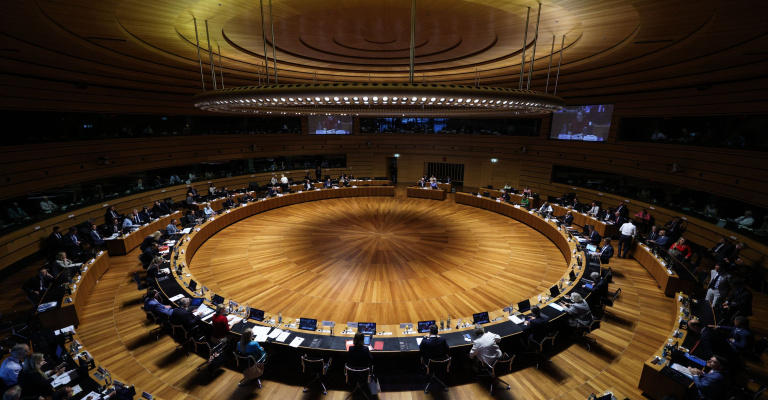
On 15 June 2026, the Council of the EU adopted its Conclusions on Global Gateway – the Union's flagship connectivity and investment strategy. Beyond the now-familiar language of ‘Team Europe’ and ‘360-degree’ partnerships, the text offers a useful window into what member states actually want from a strategy that has grown rapidly in scope, visibility and political weight since its launch in 2021. Three messages stand out: an endorsement of Global Gateway's geostrategic turn, a firm reminder that development remains its foundation and a clear push to recover political control over how the strategy is governed.
The geopolitical side of development principles
Member states strongly support the idea that Global Gateway has become a geopolitical instrument. The conclusions explicitly situate it within a ‘comprehensive offer’ combining development cooperation, foreign and economic policy, and trade, in service of EU strategic autonomy and economic security. This is a deliberate alignment with the wider external action architecture, including the Common Foreign and Security Policy – though it is worth noting that Global Gateway remains one component of that broader architecture, not a proxy for EU external action as a whole.
Yet the Council is careful to anchor this geostrategic ambition in established development cooperation principles. References to the 2030 Agenda, the Busan effectiveness principles, debt sustainability and the Seville Commitment on Financing for Development are not boilerplate; they are a signal that member states want the Global Gateway's growing strategic function to remain disciplined by partner-country ownership, mutual benefit and a tailored, differentiated, risk-informed approach in fragile contexts. The implicit worry is that an investment strategy increasingly justified by EU interests could drift from the partnership logic that gives it credibility and impact on the ground.
The repeated calls for the Commission to be more responsive, transparent and accountable suggest a degree of frustration with a process perceived as Commission-driven, with member states brought in too late to genuinely shape strategic and geographic priorities.
The strategy’s competitiveness angle
On the geoeconomic front, the emphasis on small and medium-sized enterprises (SMEs) is notable. The Council language calling for early, accessible information on pipeline projects, lighter administrative and financial barriers, and dedicated matchmaking and risk-mitigation tools reflects a concern that Global Gateway's economic dividends have so far flowed mainly to larger players. Member states are effectively asking that the strategy's competitiveness rationale translate into tangible opportunities for their own SME ecosystems, but that will require providing real financing and support, not just headline figures on mobilised investment. Yet this ambition runs up against a structural gap that is reflected in the MFF discussions: the Global Europe instrument is primarily designed for larger operators (not excluding nor supporting European SMEs), and the European Competitiveness Fund focuses in part on SMEs and their competitiveness within the EU Single Market rather than at the international level. Neither instrument is currently well-suited to supporting European SMEs' internationalisation in Global Gateway projects. At the operational level, the current approaches and trends (Global Gateway Investment Hub and the focus on large-scale infrastructure projects) seem too limited to respond to member states’ call to engage SMEs.
Governance: where the political substance is clearest
It is on governance, however, that the political substance is clearest. The conclusions read as a deliberate reassertion of the Council's ‘policy-setting role’. Member states want earlier and more systematic involvement in planning, selection and evaluation; more structured consultation; a Global Gateway board that meets at least annually and is properly prepared through Council bodies; and standardised, transparent reporting on funding and results. The repeated calls for the Commission to be more responsive, transparent and accountable suggest a degree of frustration with a process perceived as Commission-driven, with member states brought in too late to genuinely shape strategic and geographic priorities. Linking Board discussions to the Foreign Affairs Council is a way of ensuring ministers, not only technical coordinators, remain in the loop.
Member states ask for more control over direction, but stop short of defining the destination.
Questions remain unanswered
What the Conclusions do not resolve, though, is the harder question underneath all of this. On priorities and trade-offs, the text largely restates objectives rather than ranking them – it does not clarify what should take precedence when resources are constrained or when competing goals pull in different directions. This is precisely the kind of strategic definition the Council stopped short of providing, even as it sought to reclaim the steering wheel. More broadly, it did not address what, precisely, the EU's strategic interests are that this steering is meant to serve. The text treats development impact and EU strategic interest as mutually reinforcing almost by assumption, without acknowledging that trade-offs between the two can and do arise in practice. Member states ask for more control over direction, but stop short of defining the destination. Sharpening that definition – being explicit about priorities, sequencing and where development objectives and economic security imperatives might diverge – would be a natural and necessary next step if the Council is serious about exercising the strategic steering it has just claimed for itself.
The views are those of the authors and not necessarily those of ECDPM.