What is the EU's Global Gateway and how can it be improved?
Authors


The European Union is rethinking its role in a shifting global order, attempting to intertwine its security and economic interests through the Global Gateway strategy. But is this "connectivity" plan a coherent geopolitical tool or a fragmented patchwork of existing instruments?
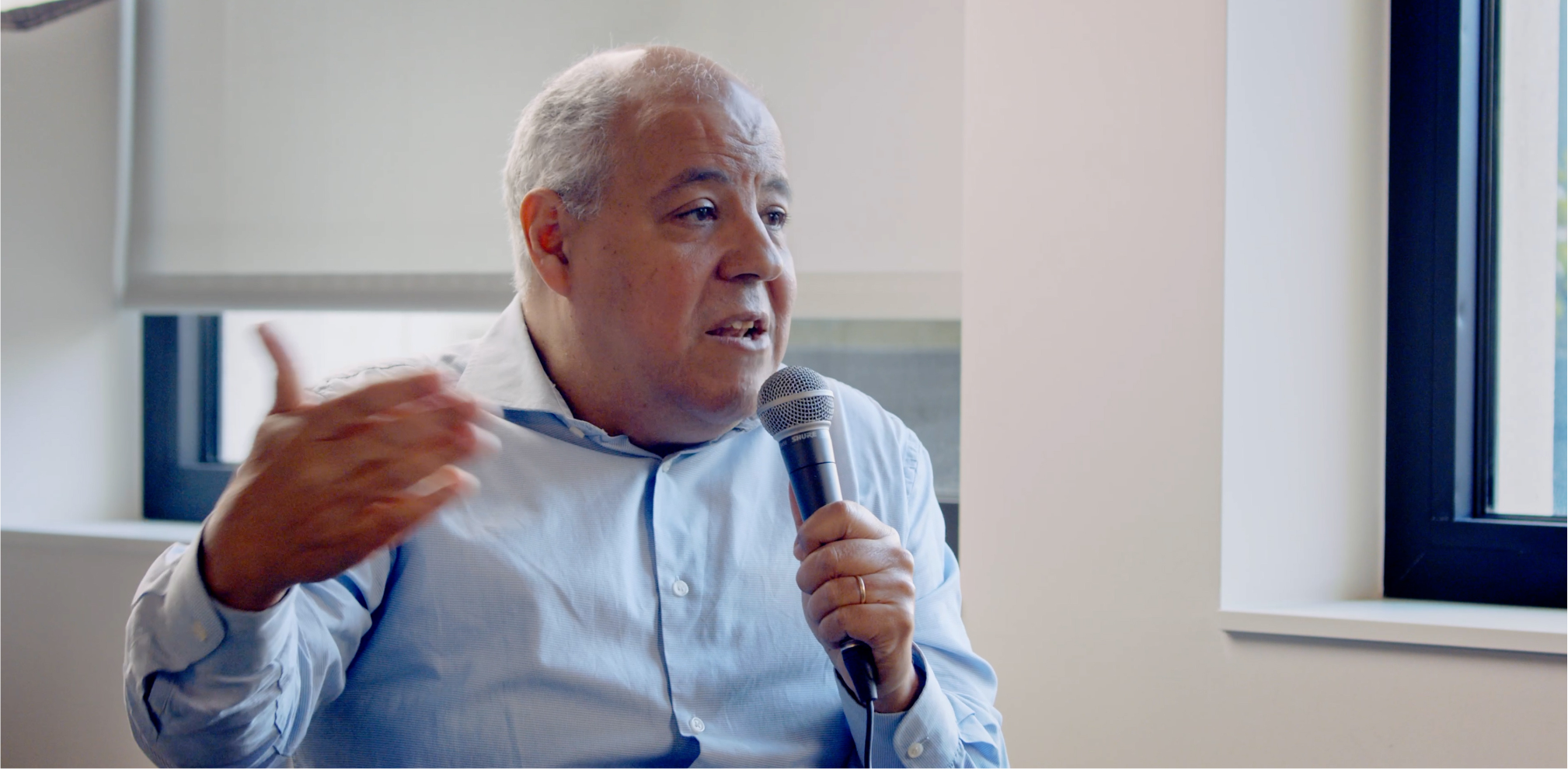
In this episode of Europolis, Chloe Teevan is joined by San Bilal, Director at ECDPM and leading expert on EU economic diplomacy. They discuss the evolution of the Global Gateway, the challenges of competing with China’s Belt and Road Initiative, and the necessity of forging "mutually beneficial" partnerships with emerging powers like India and Brazil.
Launched in 2021, the Global Gateway was initially seen as Europe’s answer to the geopolitical dominance of China. While the EU has long been a major development actor, San Bilal notes there was a growing frustration that Europe was not being recognized for its investments while China’s infrastructure projects gained global attention.
Initially anchored in development concepts, the strategy has evolved into a more "powerful geostrategic" approach. It now seeks to explicitly link EU investments in transport, energy, digital, and health with Europe’s own economic security and competitiveness. As Bilal explains, the goal is to move toward "mutually beneficial partnerships" where the EU’s private sector and strategic interests are central to the engagement.
"What is missing probably at the European level is a clear sense of direction of what do we really want to achieve, where and how... Global Gateway doesn't do that. Global Gateway is just for the time being an investment strategy." — San Bilal
A "patchwork" approach
Despite the high-level ambitions, the implementation of the Global Gateway remains a work in progress. Bilal describes the current state of EU global action as a "patchwork," where security, competitiveness, and development policies are still addressed in different silos by different actors across the Commission and member states.
While digital policy is emerging as a more integrated area, with the EU publishing an international digital strategy and forging partnerships with India and Brazil, Bilal argues that a truly holistic model is still lacking. Case studies like submarine cables highlight the need for the EU to bring together security dimensions with a robust economic model to guarantee sovereignty and competitiveness.
Strategic diversification over autonomy
A central theme of the discussion is how the EU should navigate its relationships with "middle powers". Partners like India and Brazil reject the binary "with us or against us" framing often found in the West-China rivalry. Instead, they prioritize their own development models and seek to avoid over-dependence on any single partner.
For the EU to be successful, Bilal suggests it must focus on "strategic diversification" rather than just autonomy. This means forging smart coalitions and alliances that respect the agency of partner countries while articulating clear EU objectives.
Key takeaways from the conversation:
-
The Global Gateway marks a shift from benevolent development aid to a strategy that supports EU economic security and private sector interests.
-
The EU’s current approach is fragmented, with limited instruments to support the private sector in strategic, large-scale industrial projects.
-
Emerging powers like India will continue to partner with both the EU and China; Europe must learn to manage these interdependencies through a "whole-of-EU" approach.
-
The move from an instrument-based budget to a policy-based one will be critical for the next Multiannual Financial Framework (MFF) to ensure the Global Gateway can meet its strategic goals.
About the podcast series
Faced with geopolitical and economic turbulence, Europe needs new and better partners to secure its prosperity. Europolis: the global Europe podcast looks at how new dynamics are reshaping relations between the EU and the wider world and how Europe might navigate this new terrain.
Join us as we break down EU policy through insightful conversations with leading policymakers, industry leaders and experts. Discover how the EU could drive innovation, competitiveness, and progress in the global arena, and understand how policymakers are thinking about shaping our sovereign future.