Inside the Global Gateway Forum: Beyond investments and rhetoric
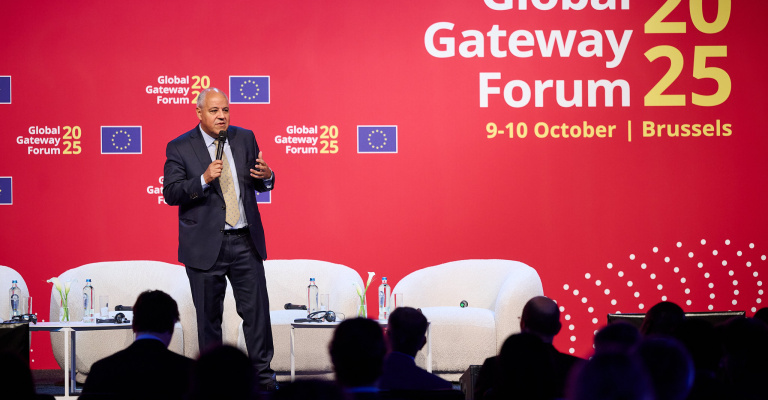

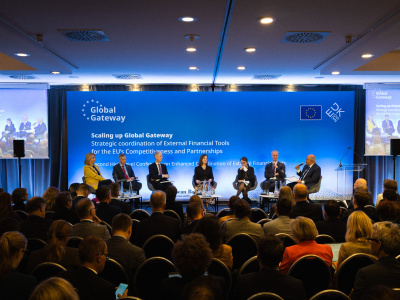
The second Global Gateway Forum, held on 9-10 October in Brussels, was a success. It was well attended, buzzing with side meetings and discussions alongside the official agenda. If the forum confirmed one thing, it’s that Global Gateway is evolving – a necessity in today’s increasingly interconnected world.
There were some key announcements, which include:
-
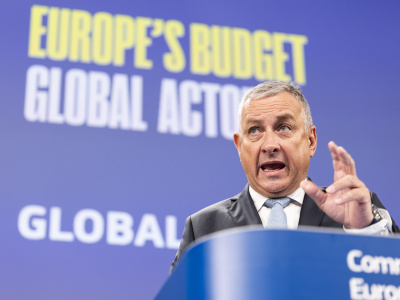
The European Commission’s president, Ursula von der Leyen, announced that the Global Gateway target of mobilising €300 billion by 2027 was already surpassed, at €306 billion today, and expected to reach €400 billion by 2027 (reflecting an untransparent accounting exercise by the Commission, which, as recently as May, claimed to have reached the €200 billion mark);
-
The launch of the Global Gateway Investment Hub, a single-entry platform for European companies, via their Team Nationals, to propose investments. This is an initiative still in the making by the Commission to enhance coordination of development and financial actors in a Team Europe effort, including export credit agencies – something that ECDPM called for (see here and here), but which leaves unclear the place of the EU’s partner countries in this hub; and
-
The announcement of several agreements, including on clean energy transition in Africa.
The conversations in Brussels reflected both the promise and the complexity of building equitable international relations.
However, the broader Global Gateway strategy remains very much a work in progress, given the scale of ambition behind this evolving European Union initiative and the challenge to combine geostrategic engagement and development aspirations. The conversations in Brussels reflected both the promise and the complexity of building equitable international relations and mutually beneficial partnerships that go beyond infrastructure investment and positive rhetoric.
How to get invited to the forum remained somewhat of a mystery, and not everyone who wanted to attend could do so. The absence of civil society was glaring. Yet, for those of us who did make it inside, it was worth it. The smaller, more focused setting created a unique atmosphere – one that fostered easy connections and straightforward dialogue rather than the endless circulation of larger conferences.
|
How was ECDPM represented? |
Global Gateway: (Geo)politics beyond investments
One of the most striking aspects of the forum was how the opening discussions stretched far beyond the investment agenda typically associated with Global Gateway. While some heads of state emphasised the financial and infrastructural dimensions of the initiative, many took a step further – situating Global Gateway within the broader political and developmental context of today’s global order and their relations with Europe.
All public recordings are available here.South Africa’s president Cyril Ramaphosa was among those who reminded the audience that partnership is not just about projects or funding. His speech underscored the persistent inequalities in global wealth distribution and called for a more balanced, respectful world order. In this light, the EU’s Global Gateway should be understood as part of a larger effort to recalibrate international relations – not merely as a vehicle for investment, but as a bridge toward shared prosperity and mutual respect.
An equally memorable moment came from president Félix Tshisekedi of the Democratic Republic of Congo, who used the platform to urge reconciliation in Eastern Congo. Turning to Rwanda’s president Paul Kagame, he called for peace – faire la paix des braves – a poignant reminder that development and stability go hand in hand.
These interventions highlighted that Global Gateway must evolve as a truly geostrategic and developmental initiative, one that acknowledges the political, social and environmental realities shaping its partner countries. Investments remain one of the foundations for shared prosperity, but they must be complemented by broader considerations – including peacebuilding, fragility, human development, governance and regional cooperation.
This broader framing should be stressed to strengthen the Global Gateway approach in the years ahead. Yet, to be taken seriously, the EU should be present at high-level by more than the European Commission, which came in its full force. With twelve heads of states and governments travelling from around the world to Brussels, the prime minister of Luxembourg appeared rather lonely: where were the other European leaders?
Networking and atmosphere: Small is beautiful
One of the forum’s greatest assets was its relatively intimate format. Unlike previous larger gatherings such as the European Development Days (EDD), the Global Gateway Forum’s smaller scale made interactions easier, more spontaneous and meaningful. I found it remarkably productive to meet both familiar and new faces, engage in informal bilateral exchanges, and build momentum around shared ideas.
The high-level dinner offered a welcome space for informal dialogue in an impressive and convivial atmosphere at the Beaux Arts Museum. Many participants I spoke with shared similar feedback: the forum struck a rare balance between high-level engagement and approachability.
Scale-up roundtables: A valuable concept with room to grow
Among the new features of the 2025 edition were the ‘Scale-Up’ roundtables, designed to encourage more targeted discussions among practitioners, policymakers and private-sector leaders. I joined the MAV+ session on Africa’s health sovereignty, which provided concrete sharing of insights among ministers, health entrepreneurs and financiers. Echoes from other roundtables (including on the Lobito corridor in which ECDPM is actively involved) were similarly positive.
The format worked well – dynamic exchanges, concise inputs, and a sense of shared ownership over the themes discussed. That said, it left many of us wishing for more time. The level of engagement was so high that additional interaction would have deepened the value. These sessions are promising, and with slightly longer formats, they could become the real engine of practical collaboration within future forums.
Panels: Quality, diversity and dialogue
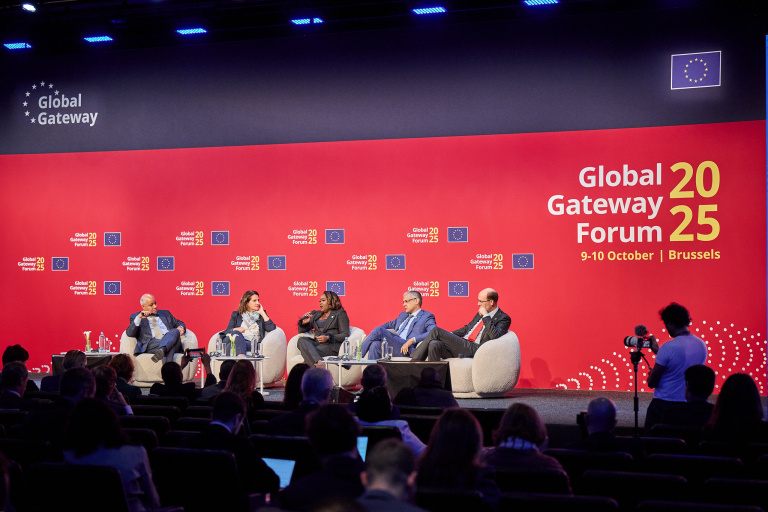
I had the pleasure of moderating the panel on energy security and competitiveness, where we discussed the challenges of the clean energy transition, both within the EU and across its partner countries. The exchange of perspectives from Europe, Africa and the Caribbean highlighted the interconnected nature of energy policy today: access, sustainability and competitiveness are global issues that affect all countries, each in its own specific ways.
A highlight for me was the contribution from Mauritania’s energy minister Mohamed Ould Khaled, who spoke about how energy investments can serve as both a catalyst for development and a test of strategic cooperation. My long acquaintance with Teresa Ribera, from her previous roles, now the European Commission’s Executive Vice-President for Clean, Just and Competitive Transition, made the discussion even more fluid and enjoyable. Her perspective on matching decarbonisation with industrial competitiveness within the EU added a valuable dimension to the conversation and echoed the transformative ambitions and challenges faced by minister Khaled and Granada’s minister Kerryne James. FMO’s CEO, Michael Jongeneel, brought the technical and practical financial insights of the Dutch entrepreneurial development bank, including his telling analogy between blended finance and a bike.
Economic, environmental and security dimensions are increasingly intertwined, and the Global Gateway has the potential to offer an integrated approach that reflects this reality.
Looking ahead: Refining the Global Gateway vision
If the forum confirmed one thing, it’s that Global Gateway is evolving. The strategy has come a long way since its launch, yet it is still defining its identity and scope. Is it primarily an investment platform? A geopolitical instrument? Or a new form of global partnership that integrates values, strategy, and mutual accountability?
In reality, it must be all of these things. The world no longer operates on single-issue agendas. Economic, environmental and security dimensions are increasingly intertwined, and the Global Gateway has the potential to offer an integrated approach that reflects this reality. The key will be for the EU to articulate and implement this vision consistently, recognise and address trade-offs and inherent tensions in this multiple agenda, ensuring that its partnerships are not perceived as one-way streets but as shared ventures built on trust and respect, which not only reflect the EU’s own interests but truly contribute to the transformational and developmental ambitions of the EU’s partners.
The views are those of the authors and not necessarily those of ECDPM.