The EU’s 2025 DAC peer review: From diagnosis to action


Looking at the 2025 OECD-DAC peer review of the EU’s development cooperation, Philippe van Damme highlights the report’s call for the Union to sustain its poverty reduction focus amid the Global Gateway strategy’s more interest-driven turn.
Summary
Last week, the OECD launched the 2025 Development Assistance Committee (DAC) peer review of the European Union’s development cooperation. The review assesses the impact of “the Union’s evolving development paradigm”, and notably of the Global Gateway (GG) strategy, on its capacity to deliver on its primary development objective to reduce poverty. The review highlights the concern that a more (commercially) interest-driven approach could divert the development agenda.
The peer reviewers urge the Union to preserve its strong track record of untied aid and to safeguard access to concessional finance for least developed countries (LDCs) and other countries most exposed to fragility. They also make a plea to continue predictable support to basic human development, institutional strengthening, crisis prevention and resilience building, and to other actions around the humanitarian-development-peace nexus, beyond GG. To scale up the Global Gateway strategy, the EU needs to simplify its working methods and make them more transparent; it also needs to clarify the newly stated 360-degree approach to ensure inclusivity and sustainability of the envisaged investments.
The peer review arrives at a timely moment because some of its recommendations can be integrated in the preparation of the EU’s 2028-2034 multiannual financial framework and, in particular, of its Global Europe instrument for external action.
Introduction
Every 5-6 years, the Development Assistance Committee (DAC) of the OECD, the club of Western high-income industrialised countries, organises a peer review of the development cooperation programmes of each of its members, conducted by two other members, assisted by the DAC secretariat. The objective is to improve the quality and effectiveness of that member state’s development cooperation policies, highlighting good practices and recommending improvements for greater impact on poverty reduction and sustainable development. As the peer review can cover a broad range of actions, the reviewers and the reviewed agree jointly on the areas on which the review will focus.
The 2025 peer review of the European Union’s development cooperation (p. 110) was conducted by Norway and Switzerland, and it was agreed to focus on how the EU’s evolving development paradigm - centred on mutual benefits and quality infrastructure - can reduce poverty and inequality.
In an increasingly polarised and competitive world and the emergence of new actors (including philanthropists like Bill Gates, BRICS or other members of the Global South, notably also in the Middle East) who are not members of the OECD, the DAC has lost a lot of its influence since the heydays of aid effectiveness some 20 years ago. However, with the USA and other bilateral donors cutting back on official development assistance, the weight of the EU as a hybrid donor (somewhere halfway between multilateral and bilateral agencies) increases, turning the peer review of the EU’s development cooperation into an important, possibly trend-setting exercise.
Being a peer review, the language used is usually soft-spoken and diplomatic. But, translated’ in plain language, the recommendations formulated are surprisingly strong, reflecting real concerns regarding the impact of the self-proclaimed ‘paradigmatic shift’ in the EU’s development cooperation and the EU’s capacity to deliver on the acknowledged ‘potential’ of the Global Gateway (GG).
The EU's paradigm shift
The EU’s so-called ‘paradigm shift’ is embedded in a broader international review of development cooperation, based on two major trends. One is to try to use official development assistance (ODA) as a catalyst for other sources of funding, and in particular private sector investments, thereby acknowledging that investment is the engine for growth, job creation and sustainable development, while ODA can at most be the oil in the engine. This trend dates back at least to the first Financing for Development summit in Monterrey in 2002. The recent Sevilla summit on financing for development only repeated the obvious.
The second trend is the recognition that ODA is not a unilateral gesture of solidarity but should be based on shared interests, moving from a paternalistic donor-recipient relation to a more balanced, ‘mutually beneficial partnership’. But this trend is not new either. The EU’s development cooperation has always had a geopolitical flavour. The decades-old 1975 Lomé Convention and 2000 Cotonou Agreement were negotiated and designed as partnerships, with shared responsibilities. The consecutive revisions of the Cotonou agreement, including the recent 2023 Samoa Agreement, reflect shifting EU interests, including on trade, migration, climate change and security, and an increasing sensitivity to economic and political governance issues, including democracy, rule of law and human rights.
However, when combining both trends, it should be noted that increased private sector investment may be a necessary but not a sufficient condition for sustainable development. Not all investments automatically sustain mutual interests and not all investments required for sustainable development can attract private investors. It then becomes important for ODA to complement and help steer those investments towards jointly defined shared goals and for the development partners to find a joint methodology to define these shared interests.
But as the review points out, there is a risk that the flexible ‘Team Europe’ cooperation mechanisms and the replacement by Global Gateway initiatives of traditional indicative programmes negotiated with the partner country will lead, if not well designed, to less stakeholder involvement, weakening alignment, ownership and shared priority setting with partners. This feeds the concern that the real paradigm shift may rather be a shift from a mutually beneficial to a more transactional approach driven by unilateral short-term commercial interests.
Yet the EU NDICI-Global Europe, the EU’s current major external financial instrument (2021-2027), refers to its Treaty obligations and commitments made at the 2015 world summits on financing for development (Addis Ababa), climate change (Paris) and the sustainable development goals (New York). The EU also continues paying lip service to the European Consensus on Development, even though the Commission’s draft proposal for the Global Europe instrument under the next multiannual financial framework (2028-2034) does not refer to it. During a panel discussion at the launching event in Brussels last week, Tanya Cox, director of NGO network CONCORD, suggested that perhaps the confusion about the EU’s evolving development policy framework may stem from a lack of clear vision about the EU’s long-term interests and the place of development cooperation in the EU’s external actions toolbox. Anyway, the DAC peer reviewers conclude that evolving strategic priorities have outpaced the foundational policy framework of NDICI-Global Europe.
Global Gateway’s governance challenges
The peer review defines the Global Gateway (GG) strategy as support to smart financial investment in quality infrastructure to build connectivity partnerships (p. 25), in a long-term perspective and a focus on investments respecting and upholding EU values. This should be achieved through a mutually reinforcing combination of investments in physical and human capital, assuming that investment in human capital enhances the economic and social return on investment. That’s what has been done in the past, too, as illustrated by the fact that many of the projects now relabelled as GG initiatives were initiated long before the new strategy was adopted, but probably in a less articulated way.
Carsten Staur, chair of the OECD-DAC, therefore proposed at the launching event to reformulate the ‘evolving paradigm shift’ as a permanent search for a new balance between solidarity and interests, rather than as a radical change of paradigm. The GG strategy attempts to translate this ‘rebalancing act’ in operational terms, being presented by the EU not as a new ‘vision’ on development but as a new implementation strategy, a new approach to leverage more efficiently and effectively the mobilisation of private investment within an unchanged policy framework. Yet it is precisely the efficiency and effectiveness of GG that are questioned by many observers, including the European Court of Auditors.
The DAC review confirms these complaints about the lack of transparency around the volume and sources of funding announced so far, the partners involved, the expected results and the stage of implementation. But criticism goes beyond an information gap, and also questions the lack of clarity around the selection criteria for projects and implementing partners, and the additionality of the EU’s concessional funding, which sometimes resembles more of a windfall subsidy for EU enterprises investing in projects that would have been realised anyway.
The continuous refinements and clarifications of the Global Gateway strategy since its launch in late 2021 and the information gap illustrate the lack of common understanding of the strategy and explain the persistent scepticism if not distrust, among various stakeholders.
But beyond information and methodological insufficiencies, the review also highlights operational challenges. The main implementation instrument of the Global Gateway strategy is the European Facility for Sustainable Development (EFSD+). The peer review notes that roughly three years passed between the announcement of the strategy and its translation into effective guarantee agreements. Project prioritisation, partner selection and choice of implementation modalities remain top-heavy, while the administrative decision-making process remains slow and complex. The resulting lack of predictability and high transaction costs (both in time and resources) significantly reduce the attractiveness of the EFSD+ instrument for private investors.
The conclusion is a huge mismatch between communication and actual EU support (p. 49).
A 360-degree approach
The selection of Global Gateway investment projects relies on a ‘360 degree approach’. However, this approach remains open to widely divergent interpretations. In the most restrictive reading, it implies that Global Gateway projects should respect minimal environmental, social and governance (ESG) standards and ensure that a minimal sector-specific regulatory framework is in place. These criteria must guarantee a more level playing field when tendering for work programmes, but also the financial and economic viability of the investments in a stable and conducive regulatory environment.
But this approach seems too narrow, and the DAC review recommends going beyond minimal institutional strengthening to create an enabling environment connected [only] to Global Gateway projects, and to also cover broader issues to support sustainable development solutions and address inequalities (p. 34). The approach adopted so far is often not entirely 360 degrees, but has many blind spots. An effective rights-driven, pro-poor 360 degree approach to investments is expected to address transversal challenges such as the rule of law (legal predictability), fight against corruption (and discretionary decisions that may impact the investment), improved public finance management (transparent fiscal policy and reliable public service provisioning) and democratic accountability. Whether this is only a perception or not, it illustrates the lack of communication around the GG strategy, the urgent need to clarify the 360-degree concept and to identify and try to understand possible blind spots for corrective measures.
Facing what is perceived as unfair competition, notably from China (although never explicitly mentioned), some EU member states and EU private sector representatives ask for protectionist measures to defend their interests in ODA-funded international tenders. But the updated DAC recommendations on untying ODA estimate that tied aid reduces value for money by 15 to 30% as well as the opportunities for local suppliers to participate in works and service contracts. The promotion of EU commercial interests therefore risks undermining the EU’s aid effectiveness and track record in untied aid. Rather than introducing market-distorting EU preferences in procurement to compensate for unfair practices elsewhere, it is therefore preferable to integrate more explicitly sustainable development goals in tender documents (Chapter V). These can include international standards of responsible business conduct and explicit ESG criteria, local skills development targets, and requirements regarding technology transfer and innovation or the crowding-in of local private sector partners. The tenders can also go beyond the hard infrastructure building phase and include the need to enter into a long-term relationship in order to develop local demand and ensure optimal maintenance and use of the infrastructure or services provided.
Global Gateway’s distributional impact
A trade and investment-driven approach to the EU’s partnerships inevitably drains funding to countries with a more diversified economy and larger consumer base, a more reliable public service and infrastructure network and a more conducive business environment. This has a triple distributional impact of reorienting funding geographically to middle-income countries with low or moderate levels of fragility, economic sectors with a high immediate financial return on investment (to the detriment of sectors with a high but long-term social and economic return on investment) and actions targeting an urban middle class or European interests rather than the bottom 40%.
Even when investing in the social sectors, GG projects will have a tendency to shift from human development to human capital development, focusing on commercially viable investments such as vaccine development or technical and vocational training directly beneficial for the building, management and maintenance of the physical infrastructure envisaged, rather than on sector-wide institutional capacity building.
Considering the reconfirmation of poverty reduction as primary development objective and the increasing concentration of the world’s absolute poor in Sub-Saharan Africa and some least-developed and highly or severely fragile contexts, it is coherent in a logic of graduation and differentiation to recommend an increasing geographic concentration of the most concessional development funding in these regions and in the sectors with high social and developmental but low financial returns. This is also coherent with the EU’s long-term interests as poverty and environmental degradation fuel conflict, insecurity and migration, including irregular migration across the Mediterranean.
Policy coherence for development
The Treaty on the Functioning of the EU (TFEU, article 208.1) defines poverty reduction as the primary objective of the Union’s development cooperation, and asks for policy coherence for development. That’s why for the third time in a row, the DAC peer review recommends to protect aid allocations to LDCs and other countries most exposed to fragility (Recommendation (R) 1 and 3), and to continue predictable support to human development, institutional strengthening (R 2b), peace, resilience, crisis response and principled humanitarian leadership (R 10). That’s why it also defends the EU’s track record of untying aid (R 7) and recommends project and partner selection based on their demonstrated added value (R 2a, 5 and 8). The Global Gateway strategy should not protect EU commercial interests through tied aid, but through increased awareness and transparency (R 6), more efficient working procedures (R 9), and the promotion of high Environmental, Social and Governance (ESG) standards in global value chains and of a regulatory framework ensuring a level playing field and long-term sustainability (R 8).
The main political challenge is to distinguish between short-term commercial interests of the member states and the real long-term strategic (economic) interests of the EU as a whole. The DAC review gives the revealing example of the Lobito corridor, a strategic transport corridor to facilitate the export of critical raw materials from the Democratic Republic of Congo (DRC) and Zambia to logistic platforms on the Atlantic coast. The review notes that achieving equitable access to infrastructure and protecting local communities from the adverse effects of mineral-centric development remain crucial for long-term social and economic benefits (p. 53). Local transformation of raw materials and the development of a formalised local private sector are equally important to protect the EU’s long-term strategic interests. As formulated in the Global Strategy for the EU’s Foreign and Security Policy (2016), we will invest in African peace and development as an investment in our own security and prosperity. We must enhance our efforts to stimulate growth and jobs in Africa. The inclusive and sustainable development of the Global South is in the EU’s long-term strategic interest. Perceived trade-offs between the EU’s real long-term interests and the development goals of reduced poverty and inequality are rare, and reconciled through consultation, both internally within the EU, and externally, with the partner countries.
In response to persistent rumours circulating in EU headquarters of a drastic rationalisation of development staff within the EU’s diplomatic network, the DAC peer reviewers therefore recommend to ‘nurture’ the EU’s country presence with development expertise, to leverage knowledge and sustain engagement with the national and local stakeholder in the partner country and so fulfil its geopolitical ambitions while preserving a coherent development cooperation policy aligned on mutual interests (R 4).
The DAC peer review also identifies institutional fragmentation in the EU financial architecture for development as a challenge, enhanced by the Team Europe approach and the scaling-up of the Global Gateway strategy which bring national interests to the front. The review doesn’t dare to meddle in the EU’s institutional complexities, but one way to protect the EU’s long-term interests through the development cooperation tool, would be to revalue the coordinating role of the European External Action Service (EEAS) (Article 9).
The way forward
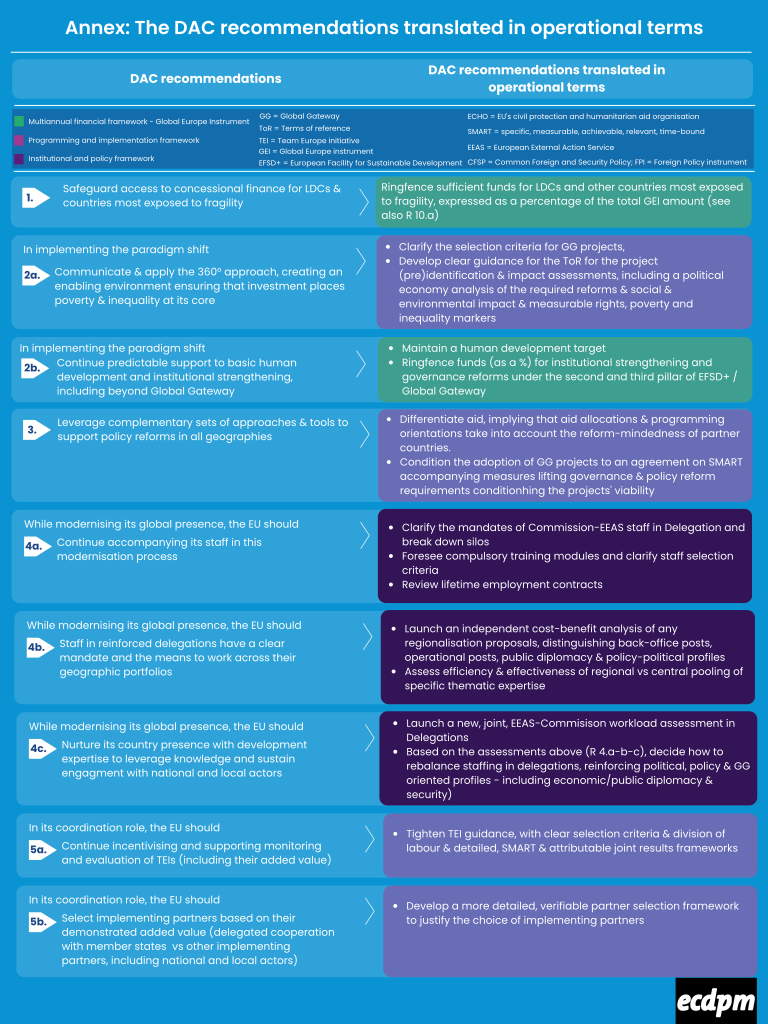
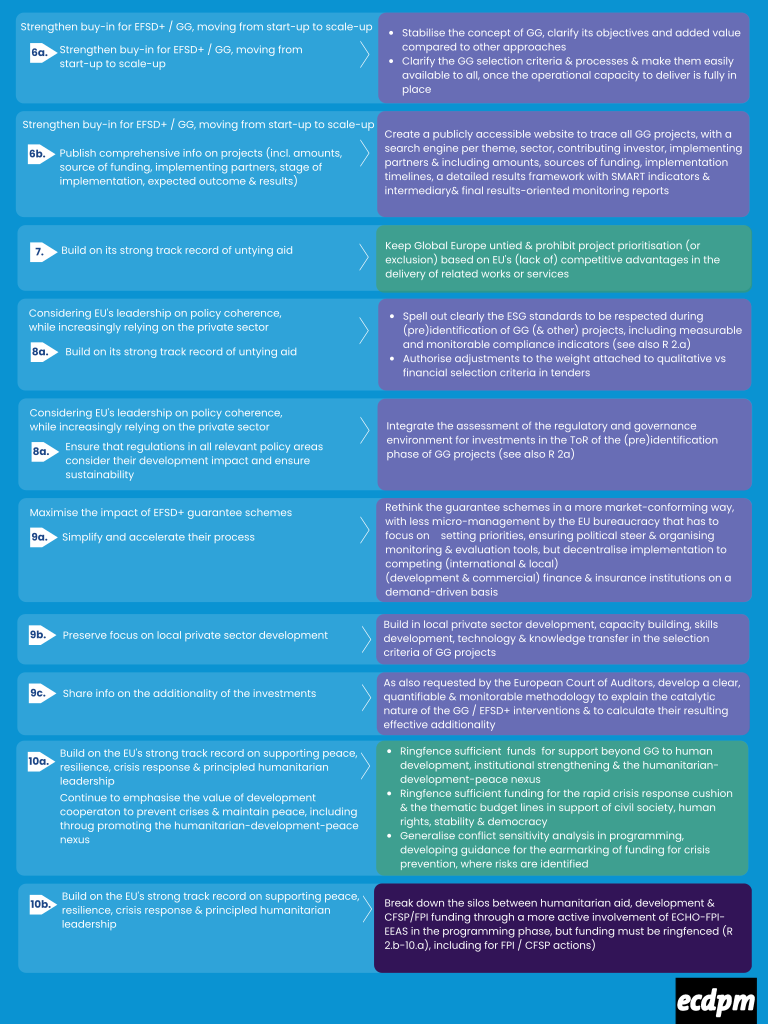
In plain language, the DAC peer review recommendations can be translated in operational guidance for the EU’s institutional, regulatory and policy framework for international partnerships and development cooperation, including the next multiannual financial framework (2028-2034), and for programming purposes (see also Annex, p.10):
- While consolidating the humanitarian aid and development instruments is a positive move to enhance flexibility and reinforce the humanitarian-development-peace nexus approach in complex settings, ringfence sufficient funds for LDCs and other countries most exposed to fragility as a share of the Global Europe instrument, as well as support beyond Global Gateway to basic human development, institutional strengthening and the humanitarian-development-peace nexus;
- Reconfirm the EU’s commitment to untied aid, including beyond the LDCs and other fragile settings falling under the DAC recommendations, while ensuring the terms of reference for procurement comply with international sustainable development standards in order to level the playing field;
- Regarding the Global Gateway strategy:
- Apply the Tinbergen principle and - while promoting an integrated approach - clearly separate funding sources between DACable private sector support through the Global Europe instrument and trade finance or EU’s export promotion, which should be supported through the proposed European Competitiveness Fund;
- Clarify the additionality of the EFSD+ instrument, redesign its procedures in a less bureaucratic way, relying more on the (development) finance institutions in a more competitive and market enhancing framework for implementation, while maintaining a strong, accountable and transparent political steer at the level of the EU institutions under the coordinating role of the EEAS;
- Maintain a focus on local private sector development;
- Design clear and transparent guidelines for the identification of flagship projects (covering stakeholder consultation and ESG aspects), for the design of the results framework (including measurable outcome and results indicators), for the selection of implementation partners (based on their expertise and added value), and for the identification of required sector-specific and broader governance and policy reforms.
-
Regarding the EU diplomatic network, foresee an independent cost-benefit analysis of any regionalisation and/or recentralisation proposals, distinguishing back-office, operational, policy-political and public diplomacy roles, and a new, joint, EEAS-Commission workload assessment to rebalance staff allocations according to the EU’s long-term geopolitical interests.
Considering the persistent misunderstandings around the Global Gateway strategy and the nature of the ‘paradigm shift’, it would be good that the - hopefully detailed - EU’s response to the DAC peer review and its recommendations is made public.
Acknowledgements
The author would like to thank Alexei Jones and Andrew Sherriff for their peer review and feedback. The views expressed in this paper are those of the author and do not represent those of ECDPM or any other institution. Any errors or omissions remain the responsibility of the author who is a fellow of ECDPM and can be contacted at: pvdamme59@gmail.com.
A full reference list is available in the PDF version of this brief.