What’s next for Global Europe in the 2026 MFF negotiations?

Negotiations on the EU’s next multiannual financial framework (MFF) have entered a more political phase following the December Council discussions. In this commentary, Alexei Jones explores how emerging horizontal budget choices are reshaping the context for the Global Europe instrument, and why connecting the dots between internal priorities and external action will be decisive as negotiations move into 2026.
From stocktaking to political positioning in the budget negotiations
The negotiations on the next multiannual financial framework (MFF) entered a new phase in December 2025, shifting from exploratory exchanges towards a more structured and overtly political process.
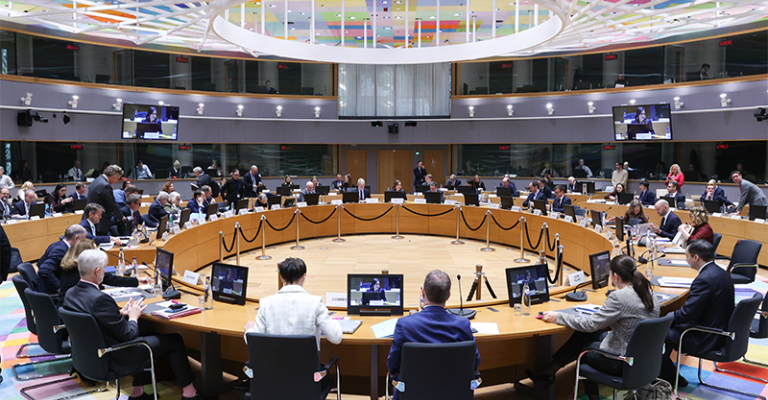
At the General Affairs Council (GAC) in December, EU ministers held their first structured exchange on the Danish presidency’s draft Negotiating Box, which defines key parameters, options and outstanding political issues guiding the negotiations. Days later, the European Council took stock of progress, endorsed the overall architecture of the future MFF, and reiterated the political ambition to conclude negotiations by the end of 2026.
From this point onwards, discussions across individual budget headings and sectoral instruments will be increasingly framed and constrained by horizontal budget politics and governance questions.
While no substantive decisions were taken, the Negotiating Box has now become the central reference point, marking the transition towards more explicit political positioning by member states across the whole package. From this point onwards, discussions across individual budget headings and sectoral instruments will be increasingly framed and constrained by horizontal budget politics and governance questions.
The GAC debate: Horizontal tensions and budgetary fault lines
The GAC exchange on the MFF focused on horizontal and politically sensitive issues in the Negotiating Box, notably the future architecture of cohesion and agricultural spending, conditionality, as well as own resources and the contentious issue of budgetary rebates. External action featured only marginally in the discussions. This is consistent with past MFF negotiations, where external action tends to be crowded out early on, before being pulled into trade-offs once the overall parameters tighten.
Key structural signals from the Negotiating Box
Several cross-cutting elements of the Negotiating Box merit particular attention:
-
First, the four-heading structure of the future MFF is now broadly accepted. While this does not prejudge funding levels, it confirms a move towards fewer, larger programmes and a more integrated budgetary architecture, which will have implications in terms of political visibility and competition between priorities.
-
Second, flexibility is firmly established as a core organising principle, with emphasis on built-in margins, reprogramming possibilities within and across headings, and horizontal instruments to respond to shocks. At the same time, it reflects a clear insistence by member states on stronger guardrails, ceilings and governance arrangements to frame this flexibility.
-
Third, political steering is being reinforced, with proposals to tighten the links between annual budgetary decisions, strategic priorities and Council guidance pointing to a broader governance shift in the MFF.
The Negotiating Box sets out clear political markers for each of the three main headings:
-
Heading 1 anchors cohesion and agricultural spending in national frameworks under National and Regional Partnership Plans (NRPPs), combining investment priorities with reform commitments;
-
Heading 2 places competitiveness and security as the organising logic of the next MFF, with the European Competitiveness Fund (ECF) as a central reference point for EU spending;
-
Heading 3 confirms the Global Europe instrument (GEI) as the EU’s main vehicle for external action, covering enlargement, neighbourhood, partnerships, migration, humanitarian aid and Ukraine, while explicitly linking external spending to internal priorities through synergies with the ECF and the Global Gateway.
Recalibrating Global Europe
Drawing on several months of intensive work in the dedicated Ad hoc Council working group on the Global Europe instrument, the Danish presidency circulated a presidency compromise text on the GEI proposal. It is presented as a first basis for discussion and is expected to evolve as negotiations progress and positions further crystallise. Although not public and primarily intended as a Council-internal consolidation document, the compromise text nonetheless offers a clear signal of emerging member state preferences regarding the future orientation of the instrument.
Stronger political steering and transactional pressures
First, flexibility of the GEI is increasingly framed as politically guided rather than primarily operational, with greater emphasis on Council involvement in transfer decisions, the use of unallocated resources and the mobilisation of assistance through the ‘cushion’. The Council is also calling for greater clarity on the balance between programmable and non-programmable actions under the instrument, highlighting the need to preserve crisis responsiveness while ensuring predictability and limiting ad hoc reallocations away from agreed priorities.
This reinforces a more transactional framing of external action, in which cooperation is increasingly expected to deliver visible economic and strategic returns for the EU.
Second, the compromise text emphasises the centrality of competitiveness, EU economic interests and the Global Gateway strategy. References to internal-external synergies are strengthened, including explicit links to the ECF. This reinforces a more transactional framing of external action, in which cooperation is increasingly expected to deliver visible economic and strategic returns for the EU, raising questions about how this logic is balanced with long-term partnerships and development objectives.
Third, core humanitarian and development principles are reaffirmed through clearer references to international humanitarian law, poverty reduction, policy coherence for development and development effectiveness. However, these reinforcements remain largely declaratory, with no new binding safeguards, ring-fencing or spending targets introduced.
Migration is the only area for which an indicative spending target is reintroduced. The reinstated 10% benchmark, combined with a tighter link between external action funding and cooperation with partner countries on migration, signals a more explicitly transactional use of the instrument and is likely to remain a key point of contention in interinstitutional negotiations.
A similar logic is visible for cooperation with the Enlargement and Neighbourhood East, where greater weight is placed on Council steering and on linking financial support more closely to reform progress and alignment with EU political priorities.
These elements point to a gradual yet meaningful recalibration of Global Europe, towards stronger political control of flexibility, closer alignment with internal priorities, and a more strategic and increasingly transactional use of the instrument.
Taken together, these elements point to a gradual yet meaningful recalibration of Global Europe, towards stronger political control of flexibility, closer alignment with internal priorities, and a more strategic and increasingly transactional use of the instrument.
The growing role and influence of the horizontal MFF track
Compared to past MFF cycles, a notable shift is the sustained and substantive scrutiny that the horizontal MFF track, managed by the Ad Hoc Working Party on the MFF and feeding into ECOFIN and the European Council, is now applying to thematic instruments, including Global Europe. This indicates a recalibration of political authority over EU expenditure, with Ministries of Finance and the horizontal MFF machinery exerting greater influence over thematic spending areas than previously.
This shift means that decisions affecting external action are increasingly shaped through horizontal trade-offs and budgetary arbitration driven by internal priorities and fiscal discipline. While this may strengthen overall coherence and budgetary discipline, it also carries risks if the specificities of external action, such as long-term partnerships, predictability and context-sensitivity, are insufficiently understood or defended in these fora.
As negotiations move into 2026, the balance of the MFF discussions will increasingly be shaped by horizontal choices on priorities, flexibility and governance. By embedding all headings within a common logic of conditionality, central control and competitiveness-driven prioritisation, the Negotiating Box risks steering budgetary decision-making towards a more transactional reading of EU external action, making it harder for Global Europe’s distinct policy rationale to remain visible and persuasive within the political economy of the next MFF.

Connecting the dots as negotiations move forward
The process moving forward is crucial. This week’s first meeting of the Ad Hoc Working Party on the Global Europe instrument under the Cyprus presidency will examine how the GEI interacts with other key EU legislation, including the new Performance Framework and relevant Regulations. This meeting, which will also include Budget Committee delegates, provides a timely opportunity to connect internal budgetary frameworks with external action objectives. Such cross-cutting discussions are indispensable for maintaining coherence between the EU’s internal and external priorities as the negotiations move forward.
Looking ahead to 2026, the institutional balance will also continue to evolve. While the current phase is clearly Council-driven, the European Commission will progressively shape outcomes in its role as broker as interinstitutional negotiations take shape. The European Parliament, having now confirmed its co-rapporteurs on the Global Europe instrument - in AFET (Michael Gahler, EPP) and DEVE (Robert Biedroń, S&D) - will become a more consequential actor, particularly on governance, flexibility, spending targets and safeguards. It will be important to ensure that similar crosscutting discussions also take place on the parliamentary side, to allow the Parliament to engage not only with the substance of the Global Europe instrument, but also the horizontal trade-offs that will ultimately shape its implementation.
For governments, NGOs and other stakeholders, this points to the importance of engaging beyond the Global Europe instrument itself: influence will increasingly depend on coordinated engagement across horizontal budget debates, finance ministries and parliamentary processes, and on clearly articulating how EU external action fits within the Union’s wider strategic priorities. How these horizontal choices are navigated in 2026 will largely determine whether Global Europe retains a distinct and credible policy role within the next MFF.
The views are those of the authors and not necessarily those of ECDPM.
Our work on the MFF
Explore our dossier featuring ECDPM’s work on the new multiannual financial framework and the budget negotiations, along with insights into current and past frameworks.