Addressing the EU Global Gateway's dual objectives and inevitable trade-offs
Authors

San Bilal looks at ‘Global Gateway 2.0’, arguing that the EU's dual development and geostrategic ambition can remain credible only if these tensions are named honestly, rather than presenting every project as serving both agendas equally.
Summary
The EU's Global Gateway strategy rests on the premise that development cooperation and the EU's own geostrategic interests can be mutually reinforcing. Genuine synergies do exist: a renewable energy project can expand electricity access while creating markets for European technology; digital infrastructure built on EU standards can advance local governance while embedding European norms abroad. But the EU's official narrative has increasingly stretched the idea of ‘mutual benefit’ to near-total, obscuring cases where tension and potential trade-offs emerge between the two sets of objectives.
The brief looks at ‘Global Gateway 2.0’ and shows how recent EU policy documents – on digital strategy, climate and energy, critical raw materials, economic security, and preparedness– have further shifted Global Gateway’s attention towards EU competitiveness, resilience and economic security interests. Critical raw materials illustrate the tension concretely: whether processing should happen within the EU for European strategic autonomy, or in the partner country for local value addition and jobs, is a real and legitimate trade-off that cannot be dissolved by mutual-benefit language and must instead be weighed case by case.
The brief cautions against two related risks: development institutions and funding being redirected towards geostrategic ends, and governance- or poverty-focused programming being redefined around short-term EU commercial payoff. It stresses that the EU's dual ambition remains credible only if it explicitly acknowledges where interests align and where they don't. Naming these trade-offs honestly, rather than presenting every EU external investment project as serving both agendas at once, is what makes genuine, durable overlap possible.
The Global Gateway dual ambition
The Global Gateway has been framed as a positive-sum proposition, contributing to the EU’s partners’ development objectives in ways aligned with the EU’s geostrategic interests, so as to foster mutually beneficial partnerships. The EU's external investment strategy for digital, energy and transport connectivity, health, education and research, as well as now critical raw materials (CRM) and agri-food, is delivered through a "Team Europe" approach, while simultaneously serving EU interests in diversified, trusted and rules-based partnerships. A connectivity project typically can also strengthen EU investment and trade links, providing enhanced opportunities for the EU’s and its partners’ businesses and financiers, in a sustainable and transparent manner. A renewable energy grid that improves electricity access can also create markets for European technology. A digital infrastructure investment built on EU standards can potentially advance data protection and good governance locally while embedding European technical norms internationally. In this respect, development objectives and the EU's own strategic interests can effectively reinforce one another.
Yet the EU’s geostrategic interests extend beyond development cooperation and sustainability objectives to include economic security, strategic autonomy, resilience, supply chain diversification, and security and defence priorities. While not harmful to partner countries, these legitimate EU interests may not necessarily directly contribute to the EU’s partners’ development priorities. The EU should explicitly recognise this, to appropriately clarify and tailor its approach and ensure genuine partnerships.
As shown in Figure 1, this can be simply illustrated as a Venn diagram of two circles, "Development" (poverty impact, partner-country priorities) and "Geostrategy" (economic security, strategic autonomy), with Global Gateway's dual purpose positioned at their intersection, held together by mutual benefits, shared standards, values, principles and quality. The Global Gateway strategy rests on the premise that this is an overlap. But it should not imply a merger: each circle also has territory of its own, where "balance and tensions" between the two objectives must be actively managed rather than assumed away. Global Gateway's dual purpose is precisely to work that intersection — mobilising investment that serves partner-country development and the EU's own resilience, competitiveness and security agenda at the same time.
Figure 1: Global Gateway's dual objectives: synergies and tradeoffs
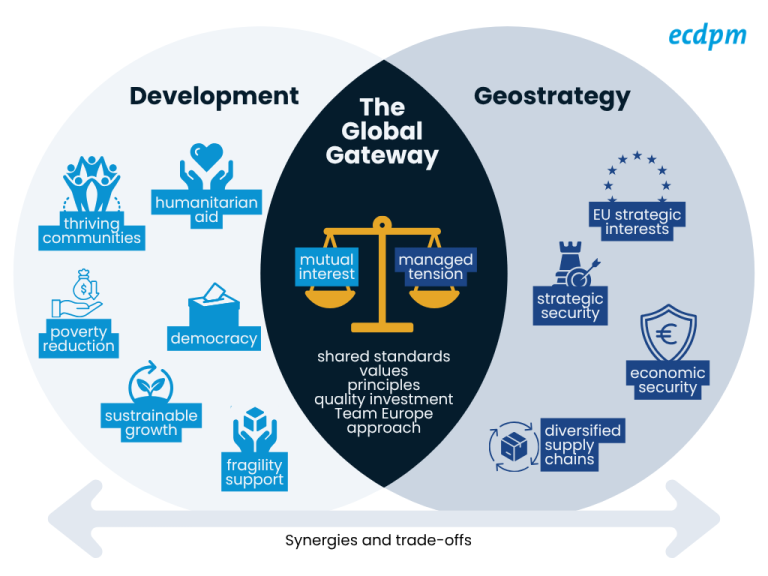
In EU policy discourse, however, the Global Gateway narrative tends to inflate that overlap until it appears to cover both circles entirely, as if all investment projects in the EU's own interest automatically focus on development, and every development project should necessarily serve EU interests. The two-circles framing is repeatedly flattened into a single, self-congratulatory story of "mutual benefit," which forecloses the harder conversation about situations where tensions and potential trade-offs may appear between the two objectives. In the words of Ambassador Pieter Jan Kleiweg de Zwaan, Permanent Representative of the Netherlands to the EU:
“‘mutually beneficial partnerships’ and ‘own interest’. It sounds good. But it only has value if both parties are clear about what it means. Sometimes there is clear overlap. Sometimes there is tension. Mutually beneficial partnerships do not mean pretending those tensions do not exist. It means putting them on the table and trying to manage them in a fair way. If we avoid them, we end up with nice communiqués and statements. If we confront them honestly, we have a chance of building durable cooperation.”
2. Real synergies
To date, Global Gateway has emphasised the zone of genuine overlap in Figure 1.
The June 2026 Council Conclusions on Global Gateway restate this logic explicitly, describing the strategy as advancing both partner-country priorities and EU strategic interests (resilience, competitiveness, economic security, diversified supply chains) while remaining anchored in the 2030 Agenda, the SDGs and the Paris Agreement. This is the diagram's intersection, and it is where the political case for mobilising scarce EU resources is easiest to make, both to partner governments and European taxpayers. It is reasonable that most of the portfolio, and most of the public narrative, has concentrated here so far.
On the way forward, the proposed Global Europe Instrument for the next 2028-2034 multiannual financial framework (MFF) also aims to foster these synergies, and “contribute to ensuring consistency, coherence, synergies and complementarity between the Union’s internal and external policies and between its external policies in order to simultaneously promote the Union’s fundamental and strategic interests and sustainable development in partner countries”.
3. A greater emphasis on geostrategy
The EU's broader external economic architecture is nonetheless increasingly pulling the Global Gateway towards responding to the EU’s own geostrategic objectives, in mutual benefit with partner countries, and potentially primarily in the EU’s interests, depending on the circumstances. This trend has been particularly pronounced since the 2024 second von der Leyen Commission, which can then be defined as Global Gateway 2.0. Recognising both the synergies that mutual benefit offers and the potential tensions and inevitable trade-offs in balancing arguably mutual benefits will be of prime importance. Several recent EU policy documents highlight this evolution, including the following.
The June 2025 Joint Communication on an International Digital Strategy for the EU stresses digital cooperation as a core element of the EU's external action. It sets three objectives: boosting EU tech competitiveness, promoting security for the EU and its partners, and shaping global digital governance and standards, channelled through an integrated "EU Tech Business Offer," managed by "Tech Team Europe," that bundles secure connectivity, Digital Public Infrastructure (DPI), AI and cybersecurity support for partner countries explicitly under the Global Gateway banner. The Digital Strategy underlines that “For the EU’s competitiveness, economic security and defence capacity, it is crucial to closely cooperate with our partners and tech allies to enhance the ability of European tech companies to innovate and grow globally” and that “Investments and initiatives launched under the Global Gateway [...] demonstrate the strategic importance of the digital sector from a geopolitical, security and economic point of view.” The EU's focus on digital connectivity as a key pillar (and historical driver) of the Global Gateway illustrates the geostrategic dimension the EU pursues in mutually beneficial partnerships.
The October 2025 Joint Communication on the EU Global Climate and Energy Vision, building on the February 2025 Clean Industrial Deal, further articulates the EU energy and climate diplomacy to “protect the EU’s core interests, drive global climate and environment action, promote climate adaptation, and ensure the security of energy supply and access to raw materials”. One of its objectives is “to promote the use and deployment of EU clean technologies and ensure that EU-financed investments and projects in partner countries are aligned with EU interests”, with Global Gateway as a key vehicle. EU trade agreements, including new Clean Trade and Investment Partnerships (CTIPs) and Clean Transition Business Fora, should help secure "undistorted access to critical raw materials" and clean-energy supply while opening markets abroad for EU clean-tech exports. And in its drive to develop tailor-made initiatives with its partners, the EU commits to “pay close attention to the interests of European companies”.
The December 2025 RESourceEU Action Plan operationalises the April 2024 Critical Raw Materials Strategy Act (CRMA), seeking to cut single-country CRM dependencies by 30–50% by 2029 while also flagging the retention of secondary raw materials and processing capacity inside the EU as a distinct resilience goal. So, while in some instances, EU domestic processing may be favoured, in others, as stated in the CRMA, the EU “should seek mutually beneficial partnerships with emerging markets and developing economies, in coherence with its Global Gateway strategy, which contribute to the diversification of its raw materials supply chain as well as add value in the production in those countries”. The CRMA also provides the option for "strategic projects", unlocking special provisions for streamlined EU financing in third countries. One example is the recently announced Zandkopsdrift rare earths project in South Africa, which leverages European institutional support to build advanced, local processing capacity.
The December 2025 Joint Communication on Strengthening EU Economic Security explicitly includes the Global Gateway among the instruments that “should strengthen the EU’s economic security”. The European Commission commits to "a more strategic and assertive use of the Union's tools — complementing their original policy objectives — to support Europe's economic security," although most of these tools "were not originally developed with economic security in mind" but are "nevertheless highly relevant" to that goal.
The March 2025 Joint Communication on the European Preparedness Union Strategy folds external resilience and hybrid-threat protection into a "preparedness by design" logic that increasingly conditions investment choices, explicitly stressing the need for the EU to build mutual resilience through external economic and development policies, including areas such as economic security, trade, and investment. In practice, this means that Global Gateway projects should be screened not only for development impact but also for their contribution to EU crisis resilience and hybrid-threat protection. As an example of the overlap between development and geostrategic objectives, the EU’s own resilience and preparedness objectives have gained additional attention.
The June 2026 Council Conclusions on Global Gateway endorse this geostrategic pull (referring seven times to the EU's “strategic interests”), while clearly emphasising partner-country development priorities and objectives, thereby confining the Global Gateway to the overlap between development and geostrategic realms. Yet, by doing so, the EU Member States fail to acknowledge and help address the potential trade-offs and inevitable dilemmas in steering the Global Gateway forward, the same tension this note argues must be named explicitly rather than papered over, thereby seemingly steering without a map.
Ignoring tensions and wrapping every project in a cosy mutual-benefit narrative is misleading.
4. Where interests and development genuinely diverge
Critical raw materials make the trade-off concrete. Whether the CRM processing should happen within the EU, for strategic autonomy, resilience, economic security, and diversity and security of supply chain purposes (i.e. the geostrategic EU interests realm), or in the extractive partner country, for job creation, local value addition and sustainable economic transformation objectives (i.e. the development partner interests realm) remains a balancing act, which will depend on specific circumstances and considerations. Explicitly acknowledging these potential tensions and inevitable trade-offs across objectives is critical, as both may be legitimate and should be assessed on a case-by-case, project-by-project, mineral-by-mineral basis, weighting priorities accordingly. Ignoring these tensions and wrapping every project in a cosy mutual-benefit narrative is misleading.
Some Global Gateway investments sit squarely in the overlap in Figure 1: genuinely beneficial to the partner country and aligned with EU interest. Others follow a more extractive logic, where the EU would not support a project with a negative effect on the partner country, but where the objective is not development either — the local benefit is a marginal, incidental return rather than the purpose of the investment, and gender, inclusion or local-capacity objectives are simply not what the project is designed to achieve. "Do no harm" is a floor, not evidence of a development objective, and the diagram should not blur that difference. So while the EU should continue to promote sustainable (ESG-aligned) investments, both public and private, that ultimately have some positive (or at least no negative) impact on the recipient country, this does not mean all investments are development-oriented.
The inverse discipline matters equally. Humanitarian aid, poverty eradication, human rights, addressing fragility and governance challenges belong in the Development realm of Figure 1 and should not be systematically redefined around short-term EU commercial or strategic payoff. Global Gateway should contribute to, but is no substitute for, a comprehensive EU development policy, which, according to Article 208 of the Treaty on the Functioning of the European Union (TFEU), has as “its primary objective the reduction and, in the long term, the eradication of poverty”. EU development policy cannot and should not be reduced merely to the Global Gateway, even in its 360-degree approach iteration, and in itself needs to be refreshed.
As the Global Gateway articulates ambitions beyond development objectives, in defending the EU’s own interests, it should not unduly stretch and divert development institutions, instruments, and funding from these basic development objectives to pursue less development-oriented investment-promotion, migration, and geostrategic objectives.
Going forward, the Global Gateway should also be able to rely on non-development institutions, tools and funding, including investment and trade promotion mechanisms, thereby enhancing the coordination between trade and development finance. In this respect, the EU endeavour in that direction is promising, harnessing the sizeable potential of EU export finance.
5. Naming the trade-offs is the precondition for genuine overlap
An overlapping Global Gateway, as depicted in Figure 1, remains the right ambition, and much of the portfolio can legitimately sit in the space where partner development and EU interest reinforce each other. But that ambition is credible only if the EU stops presenting the whole of both circles as if they already coincided.
Building on the June 2026 Council Conclusions on Global Gateway, and the Council’s call “for a transparent methodology to assess development outcomes, resources mobilised and contributions to the Union’s strategic interests”, the EU should aim to acknowledge, identify and address in a transparent and open manner potential tensions and drawbacks in the pursuit of the dual objectives of meeting the EU’s and its partners’ interests in a mutually beneficial manner. It should also formally recognise the limits of this endeavour, commit to continue supporting core development objectives even when not directly linked to the EU’s direct geostrategic interests, and harness mechanisms to support the EU’s strategic interests outside the development realm.
Acknowledgements
The author would like to thank Genís Gomà, Alexei Jones, Karim Karaki, and Andrew Sherriff for their comments. The views expressed in this briefing note are those of the author and do not necessarily represent those of ECDPM or any other institution. Any errors or omissions remain the responsibility of the author. For comments and feedback, please contact San Bilal at sb@ecdpm.org.
A full reference list is available in the PDF version of this brief.