Why cutting back on aid might be an incentive for structural transformation

2026 brings a radical shift from development support to military expenditure. While this has important repercussions for millions in Africa, Asia and Latin America, Geert Laporte argues that it could also open the door to more mutual interest-based partnerships between the EU and the Global South.
For decades, relations between the rich world and the Global South have been trapped in a perverse cycle of unequal partnerships and hollow rhetoric. We talked about ‘ownership’ and ‘partnership amongst equals’ while rich countries, often with the complicity of authoritarian leaders in the Global South, have called the shots. But as 2026 unfolds in a world of increasing conflicts, a radical shift is underway from development support to military expenditure. This is creating new challenges for the EU in particular, which has traditionally been the most generous provider of development assistance. For some, this is a disaster that will affect millions in Africa, Asia and Latin America. For others, a window of opportunity is opening up for building mutual interest-based partnerships, provided that some major risks can be carefully managed.
Why aid cuts are not causing outrage
The DAC-OECD announced today that official development assistance has dropped by almost 23.1% in 2025, the largest single-year drop in history. This trend is likely to continue in the near future. While the ‘aid business’ is responding with predictable alarm, the reactions in the Global South are rather lukewarm. Predominantly, young generations in Africa do not seem to mourn the loss of aid. They hardly felt a real impact and perceived aid as a dependency trap and a tool to advance donors’ interests.
For too long, declarations like the 2005 Paris Declaration on Aid effectiveness claimed ‘partner countries’ leadership of their own development. But many authoritarian political regimes did not assume such a role and, de facto, external funders continued to dictate the rules of the game. This caused major frictions due to double standards and weak accountability on both sides of the ‘partnership’. We are now at a crossroads, and the reduction of external support could help to create the space for a more honest dialogue on mutually beneficial partnerships amongst strategic peers.
Catching the new waves
New trends are shaping the international cooperation system:
First, relations are becoming more ‘transactional’. In this Trumpian age, this could have a negative connotation if based solely on selfish, immediate economic gains. But a collaborative ‘give-and-take’ transactional approach in a longer-term perspective could stimulate structural transformation. Today, previously “aid-addicted” countries in Africa strongly advocate industrialisation and productivity-enhancing sectors over charity. Smart investments, private-sector cooperation and mutually beneficial trade agreements could deliver tangible returns for both sides of the partnership.
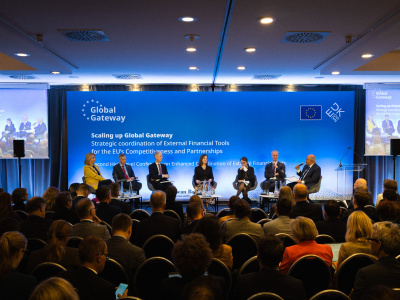
The EU Global Gateway- despite its shortcomings- aims to achieve this win-win in creating prosperity and raising people out of poverty in the Global South while also opening new markets for the EU.
Second, geopolitical and strategic interests regain importance. Development policy has never been neutral. But with the growing rivalry in the geopolitical landscape, this dimension takes on renewed significance. For the Global South, and Africa in particular, this increases the possibility to accelerate a long-overdue recalibration toward strategic autonomy through diversified global partnerships. In this volatile global context, the EU is also stepping up efforts to build stronger alliances with countries in the Global South, as we have recently seen with the EU trade deals with Mercosur and India.
Third, despite ‘America First’ policies and nationalistic headwinds in parts of Europe, the efficient and urgent management of global public goods – such as global health, climate adaptation, or food security, in our highly interdependent world regains importance. Countries that were labelled in the past as ‘North’ and ‘South’ are forging new joint alliances in areas such as climate change, investment, trade and artificial intelligence, recognising that collective efforts, the pooling of resources and sharing of expertise are vital to tackling global challenges.
Fourth, a healthy shift is underway towards other sources of finance beyond public development cooperation, including private, blended and philanthropic funding and, most importantly, domestic resource mobilisation.
The recent Accra Reset Initiative aims to reduce aid dependency by keeping greater control over natural resources, building Africa’s manufacturing capacity and mobilising Africa’s substantial but underused domestic capital.
Development financing must also include joint efforts to stem illicit financial flows. African countries lose about $90 billion every year to corruption, illicit capital flight, and tax evasion, which is significantly more than the $60 billion in external aid to the continent annually.
Today, the conditions seem to be in place to break from structural dependency and construct interest-driven partnerships that truly deliver mutual benefits.
The above trends could be perceived as ‘old wine in new bottles’. Economic and political interests have always been drivers of international cooperation. But today, the conditions seem to be in place to break from structural dependency and construct interest-driven partnerships that truly deliver mutual benefits. Obviously, the wider choice of partners has also increased leverage of the emerging countries in the Global South, who could become the architects of their own development.
Navigating the risks
While these shifts should be welcomed, the EU, in particular, must also gain credibility as a trusted geopolitical and development actor.
First of all, the most fragile and vulnerable states and populations should be given the fullest attention. Economic and geopolitical interests will inevitably prioritise stable, mostly middle-income countries in the Global South with high potential for returns on investments. There is a real danger that industrialisation and investments are likely to bypass the poorest countries, which in most cases are also the most conflict-affected countries.
The EU should stay engaged and co-design adequate response strategies for resilience building in fragile settings. A Team Europe approach could increase scale and impact, amongst others, by localising its interventions, with a particular focus on engaging cities and local governments.
Second, in its rush for geostrategic wins, the EU should not throw out its values agenda. The EU has always been a promoter of democracy, governance, rule of law, human rights, inclusive societies and a rules-based international order. These principles have not always been implemented in a coherent way, including with shaky deals on curbing irregular migration and return and readmission and support to pro-Western anti-democratic leaders. In today’s world, with the systematic violation of international agreements and rules, the EU should never give up on these values. But it should avoid double standards and, in a more modest way, recognise its own governance problems at home. At the same time, it should continue its support for local organisations and “change agents” who could help to create the enabling environment for societal change and development. There is a risk that financial resources for these types of actors will be curtailed as Global Gateway-type initiatives focus primarily on investment and business opportunities.
Third, whatever it takes, the EU should continue to invest in ‘soft power’. In a divided and increasingly competitive world, the EU could still be an attractive and inspiring societal model that could earn global goodwill and influence. It should therefore step up efforts to shape global norms, standards and legislation in major policy domains such as international trade, climate change and green transition, renewable energy, critical minerals, labour standards, cybersecurity and ethical use of artificial intelligence. Increased and smarter public diplomacy could help to polish its tarnished image and reputation, particularly in Africa. This will require substantial (financial) investments in cultural, academic and business exchanges, which could foster goodwill. By distancing itself from the ‘New Washington Dissensus’, the EU could enhance its global standing and credibility in the Global South. More than ever, the EU needs allies and friends and therefore needs to enhance its global presence, not reduce it.
The EU must wholeheartedly embrace these ‘new waves’ and lead by example.
In conclusion, the old aid system of dependency and mutual self-delusion has run its course. While the current budget pressures are painful, they are forcing us towards a more balanced and interest-based form of cooperation. This is the smartest way of ensuring security and welfare at the global level. The EU must wholeheartedly embrace these ‘new waves’ and lead by example, while also ensuring that European commitments to values and smart support for the poorest and most fragile settings are fully integrated not only into new narratives, but also into action.
The views are those of the author and not necessarily those of ECDPM.