Geopolitical branding: Why ‘globetition’ requires new marketing skills for Europe
Authors
In this guest commentary, Christian Lungarotti and Carlo Alberto Pratesi explore to what extent an effective geopolitical branding strategy can help strengthen a country or international organisation’s global standing and support its economic and political objectives.
Is globalisation over? Not quite
Although protectionist or autarchic trends have led some observers to describe the current landscape as one of ‘de-globalisation’, the reality is very different. Far from reversing course, globalisation is today even more pervasive than before.
All the issues that have dominated media attention in recent years feature a strong global component: supply chain disruptions during the pandemic, restrictions on people’s movement, inflation, food crises, defence, tariffs, protectionism, transport bottlenecks, migration, cryptocurrencies, artificial intelligence in all its many applications, and much more.
Towards globetition
However, globalisation is undergoing a transformation: formerly centred primarily on cooperation with a win-win logic, it is now increasingly characterised by a growing component of competition and zero-sum games.
Globalisation is undergoing a transformation: formerly centred primarily on cooperation with a win-win logic, it is now increasingly characterised by a growing component of competition and zero-sum games.
We call this new context, where globalisation is reframed through a competitive lens, ‘globetition’. Its primary feature is that some of the typical dynamics of rivalry between large private companies are now emerging between geopolitical actors.
States and international organisations now compete to keep export markets open and to secure the supply of energy but also critical raw materials beyond their borders. They are poised to ensure access to semi-finished goods, weaponry and various forms of technology; and, in many cases, to gain political, military or even merely ideological support.
This new perspective adds another layer of competition to the traditional forms of relations between states, bringing together socio-political objectives and typical market-driven goals in an unusual way.
When power relations between states begin to look like those between big companies
Those who design geopolitical strategies are implicitly adopting classic marketing tools: targeting, positioning and, above all, branding. Branding is what turns a name, symbol or sign into an instrument capable of evoking distinctive values and the essence of a company, product or any initiative that aims to be recognised and appreciated by its audience.
Examples of such geopolitical branding are already numerous and show varying degrees of success. These include:
- China’s Belt and Road Initiative (BRI)
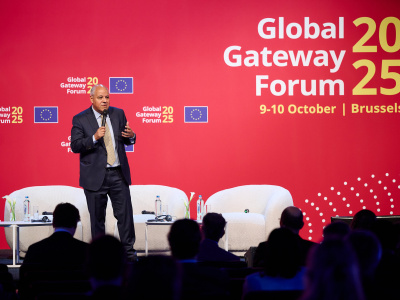
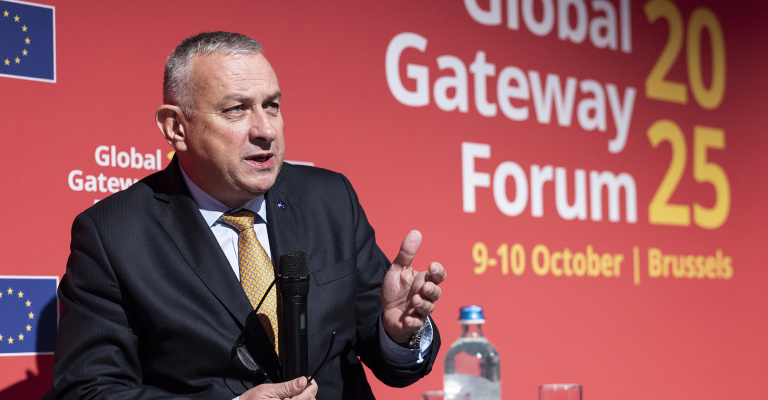
- The EU’s Global Gateway strategy
- The G7’s Partnership for Global Infrastructure and Investment (PGII)
- The US-led Blue Dot Network
- The Indo-Pacific Economic Framework for Prosperity (IPEF)
- India’s Act East Policy
- The Eurasian Economic Union (EAEU) involving Russia and former Soviet republics
- The India–Middle East–Europe Corridor (IMEC)
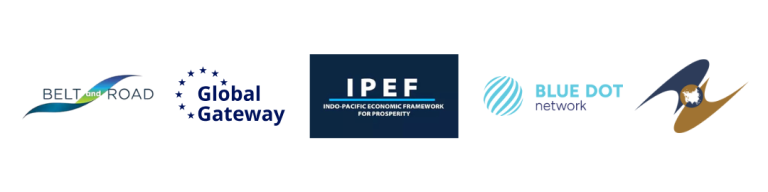
Among all these, China’s Belt and Road Initiative is undoubtedly the most visible – effectively a benchmark. Proof of this is that other geopolitical actors tend to frame their own new initiatives implicitly as ‘responses’ to the BRI.
Comparing geopolitical branding strategies
Beyond the resources and outcomes of a geopolitical initiative, its ultimate impact also depends significantly on the strategy adopted to define, communicate and promote its representative brand.
For example, Europe is the leading donor in Africa in terms of development aid, the continent’s top trading partner and its biggest investor. Yet, surveys by Afrobarometer and Gallup consistently show that Europe enjoys lower visibility and reputation than other competitors such as China, the United States and, at times, even Russia.
The 2024 China–Africa summit is widely remembered for the striking announcement by China’s president of 50 billion US dollars in support over the following three years. This is a significant figure, but it remains far lower than what the EU and its member states deliver to Africa annually through development aid and investments. Europe’s overall stock stands at around 250 billion euros, compared to the 40 billion US dollars from China.
China’s communication success stems from a well-structured, multi-level approach – including political presence on the ground – fully aligned with the BRI’s branding strategy, which Beijing has consistently pursued for approximately twelve years.
The same cannot be said of other initiatives, such as the Blue Dot Network, launched in November 2019 by the United States, Australia and Japan, but never consolidated into a global brand, or other programmes whose names or acronyms remain confined to specialist circles. The Global Gateway has significant growth potential, which may strengthen its role as the European response to China’s Belt and Road Initiative.
This raises an important question: to what extent can an effective geopolitical branding strategy help strengthen a country or international organisation’s global standing and support its economic and political objectives?
China’s communication success stems from a well-structured, multi-level approach fully aligned with the Belt and Road Initiative's branding strategy.
|
A brand is not created, it is earned
The complexity and dynamism of the challenges in this new era of globetition require multidisciplinarity and add a new layer of confrontation (and competition) between countries, alongside traditional spheres such as diplomacy, military capabilities, technology and soft power.
As demonstrated in the African context, branding is indispensable for making a strategy visible and effective, and for ensuring that the financial (and non-financial) efforts behind it are fully recognised.
Just like in the commercial world, in the geopolitical domain, an initiative becomes a true brand only when it succeeds in conveying the values on which it was built, thus serving as a key instrument for achieving the political and strategic goals for which it was conceived.

Christian Lungarotti is a diplomat with an academic background in economics and finance, and has held international postings in the Middle East, the US and Europe. Carlo Alberto Pratesi is full professor of marketing at Roma Tre University, School of Business, as well as president and cofounder of EIIS – European Institute for Innovation and Sustainability.
The views are those of the authors and not necessarily those of ECDPM.