Putting mutual interests into practice: What it means for the future of EU development cooperation
Authors


Alexei Jones, Sophie Desmidt, San Bilal and Sara Tessema Manshlot argue that the language around ‘mutual interests’ and ‘mutually beneficial partnerships’ is appealing, but what does it actually entail, and what happens when European and partner-country interests do not fully coincide?
Mutual interests and ‘mutually beneficial partnerships’ are becoming increasingly prominent in the debate about the future of EU development cooperation. The language is appealing. But what does it actually entail, and what happens when European and partner-country interests do not fully coincide? What does a stronger focus on investment and European strategic interests mean for development priorities that are less commercially or geopolitically attractive?
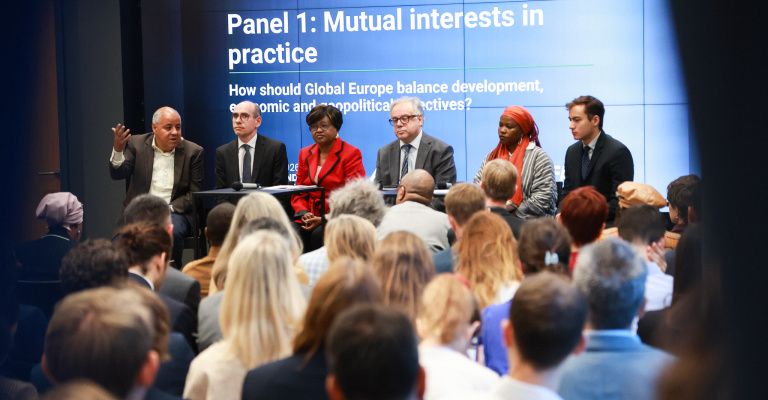
As the EU is reconsidering both the role and the scope of development cooperation, we explored some of these questions at an ECDPM–Oxfam discussion in Brussels on 23 September, held as an associated event of the Irish Presidency of the Council of the EU.
There was broad recognition that European strategic interests, partner countries' investment needs, and development objectives can reinforce each other. The more difficult issue is what happens when they do not. Across the discussion, four areas in particular seemed to deserve more attention as the EU shapes its next seven-year budget.
Mutual interest needs to be defined, not assumed
Many areas allow European and partner-country interests to reinforce each other: investment, energy, infrastructure, health, manufacturing, trade, regional integration, peace, stability and resilience. But mutual interests cannot simply be assumed because a project appears to offer benefits to both sides.
One useful distinction emerging from the discussion was between mutuality and equality. Partners do not enter a relationship with the same interests, risks, resources, or bargaining power. The benefits of cooperation will therefore not necessarily be the same for both sides. This makes it important to look at how priorities are defined, who influences decisions, and how risks and benefits are distributed. These questions become particularly relevant when the idea of mutual interests moves from political language into planned action. Who decides which priorities receive resources? Which instruments are chosen? How much influence do partner governments and other local actors have over programme design and implementation? And how are results assessed?
Some of the examples raised showed what this can mean in practice. In vaccine manufacturing, the ambition to develop regional capacity was already present on the African side, with European support responding to a partner-country priority rather than defining it. Similar considerations apply to investment and private-sector engagement: European strategic interests can form part of the picture, but cooperation needs to remain anchored in country priorities, development impact and the conditions that allow local and international actors to engage and invest.
European strategic objectives may be legitimate, but the EU also needs to be transparent about the interests driving its engagement and about the choices that follow when these differ from partner-country priorities.
The conversation is moving towards choices
The harder cases are those where interests only partially overlap. European strategic objectives may be legitimate, but the EU also needs to be transparent about the interests driving its engagement and about the choices that follow when these differ from partner-country priorities. This is where trade-offs become particularly important. In areas such as public health, education and governance, development needs can remain substantial even where the economic or geopolitical case for European engagement is less immediate. These are also areas where the benefits of cooperation are often longer term and harder to capture through conventional measures of economic return.
The wider relationship in which cooperation takes place matters too. Trade, debt, taxation, migration, access to resources and the distribution of value can shape how partners experience cooperation. Looking at the benefits of an individual project in isolation can therefore miss some of the dynamics that determine whether a partnership is genuinely mutually beneficial.
Investment matters, but it cannot be the whole model
There was broad recognition of the contribution that investments can make to development. But the discussion also brought out some of its limits. Structural transformation, local value addition, productive sectors and regional integration all require more than simply mobilising capital. The same applies to blended finance, where the developmental additionality of public resources matters as much as the amount of private finance mobilised.
Some of the most important areas of development cooperation are also unlikely to generate immediate financial returns. Public and social investments can nevertheless create conditions for more resilient societies and longer-term economic transformation.
Investment, grants, technical assistance and other forms of cooperation will continue to have different roles, depending on the objectives being pursued and the context. Eu country-level programming brings these choices together, determining which priorities receive resources and how different instruments are combined. A stronger focus on investment therefore raises a practical question for the next era of EU cooperation: how should resources be allocated when development needs and investment opportunities do not point in the same direction?
Fragility brings these tensions into sharper focus
Fragile and conflict-affected contexts bring these choices into sharper focus. Development needs are often greatest where institutional, geographic, political and commercial conditions make mobilising investment more difficult. The example of Somalia illustrates why fragility and economic opportunity should not be treated as mutually exclusive. Somalia needs continued humanitarian and development support, while investment and economic transformation are also part of its future. There is a risk that a sharp reduction in support could undermine gains that have taken years to build. Opportunities in areas such as the blue economy and agriculture can form part of a longer-term pathway out of fragility. The challenge is to combine these different forms of engagement and adapt them as circumstances change.
This applies more broadly to the ‘missing middle’: contexts where humanitarian assistance alone is not enough, but where conditions are not yet conducive to significant private investment. These settings require sustained development engagement on resilience, governance, peacebuilding and conflict prevention, alongside efforts to create the right conditions for future economic opportunities.
The discussion also brought gender equality and civil society into the picture, amid reduced funding for civic space actors and a global backlash against equal rights. Gender equality is closely linked to (economic) resilience, peace and security given the central role of women in a wide range of economic sectors and in peacebuilding and conflict prevention; civil society can contribute to implementation, accountability and the resilience of institutions and communities. The discussion showed how these aspects are part and parcel of how partnerships work in practice, rather than separate considerations alongside investment.
The question for the EU is how to maintain this broader engagement while also responding to partner countries’ ambitions for economic transformation and to the wider strategic interests shaping European cooperation. How the EU sustains support for gender equality, civil society and other longer-term development priorities will also say something about how it balances interests and values, and about the kind of international partner it wants to be as the geopolitical environment changes.
We need to move beyond the language itself and into the way partnerships are designed and implemented.
One thing became clear at the end of the discussion on ‘mutual interests’: We need to move beyond the language itself and into the way partnerships are designed and implemented. What matters is how priorities are set, who has influence, which instruments are used where and how, and what happens when European and partner-country interests do not fully align.
These are questions that will increasingly shape the next generation of EU development cooperation. The debate over the next multiannual financial framework (MFF) and Global Europe instrument will give them a very concrete form, through decisions on priorities, resources, programming, location and choice of instruments. The informal meeting of European Development Ministers in Dublin next week comes at an important point in this discussion on how the EU intends to shape its role as a reliable and principled partner alongside the wider negotiations shaping the next EU framework.
The views are those of the authors and not necessarily those of ECDPM.