Building a European industrial offer on digital connectivity


Summary
The European Union (EU) possesses world-class industrial capabilities across foundational digital connectivity infrastructure, including subsea cables, satellite systems, 5G/fibre networks, and data centres. However, this strength is fragmented and not always backed by strong local operators, leading to dependencies on non-EU providers that create structural vulnerabilities that undermine the EU's goal of digital sovereignty.
This fragmentation is reflected in Europe’s uneven position across key sectors. Europe's position is uneven: Subsea capacity is strong, evidenced by the global market leadership of Alcatel Submarine Networks (ASN) and recent state-led consolidation of key operators. In satellite connectivity, the EU is building the IRIS² constellation as a sovereign alternative. Nordic companies like Nokia and Ericsson remain leaders in 5G and fibre equipment, but have been losing market share. European involvement in the rapidly growing data centre market is primarily as a supplier of expertise in sustainable engineering and energy efficiency, rather than as a major operator.
Ultimately, the core challenge, therefore, is not merely one of capacity but of integration: the EU must consolidate and scale a coherent, end-to-end European connectivity offer that can translate control over physical infrastructure into geopolitical leverage and provide a credible, secure alternative for partner countries. To increase the competitiveness of its tech business offer, the EU must focus on strengthening digital infrastructure operators with strategic financial and regulatory support. Further efforts should include promoting cutting-edge innovators, leveraging cross-sectoral strengths like engineering expertise for data centres, reinforcing innovation ecosystems, and supporting enabling regulatory environments for EU connectivity investments.
Introduction
Subsea cables, satellite systems, terrestrial networks and data centres form the foundational connectivity infrastructure layer that underpins the global digital economy. Subsea cables carry intercontinental data flows, satellites extend coverage and provide resilience, fibre and 5G networks enable national digital ecosystems, and data centres provide the computing power that supports cloud services and AI.
Secure digital infrastructure is a foundational component of the EU’s tech business offer. Although Europe is less competitive in other parts of the technology stack, it retains world-class industrial and operational capabilities in the connectivity layer. Leading manufacturers deliver advanced engineering solutions for subsea cables, satellite and terrestrial networks, and data infrastructure. Together, these assets form the backbone of the wider EU tech offer. Yet as the EU seeks to strengthen digital sovereignty and expand secure connectivity with trusted partners, fragmentation among actors and dependencies on non-EU providers create structural vulnerabilities. A truly comprehensive European connectivity offering requires not only industrial and operational control but also stronger horizontal integration across the ecosystem to support secure data traffic for cloud services, content delivery, and communications.
Europe’s connectivity ecosystem is anchored by companies such as subsea cable giant Alcatel Submarine Networks (ASN), aerospace manufacturers Airbus, Thales and Leonardo, and telecom equipment providers Nokia and Ericsson. Despite these capabilities, Europe struggles to commercialise its strengths at scale. It cannot match Starlink’s reach in satellite connectivity, is losing ground to China in 5G and terrestrial fibre markets, and remains heavily dependent on US hyperscalers for commercial subsea cable and data centre projects. This gap is particularly evident in Africa, where Europe has enhanced subsea cable connectivity, but China dominates the build-out of terrestrial fibre networks - meaning that while European infrastructure reaches the continent's shores, it is Chinese-built networks that determine how connectivity is distributed inland. In data infrastructure in particular, European firms are competitive in energy and engineering solutions but largely act as suppliers rather than operators with ownership or strategic control.
Amid intensifying US-China technological rivalry, Europe must therefore operationalise its international digital strategy to enhance sovereignty and strategic influence. Control over the physical foundations of connectivity - from cables and satellites to terrestrial networks and data centres - translates directly into geopolitical leverage. Access to an integrated European offer for secure connectivity can also strengthen the strategic agency of partner countries by presenting a credible alternative to dominant infrastructure models.
European governments’ recognition of the geostrategic significance of subsea cables and satellites has led to nationalisation and consolidation of assets in these sectors. The private players that drive the market for terrestrial broadband and mobile networks can count on strong public support. Their offers are complemented by solutions for energy and electricity, as well as by expertise in cybersecurity and software layers. Players range from leading EU engineering companies to a large ecosystem of specialised SMEs – from manufacturers to service providers offering everything from project planning to financial structuring and compliance. In many cases, more work is needed to identify these smaller companies and integrate them into the EU’s external offer.
The analysis of each sector below will give examples of where stronger support for manufacturers and operators can lead to a more comprehensive and competitive EU tech business offer. As we explore in the accompanying briefing note, addressing the gaps in the value chain more systemically requires closer EU-wide coordination and cooperation, especially on project financing.
This briefing note is part of a four-part series on digital connectivity in the European tech business offer. The other three parts of the series explore the role of sovereignty in EU international digital policy, the evolving European toolbox around international digital connectivity, and the evolution of Team Nationals and Team Europe in the area of digital connectivity.
These policy briefs draw on a targeted review of publicly available literature and programme documentation, as well as on approximately 40 semi-structured interviews with stakeholders, including those from public institutions, development partners, private companies and civil society. In addition, the authors participated in the D4D Connectivity Working Group in December 2026, which included presentations and comments from many stakeholders.
Subsea cables: Securing European industrial leadership
Strong European industrial capacity and operational ownership of subsea cables are central to the EU’s ambitions for strategic diversification and tech sovereignty. Carrying around 95% of global data flows, subsea cables form the backbone of international connectivity and are therefore critical to Europe’s digital and geopolitical positioning. Ensuring the resilience of cables - through route diversification, redundancy, and repair and maintenance capacity - is therefore a primary concern. At the same time, reducing reliance on strategic chokepoints, such as routes crossing the Red Sea and the Suez Canal, has become increasingly important in light of geopolitical instability. However, Europe’s position in this sector faces growing pressure, as US hyperscalers have entered the subsea cable market and European operators have gradually lost market share.
France, in particular, has recognised the strategic importance of the sector, while Italy has also stepped up its focus. The French state acquired ASN from its previous owner, Nokia, at the end of 2024, as political attention on the cable sector grew. Similarly, in April 2025, a consortium led by the Italian Ministry for Economics and Finance bought Telecom Italia’s subsea cable unit, Sparkle.
Figure 1: ASN is unrivalled in the global subsea cable market
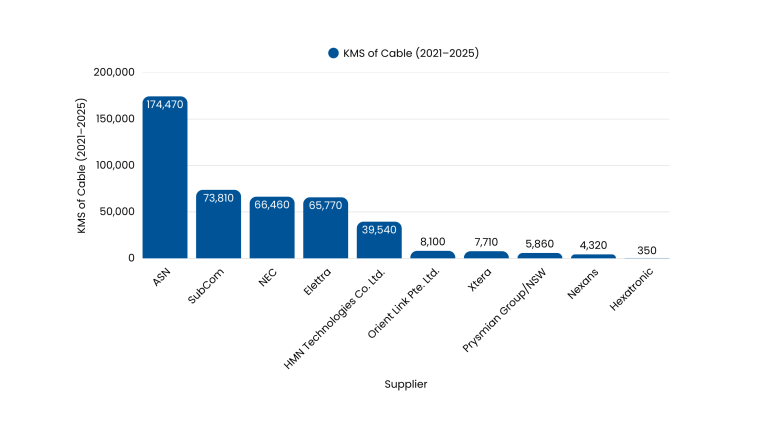
ASN is the leading global supplier of cable systems - from production to installation. Between 2021 and 2025, the company supplied 23 cable systems and installed a total of 25, a scale that no competitor comes close to matching. Italy’s Elletra is a strong global mid-tier player. Installation capacity further reinforces European leverage. ASN leads the global market, accounting for 29% of system installations between 2021 and 2025, while Orange Marine, the other major French player in the subsea cable ecosystem, delivered almost 13% (11 systems). Both companies also retain a strong fleet of cable ships, each owning six ships, providing critical repair and deployment capabilities.
Europe’s broader subsea ecosystem also features several important smaller players. Italy’s Prysmian Group, France’s Nexans, and Sweden’s Hexatronic play a critical role in supporting regional and specialised systems. Their capacity is particularly important as demand for large-scale projects increasingly absorbs the production resources of the leading global suppliers. Some smaller players are strengthening their portfolios and operational capabilities, bolstering Europe’s end-to-end capacity across the subsea value chain. In December 2025, Prysmian Group and Italian state-owned ship builder Fincantieri signed an agreement to acquire Xtera, a US-based company that offers end-to-end solutions for subsea cable systems, from designing them to handing them over to operators. This was followed in January 2026 by the announced acquisition of Spain-based ACSM, a specialist in subsea surveying, installation, and route planning.
Beyond manufacturing and installation, operators such as Sparkle, Orange and GlobalConnect play a critical role in route diversification, network resilience, and ensuring Europe’s influence over global data flows. The Italian operator Sparkle, which boasts a global fibre network exceeding 600,000 km, has championed the development of alternative cable routes that avoid strategic chokepoints. Orange maintains a similar global presence, managing more than 450,000 km of subsea cables connecting all continents, underscoring capabilities beyond installation and repair. While smaller and more regionally oriented than Orange and Sparkle, Sweden’s GlobalConnect remains important within Europe’s subsea ecosystem. By strengthening connectivity across the Nordic region and participating in the Polar Connect initiative to link Europe with Asia and the US, the company contributes to broader European objectives for route diversification, infrastructure resilience, and the development of secure international data corridors.
Europe’s industrial and operational strength within the subsea sector has been demonstrated through its involvement in several strategically important infrastructure projects. These include the completed EllaLink cable between the EU and the LAC region, and also the ongoing Global Gateway flagships Medusa and Blue-Raman, which provide connectivity between Europe and North Africa and all the way to India.
|
EllaLink: Connecting the EU and Latin America Medusa Submarine Cable System: Linking both sides of the Mediterranean Blue-Raman: Bypassing the Suez Canal Beyond the Global Gateway
|
Satellite connectivity: Europe’s bet on sovereign solutions
Space is another strategic domain in which the EU strives to secure its agency amid US dominance and growing Chinese competition. Despite budget increases, the EU’s share of the global public space expenditure stood at 10% in 2024, falling behind China’s 15%, while the US remained the largest single space power with 60%.
Satellite infrastructure is not simply a commercial asset but a foundation of strategic security and autonomy. Satellites serve the purposes of earth observation, navigation and communication. The former two are used for agricultural and environmental monitoring, disaster management and intelligence, as well as for route planning and logistics. Communication satellites are mostly used for broadcast media, but also for providing internet access or IoT services to remote and underserved regions. These networks also provide secure communications during crises - from humanitarian response to military coordination.
Europe’s strengths lie in its major institutional programmes, from navigation (Galileo) to earth observation (Copernicus) (3). In addition, the EU is now positioning itself as a player in secure connectivity from space through its IRIS² initiative. “Copernicus provides the eyes of Europe on Earth, and IRIS² adds the secure channel through which information can flow,” according to the Copernicus programme’s website. The EU’s weakness is the lack of sufficient launch capacity to enable autonomous access to space. It also has a more limited civil-military integration of the sector compared to the US and China.
Figure 2: Satellite Connectivity: Understanding the orbits
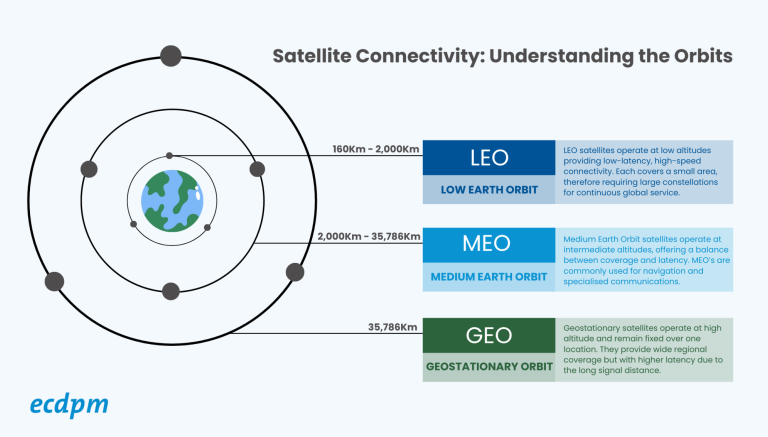
The multiorbital IRIS² constellation is supposed to provide secure connectivity to Europe but will also cover the African continent. The main objective is to strengthen secure EU government communications, but commercial uses are also foreseen. The project is sometimes branded as the European answer to Starlink, a subsidiary of Elon Musk’s SpaceX. This is a tall order given that IRIS² will consist of about 290 satellites in different orbits, while Starlink already has more than 10,000 satellites in space and has filed for permission to launch and operate 30,000 in total.
Three national European champions with an important share of state ownership - France’s Eutelsat, Spain’s Hispasat and Luxembourg’s SES - are the leading operators in charge of IRIS²(4). While they provide the strategic and financial leadership, the components of the IRIS² fleet are produced by the consortium’s industrial manufacturing core, Airbus Defence and Space, Thales Alenia Space, and Germany’s OHB. In another step towards building a joint EU space offer, industrial giants Airbus, Leonardo and Thales plan to combine their space operations in a new company as of 2027.
Airbus Defence and Space, the Franco-German powerhouse, acts as the lead system architect. As the only European company with the scale and integration to manage the entire lifecycle - from design and manufacturing in Toulouse to complex in-orbit support - it is essential for Europe’s sovereignty in space. Thales Alenia Space, a Franco-Italian joint venture, complements the offer with its capacity to mass-produce satellites in its automated 'Smart Factory’ in Rome. By standardising ‘Direct-to-Device’ hardware, it ensures the IRIS² network functions as a seamless extension of terrestrial 5G, allowing standard smartphones to connect directly to space without specialised ground equipment. Lastly, the German company OHB provides the system’s security. Drawing on its technical expertise from the Galileo constellation, it uses its navigation satellites to build a protective ‘anti-jamming’ layer in Medium Earth Orbit (MEO).
All three operators leading the SpaceRISE consortium to build IRIS² are active in Global South markets. Eutelsat partners with French operator Orange in providing access to its OneWeb Low Earth Orbit (LEO) constellation. A new gateway in Martinique extends the constellation’s global footprint and is designed to deliver secure connectivity for residential, enterprise, maritime and defence users in the Caribbean and on key transatlantic maritime routes. The two companies also partner in Africa, where they offer access to Eutelsat’s geostationary Konnect satellite.
In addition to sovereign solutions, European satellite operators and service providers are active in last-mile connectivity projects. Italian space service provider Telespazio - a joint venture between Leonardo and Thales - is active across the LAC region. In the ‘Conecta Selva’ project, it has used capacity on Eutelsat’s 117 West B satellite to bring internet connectivity to over 1,300 remote locations (mostly schools and health centres) in the Peruvian Amazon.
With the help of EU grants and EIB loans under Global Gateway, SES is connecting remote areas in Central Asia to its MEO constellation, partnering with OneWeb where necessary to increase the reach through LEO. The EU’s growing geostrategic interest in Central Asia aligns with the aims of regional governments to reduce their dependence on Chinese and Russian connectivity infrastructure. Meanwhile, Spanish operator Hispasat is in talks with LAC governments to sell sovereign capacity in a shared satellite for the region, with EU political support and hoping for EU financing. This is based on the relatively new model of a ‘Condosat’, where the owner of the satellite itself and its ‘payload’ (mission-specific instruments and equipment) are not the same.
A new generation of space technology companies is developing across the EU. One example is Finland’s ReOrbit, which specialises in software-defined GEO satellites for secure communications. The company has raised €45 million in private financing and is working on a secure ‘space cloud’ project with Google. ReOrbit plans to scale up operations on sovereign GEO connectivity in India.
Other European companies are offering solutions that no longer require ground stations, but can broadcast signals directly to devices. This would allow a tractor or shipping container to connect from anywhere on Earth without a specialised antenna, taking the Internet of Things (IoT) to a new level. The Spanish company Sateliot is a global frontrunner in offering 5G-from-space through its LEO constellation. In the LAC region, Sateliot partnered with an AgTech company in Chile to provide agricultural monitoring in regions without terrestrial 5G networks. The company has acquired a spectrum licence in Brazil and plans to expand to additional markets in the LAC region. SES also offers satellite-enabled IoT technology for data-driven agriculture in Africa. Other European companies in this Direct-to-Device and IoT segment are Luxembourg-based OQ Technology and French company Kinéis.
European satellite manufacturers also work directly with clients in the Global South. Thales Alenia has collaborated with African satellite operators and signed a strategic partnership agreement with the Moroccan operator Panafsat to develop a Moroccan satellite communications system.
5G and fibre: Defending market shares of European champions
5G and fibre networks are critical enablers of secure connectivity and inclusive digital development. Europe’s strengths in these sectors reflect a mature industrial base. European providers can offer open, interoperable and secure networks that help partner countries avoid lock-in and retain control over their own digital systems. This gives the EU a distinct position in digital development: combining reliable technology, cybersecurity expertise and regulatory credibility in a way that supports both sovereignty and resilience.
Nordic countries lead the European offer on 5G and terrestrial fibre equipment, complemented by a strong offer from SMEs and cybersecurity providers across much of Europe. Finland’s Nokia and Sweden’s Ericsson are the main rivals to China’s Huawei and ZTE in the competitive RAN market (notably 5G), while Nokia is also a leading supplier of fibre connectivity. The two companies became the main equipment suppliers in those countries that formally banned or informally excluded Chinese ‘high risk’ suppliers in the US, Australia and Europe, as well as in some emerging economies such as India and Vietnam. Yet, both providers struggle to compete with Chinese suppliers in many developing and emerging markets.
Nokia continues to be an important exporter, accounting for 13% of the global telecoms equipment market in the first half of 2025 (and 17% outside China). Ericsson follows a similar trajectory, placing marginally behind with an estimated 12% global market share (around 16% outside China). While undoubtedly the EU’s top fibre cable supplier, Nokia has fallen behind not only the Chinese but also European rival Ericsson in the crucial RAN market. This has prompted the company to focus on adapting its RAN offering to an AI-infused future, with a recent $1 billion investment by Nvidia. Ericsson (5) is pursuing a related but distinct strategic direction, reflecting wider industry efforts to generate greater value from 5G through software, automation and new service models.
Taken together against the backdrop of an expected flat RAN market in 2026, the trajectories of Nokia and Ericsson suggest that the EU’s competitive advantage in telecoms is shifting away from scale manufacturing toward higher-value, software- and AI-driven network capabilities. This evolution reinforces Europe’s position as a trusted provider of advanced connectivity solutions, while also reflecting a more specialised and narrower global industrial footprint.
Progress on 5G and fibre connectivity has been slow under the Global Gateway. These projects come in a variety of shapes and sizes, with several originating from the private sector. For example, Sweden’s Ericsson is supplying Axian Telecom in Tanzania and Madagascar with critical RAN infrastructure through a combination of a $ 100 million EIB loan and a J.P. Morgan loan of $ 159 million, backed by Swedish export credit agency EKN (See Box 9). EBRD is providing a € 190 million loan to Tunisie Telecom to improve Tunisia’s digital infrastructure (both fibre and mobile networks) as part of a comprehensive EU package, bringing together a guarantee, an investment grant and technical cooperation. German DFI DEG, together with France’s Proparco and Finnfund, is providing an $80 million loan to IPT Power Group to supply power to telecom towers in various African countries (See accompanying policy brief for more). Finnfund has been very active in supporting smaller projects, such as two equity investments of € 2 million each to Fibertime Group in South Africa and a $ 4 million loan to Poa Internet in Kenya to expand broadband internet access in underprivileged communities. A number of interviewees highlighted the importance of these smaller projects for 5G projects and smaller local networks.
|
Nigeria’s Project Bridge is Africa’s most ambitious terrestrial fibre project. Even before its launch, it has become a case study for how Team Europe coordinates with partners and approaches co-financing with international financial institutions. Under the leadership of Nigeria’s communications minister, Bosun Tijani, a former tech entrepreneur, the project will deploy 96,000 km of fibre optic backbone. The estimated $ 2 billion public-private partnership will be managed by a Special Purpose Vehicle with independent oversight and funded through a combination of debt, sovereign loans and private equity. The Nigerian government will be a minority partner, with a shareholding of between 25 and 49 per cent. The EU Delegation in Nigeria has actively engaged with the Nigerian government to play a meaningful role in the project, and is supporting implementation with a € 45 million programme. It also brought on board the EBRD, which has recently opened a local office in Nigeria. Minister Tijani spoke at the Global Gateway Forum in October 2025 and at the EU-Nigeria Digital Open Day in Brussels alongside Commissioner Síkela in December 2025. The EU grant offers technical assistance and equipment to support the design of the detailed fibre optic network, training for local suppliers, and to mobilise the European and local private sector in developing the supply chain. The project has so far secured more than $ 800 million in financing, with the World Bank Group providing $ 500 million (Paradi-Guilford 2025). The European EBRD (with $ 100 million) and the African Development Bank (AfDB) are also among the funders. Negotiations with additional potential financiers are ongoing, including a number of European private sector companies. |
In the mobile sector, the Nordic offer is complemented by the multifaceted French multinational Orange. The company is known as a mobile operator, but also plays an important role in cable repair, and has interests in fibre connectivity and a small role in data centres. Orange has a strong presence in African markets, and in the French-speaking Caribbean, including France’s overseas territories. The company cooperates with Eutelsat on last-mile connectivity through LEO satellites. Yet, several Orange subsidiaries are independently run from the parent company in Paris, and are in part locally owned. For instance, the Senegalese state has a 27% stake in Sonatel, employees own 8%, and Orange has a 42% controlling share.
Other European telecom operators also have some share in global markets. Spain’s Telefónica sold its subsidiaries in Colombia, Mexico and Chile to Hiberus - another Spanish ICT company - at the end of 2025. Its core business now focuses on Spain, the United Kingdom, Germany and Brazil. Deutsche Telekom limits its regional focus to Eastern Europe and the United States, apart from its home market, Germany. The UK’s Vodafone is active in 15 markets, including Germany, the UK, South Africa (Vodacom), and Kenya (Safaricom).
Data centres: Combining sectoral strengths for a coherent EU offer
Data centres are becoming a strategic part of Europe’s digital infrastructure offer, not only because of the rapid growth of the market, but because they sit at the intersection of cloud services, AI compute, connectivity and energy systems. While European firms are still less present than US and Chinese competitors in large-scale international projects, they have clear strengths in engineering, energy efficiency, cooling, as well as regulatory expertise that can shape how data centres are designed, financed and operated. This allows Europe to move beyond the role of supplier and contribute to more sovereign, sustainable and interoperable digital infrastructure.
With a few exceptions, and in light of the considerable demand at home, European companies are only beginning to explore data centre projects in international markets. The global data centre market is expanding rapidly, with analysts anticipating growth from around $ 300 billion in 2026 to almost $ 700 billion by 2034. Even the African market, currently the least developed, is projected to more than double in value from approximately € 3.2 billion in 2024 to € 6.8 billion by 2030.
The dominance of large US and Chinese providers in this segment leaves little room for direct EU competition. Yet there are opportunities for European suppliers in international data centre markets. In addition, an upcoming market study by the Digital Investment Facility (DIF) argues that Europe can influence how data centres are financed and built, drawing on its regulatory experience and high-quality offer of sustainable industrial and energy solutions.
China offers vertically integrated engineering and finance models (turnkey solutions) that secure long-term vendor control through its leading companies (mainly Huawei and Alibaba Cloud). The US offer combines large real estate investment trusts such as Equinix and Digital Realty, and large cloud providers: Amazon Web Services, Google and Microsoft. The current wave of ambition to secure the EU’s digital sovereignty has produced the plan to create ‘AI factories’ by scaling up sites for supercomputing in several EU countries, more than tripling Europe’s previous high-performance AI computing capacity by 2026. Private-sector projects are also underway. The ‘Industrial AI Cloud’, a €1 billion cooperation between chipmaker Nvidia and Deutsche Telekom, opened in Munich in early 2026 after six months of construction. German software leader SAP will provide the platforms and applications for what Deutsche Telekom calls a “secure, sovereign, and high-performance digital infrastructure” for German public institutions and industry. These digital solutions will be developed on a set of technical specifications under a new "Deutschland-Stack".
Given the lack of globally competitive European operators and cloud providers even at home, it is natural that the EU is a relatively minor player in the global data centre market. European vendors mainly serve as suppliers to data centre projects in other parts of the world, especially for solutions that enhance quality and sustainability. This offer builds on European strengths in electrical engineering and energy solutions, but also cooling systems by companies such as Schneider Electric, Siemens, ABB, Legrand or Stulz.
There are some pioneering examples of European companies entering international markets with end-to-end solutions. Altron is active in the African market for prefabricated modular facilities, which may be better suited to local demand than gigantic hyperscaler facilities. PAIX and Raxio Group are two leading Pan-African data centre operators headquartered in the Netherlands. They both provide carrier-neutral colocation and interconnection services, acting as digital hubs for cloud providers, telecommunications carriers, and large enterprises.
On the operator side, the French cloud service provider OVHcloud, currently the leading European alternative to US hyperscalers, has taken steps towards internationalisation. It operates data centres in India and Morocco, and has begun to extend its edge infrastructure into Africa, with Local Zone deployments announced in South Africa and Kenya. The company also has plans to build a government data centre in Côte d’Ivoire.
The business case of European companies like OVHcloud lies in sovereign solutions that can guarantee localised data control and compliance with high EU standards for data protection and sustainability. “European engagement is largely indirect, shaped by capabilities developed through its regulation-intensive domestic market”, notes the DIF market report. This expertise is also reflected in the area of professional and technical services – from engineering, design, project management, commissioning, permitting, and operations – where EU firms support customers with advice on issues such as legal compliance or optimisation of energy use.
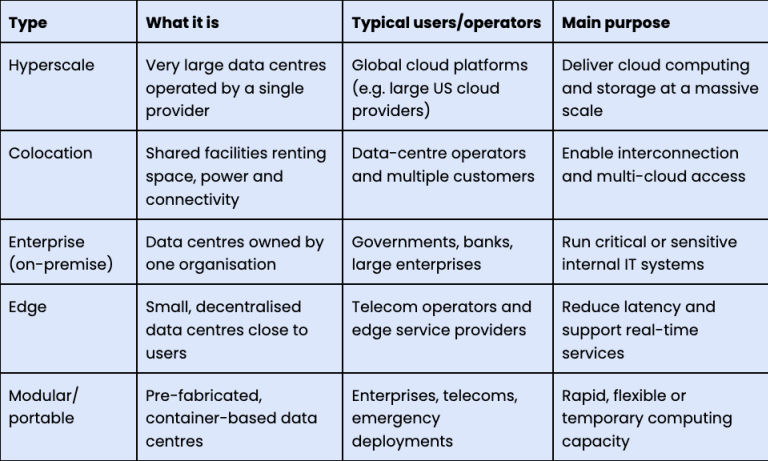
Table 1: Types of Data Centres: Characteristics, Users and Purposes
Conclusion and recommendations
Europe has the key ingredients for a solid EU tech business offer on digital connectivity, but its position across the stack is uneven. The EU’s strategic challenge is less about technological capability than about integration and scale. The competitiveness of the EU tech business offer depends on strengthening coordination across these infrastructure layers and consolidating European strengths while compensating for weaknesses.
-
Addressing the weakness of European digital infrastructure operators. Although Europe has a strong industrial base in hardware manufacturing, it has weaker financial and regulatory instruments to allow for thriving operators. The European Commission and member states should develop a more strategic approach to supporting operators in the face of growing strategic, competitive and financial pressures (6). This will require joint action, including measures to combine domestic and EU financing - both within Europe and beyond - as well as specific support to address security threats.
-
Promote European providers of cutting-edge solutions. In most sectors, some innovators can fill a competitive niche with cutting-edge technologies. The EU may not have an alternative to Starlink, but it has several companies that are leading on satellite-to-device solutions, which do not require large satellite constellations. They can play an important role in the Internet-of-Things (IoT) market and serve developmental goals, for example, by supporting agricultural production in remote regions. Early and decisive political and financial support could incentivise some of these companies to internationalise while they continue to grow at home.
-
Pull strengths from sectors beyond digital. A cross-sectoral approach, for example, on data centres, can help bring in companies from member states that don’t have strong players on digital infrastructure per se, but are leaders in engineering or energy solutions that can be transferred from traditional infrastructure projects to the digital sector.
-
Strengthen innovation ecosystems and human capacity. The EU should reinforce innovation ecosystems to build talent, research capability, and cross‑sector collaboration across connectivity industries. While satellite benefits from strong institutional backing through the European Space Agency (ESA), sectors such as subsea cables and terrestrial fibre face acute skills and human capacity gaps, and data‑centre innovation remains reliant on non‑EU platforms. Integrating connectivity sectors into industrial, digital, and skills strategies - through targeted training, funding, and research initiatives - will help Europe commercialise its strengths, reduce technological dependencies, and sustain leadership in global digital infrastructure.
-
Create legal safeguards for businesses to engage. The European Commission and member state governments need to ensure that the Tech Business Offer is not an arena for competition between member states, but rather a set of complementary solutions. It needs to provide a safe space for companies to engage across borders and to share information with competitors. This would likely require non-disclosure agreements to respect confidentiality.
Acknowledgements
The authors would like to thank Alberto Rizzi for peer reviewing. We are also grateful to those who provided us with constructive feedback. In addition, we would like to thank Annette Powell and Joyce Olders for formatting support and Isabell Wutz for communications support. We are also deeply grateful to the many people who consented to be interviewed for this work.
The views expressed in this briefing note are those of the authors and do not necessarily represent those of ECDPM or any other institution. Any errors or omissions remain the responsibility of the authors. For comments and feedback, please contact Sabine Muscat (smu@ecdpm.org), Sasha Pearson (sap@ecdpm.org) and Chloe Teevan (cte@ecdpm.org).
A full reference list is available in the PDF version of this brief.
Endnotes
1. EllaLink Cape Verde Branch (in service since 2022) is an extension between Cape Verde and Europe and was supported by an EIB loan of $25 million.
2.Mauritania extension, a Global Gateway flagship initiative, involves constructing a 500 km branch to Nouadhibou. Set to be completed in 2027, the project is co-financed by a €25 million loan from the EIB and €9.6 million from CEF Digital.
3. ECDPM explores the financing of space earth observation in an upcoming paper (NDour and Veron, 2026).
4. In June 2025, the French government became the largest shareholder of Eutelsat after injecting €717 million into the debt-ridden satellite company (as part of a €1.35 billion deal together with other investors) (France 24, 2025). Hispasat was acquired by defense and IT conglomerate Indra Group, in which the Spanish state holds a majority, at the end of 2025 (Indra, 2025). Luxembourg is a major shareholder of SES and holds a third of the voting rights (SES, 2025).
5. In February 2026, the company announced a joint 5G Standalone ecosystem with Far EasTone and OPPO integrating programmable networks, network slicing and on-device AI to enable performance-based, or ‘differentiated’, connectivity across applications and devices.
6. ECDPM recently published work exploring these dynamics in the subsea cable sector (Pearson 2026)