How can mutual interests work for development?


This note draws on last week's ECDPM-Oxfam event on the future of EU development cooperation in a contested world. Four messages emerged on how these EU interests interact with development objectives and partner-country priorities in practice.

Key messages for the future of EU development cooperation
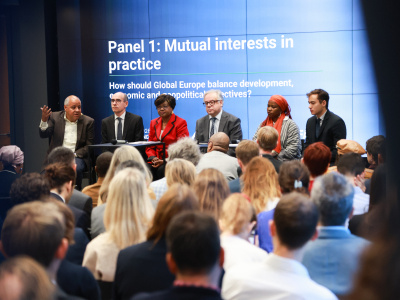
This note draws on the ECDPM-Oxfam event on The future of EU development cooperation: Navigating trade-offs in a contested world, held in Brussels on 23 September 2026 as an associated event of the Irish Presidency of the Council of the EU.
The event brought together EU and member state representatives, partner-country ambassadors, civil society, the private sector, academia, think tanks, development finance institutions and international organisations to consider what an increased focus on mutual interests means for the future of EU development cooperation.
The discussion comes as negotiations on the next EU multiannual financial framework (MFF) and the proposed Global Europe instrument are under way. Economic, geopolitical and security interests are playing a larger role in how Europe approaches international partnerships, reflected in initiatives such as Global Gateway, while development funding has faced significant cuts. The discussion focused on how these EU interests interact with development objectives and partner-country priorities in practice.
Four messages emerged.
1. Mutual interests require practical mechanisms to be credible
European and partner-country interests may often overlap, but not always. Nor are they negotiated between equal actors. The EU and its partner countries enter discussions with different levels of economic, political and financial influence, reflecting longstanding power imbalances that continue to shape global inequalities. The wider relationship also matters, including how trade, debt, taxation, migration and access to resources influence the distribution of risks, costs and benefits between partners.
The language of mutual interests therefore needs to have practical implications for how priorities are defined and by whom, how resources are allocated and how country and regional programmes are designed and implemented.
Cooperation should align with partner countries' own development strategies, ensuring they possess genuine influence over the priorities, instruments, and programmes impacting them. This means involving partner countries in shaping priorities and decisions from the outset. It also requires transparency about the interests driving European engagement and about the trade-offs where European and partner-country priorities do not fully align.
Mutual interest also raises a more basic question: why would partner countries choose Europe? Funding is one part of the European offer, but the discussion also highlighted the EU’s added value in areas such as regulatory and institutional expertise, technical knowledge, regional cooperation and the ability to bring together public and private actors. Europe’s offer also rests on the values it brings to its partnerships, including human rights, democracy, gender equality and the rule of law. A credible European offer therefore needs to respond to partner-country priorities and provide value alongside the other options available to them.
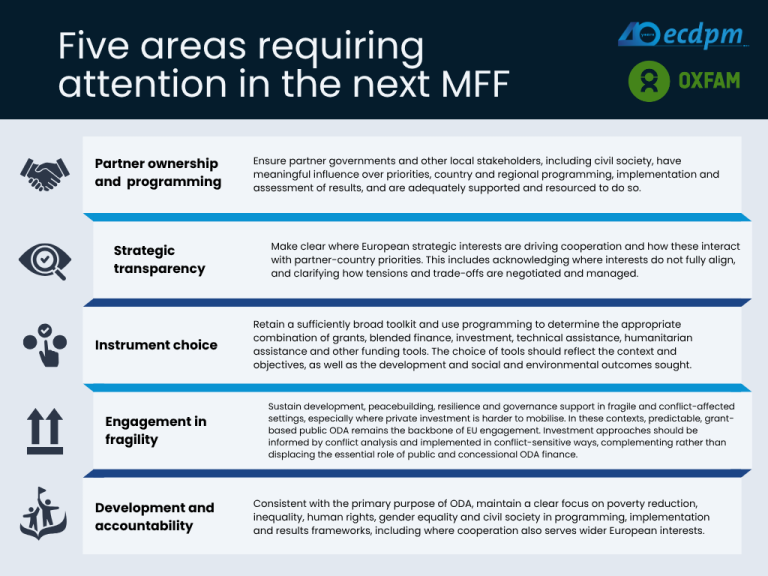
> For the next Global Europe framework, this means strengthening partner-country ownership and ensuring local stakeholders, including civil society, have a meaningful role in strategic dialogue, country and regional programming, instrument selection, implementation and assessment of results.
2. Private investment can strengthen development objectives, but cannot define them
Private investment can make an important contribution to development, including through infrastructure, productive transformation, jobs, regional integration and economic opportunity. However, the capacity to attract private capital should not determine where the EU engages or which development priorities receive support.
Many important development objectives are unlikely to be adequately addressed through an investment lens alone and will continue to require public finance and ODA. Health, education, social protection, governance, gender equality, human rights, peacebuilding and support to civil society remain essential in their own right, while also contributing to more resilient societies and longer-term economic transformation.
The same applies to blended finance: developmental additionality matters alongside the volume of private finance mobilised. Where private investment is pursued, greater attention is needed on how environmental, social, governance and human rights risks are anticipated and managed, as well as to its broader development impacts on local communities, including their meaningful participation.
> The next Global Europe framework therefore needs to retain a broad range of tools, with programming determining the appropriate combination of grants, blended finance, investment, technical assistance, humanitarian assistance and other forms of cooperation according to context, needs and objectives.
3. Addressing fragility requires a broader approach
Fragile and conflict-affected contexts bring the tensions in the emerging model into sharper focus. Development needs are often greatest where institutional, political and commercial conditions make it harder to mobilise private investment.
At the same time, fragility does not mean that economic engagement is inappropriate. The discussion on Somalia illustrated the case for combining humanitarian, development and economic approaches and adapting them as circumstances change. Peacebuilding, conflict prevention, governance, resilience and support to civil society remain important elements of sustained engagement.
The challenge is to avoid creating a gap between humanitarian assistance and private investment. In many contexts, neither approach on its own is sufficient and sustained development engagement remains necessary. In such contexts public and concessional finance remain indispensable for supporting development outcomes, resilience and providing essential services.
> The next Global Europe framework should not overlook fragile or conflict-affected contexts where commercial opportunities are more limited. Global Gateway and other investment approaches should reflect the realities of fragile and conflict-affected contexts, while recognising that in many contexts public and concessional finance remains essential for achieving development outcomes.
4. Development objectives and results need to remain a core component
A stronger focus on European strategic interests also raises questions about the extent to which poverty reduction, inequality, human rights and support for those furthest behind will continue to shape the future model of cooperation. EU development cooperation should remain rooted in solidarity and guided by values, while responding to changing realities. Development objectives and results therefore need to remain a core component of programming and assessment, including where cooperation also serves wider European strategic interests.
This raises practical questions about how partnerships are designed and assessed under a mutual-interest approach: how success is defined and measured, whose interests prevail when trade-offs arise, and whether poverty reduction, inequality, human rights and gender equality remain visible in programming and results frameworks.
The discussion highlighted the role of civil society and women’s organisations in implementation and accountability, and the contribution of gender equality to resilience, peace and security.
> The future Global Europe framework should maintain clear development objectives and reflect the EU’s values in the design and assessment of its partnerships, including through transparency, accountability, meaningful civil society engagement and gender equality.
Implications for the next MFF and Global Europe
A stronger focus on mutual interests will have practical implications for the next MFF and Global Europe instrument, from strategic priority-setting and programming, to governance, instrument choice and allocation of resources.
This note is based on our recent event