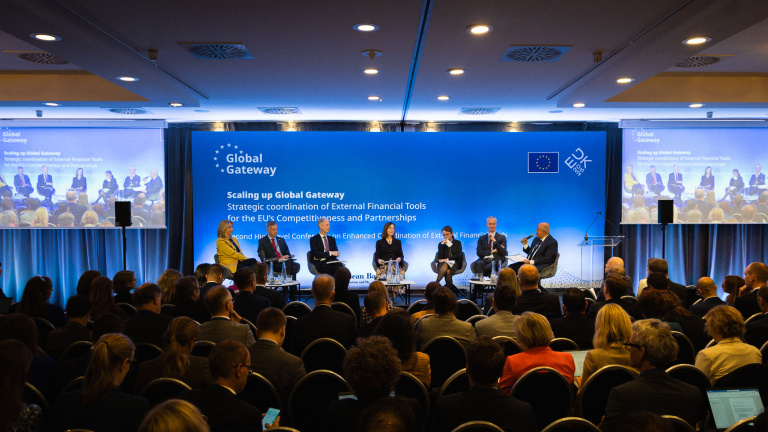
Global Gateway: A bridge between development and geostrategic interests
Authors

San Bilal examines the evolution of the EU's Global Gateway strategy and offers ten concrete recommendations.
This page is also available in French.
Summary
This brief examines the evolution of the EU's Global Gateway strategy. The strategy has shifted from an approach in which development impact was the primary objective and geopolitics a secondary consideration (Global Gateway 1.0) towards a more strategic instrument that places greater emphasis on European geostrategic and geo-economic interests (Global Gateway 2.0).
Launched in 2021, Global Gateway 1.0 prioritised sustainable infrastructure and social sectors through traditional development financing. By 2024, the initiative started prioritising the EU’s competitiveness, strategic autonomy, and supply chain security — specifically regarding critical minerals and energy — aiming to compete with rivals like China and restore a level playing field. The core challenge is aligning these EU geostrategic objectives with the developmental needs of partner countries.
The brief offers ten recommendations: clearly define the EU's specific geostrategic objectives; build coherence between geo-economic and development instruments through whole-of-government coordination; differentiate strategies between emerging-market deals and fragile/poor-country operations; improve transparency and monitoring of projects and their status; strengthen governance and parliamentary oversight at EU and national levels; expand the toolkit beyond development finance to include export credit, innovation funding, and diplomatic tools (without diverting aid budgets), while implementing the 360-degree approach; engage the private sector more broadly, covering large firms, SMEs, partner-country businesses and institutional investors; combine project-by-project and portfolio-based investment approaches; embed Global Gateway within wider national strategies; and support a Team National approach encompassing, but going beyond Global Gateway's current scope.
With Global Gateway 2.0, the focus is now on the European Union’s own geostrategic interests, which guide the Global Gateway’s development approach.
The Global Gateway evolution: from 1.0 to 2.0
The European Global Gateway initiative has evolved significantly since its launch in December 2021. Initially, with Global Gateway 1.0, the focus was on sustainable investment, centred on infrastructure (clean energy, digitalisation, transport), health, and education & research, underpinned by the European Union’s fundamental values and principles, its standards, quality and safety. The approach adopted was based primarily on development cooperation and the ability to mobilise public and private capital through development finance instruments (guarantees, blended finance, grants/technical assistance). The selection of development projects was intended to be more geopolitical in nature, but with a primary focus on development through the mobilisation of investment.
The European Union’s approach has, however, evolved significantly over the past two years, mainly following the reappointment in 2024 of Ms Ursula von der Leyen as President of the European Commission, which she has characterised as an ‘Investment Commission’. Indeed, with Global Gateway 2.0, the focus is now on the European Union’s own geostrategic interests, which guide the Global Gateway’s development approach. In particular, the Commission highlights the need to strengthen European competitiveness, resilience, strategic autonomy, economic security, critical supply chains’ diversification and security. In practice, this mainly involves the European Commission better integrating and supporting European businesses in the development and implementation of the Global Gateway. This approach, which is more focused on the EU’s own interests—and primarily its (geo)economic interests—forms part of the pursuit of mutually beneficial partnerships with the EU’s partners. It should be noted that access to critical minerals has effectively been added to the Global Gateway’s priorities, and more recently, albeit in a manner that remains somewhat vague, the agricultural sector, which is particularly prominent in Africa.
This evolution is significant, as it shapes the priorities, strategic direction and implementation of the Global Gateway. The aim is therefore to align development approaches and the instruments and actors involved in development and development financing (such as technical development agencies and development finance institutions) with the EU’s geostrategic, geo-economic and geopolitical approaches, at both EU and Member State level. The principle is to be able to compete more effectively with other countries, whether they are systemic rivals (such as China and Belt-and-Road Initiative - BRI) or other active players and therefore also competitors of the EU in the EU’s partner countries (such as the United States, Japan, South Korea, the Gulf States, Turkey, etc.). Indeed, these countries often combine their development tools very effectively with their trade and economic promotion tools, in the service of their own interests. The EU is therefore seeking, with this new approach to the Global Gateway, to restore a level playing field. Furthermore, given the geostrategic rivalries and its budgetary constraints, the EU cannot afford to indirectly subsidise its competitors, and in particular China, through support for the Global Gateway, to the detriment of its own interests and those of its businesses. This shift in the Global Gateway reflects developments within the EU, where issues of security, competitiveness, strategic autonomy, economic security and European preference in strategic public procurement are also very much at the forefront. This geostrategic shift is also reflected in the negotiations on the EU’s next long-term budget (known as the Multiannual Financial Framework (MFF) for 2028–2034), notably in the Global Europe Instrument, of course, but also in other pillars, such as the European Competitiveness Fund, as well as in support for Ukraine, for example.
The challenge is therefore to mobilise and align the development ambitions of the EU’s partners with the EU’s more geostrategic approach coherently and responsibly. The establishment of the Global Gateway Investment Hub and the ‘Team National’ – gateways for European investment projects that complement the ‘Team Europe’ – aims to stimulate the mobilisation of actors beyond the development sector, such as those involved in economic diplomacy, export credit and investment promotion agencies, private sector representatives, businesses and private financiers (including commercial banks and institutional financiers – pension funds and reinsurers). For the government, the aim is to break down silos in development cooperation, without losing sight of its principles, values and expertise, and to identify links with other foreign and strategic policy tools, in order to maximise complementarities and synergies between its objectives. In doing so, it is also necessary to clearly identify and resolve the inevitable tensions and trade-offs between these objectives. To achieve this, a ‘whole-of-government’ approach, at both national and EU levels, is desirable, in close collaboration with parliaments, the private sector and civil society. Finally, to remain an attractive proposition, the Global Gateway must respond to the development priorities and objectives of the EU’s partner countries.
Recommendations
In practice, this ambitious approach poses numerous challenges that need to be identified and addressed comprehensively. To this end, the following recommendations should be considered.
- Clearly define the geostrategic objectives pursued by the Global Gateway: Beyond identifying priority sectors, the EU and its Member States must identify the economic and geostrategic interests they intend to pursue (both collectively and individually), in which regions and countries, in which areas, and with which entities. Clearly, the EU’s economic interests cannot be reduced to simply having a European company, of whatever kind, involved in every Global Gateway project.
- Building bridges between geo-economic instruments and approaches and those dedicated to sustainable development: to ensure the coherence of the Global Gateway approach, it is necessary to combine development approaches and instruments, which focus on the impact in partner countries, with geo-economic and geostrategic approaches and instruments, designed to defend European interests and support the European private sector in Global Gateway projects. This requires, in particular, a whole-of-government approach at both national and EU levels.
- Adopting a differentiated approach depending on the contexts and objectives of Global Gateway projects: the current narrative surrounding Global Gateway suggests a one-size-fits-all approach, addressing all needs and ambitions with the same strategy. However, it is necessary to distinguish between, on the one hand, operations aimed at promoting access to emerging markets (such as with Brazil following the conclusion of the EU-Mercosur free trade agreement, or with India following the agreements concluded by the EU earlier this year), where geo-economic and geo-strategic interests take precedence; and, on the other hand, operations in the poorest or most fragile countries, where the development dimension must take precedence.
- Ensuring greater transparency and better monitoring of Global Gateway operations: to date, it is difficult to obtain a clear overview of who is doing what and where, what the projects are (only a limited number of flagship projects have been identified), what their current status is (announcement of an ambition, feasibility study, commitments, disbursement, finalisation), which entities are partners, and what the expected impacts are in terms of local development and the achievement of the geostrategic objectives of the EU and its Member States.
- Strengthen the governance of the Global Gateway strategy: the current governance system is not functioning properly; Member States, within the Council of the EU, the European Parliament and national parliaments, are not sufficiently involved (and sometimes lack sufficient operational information) to fulfil their role of strategic leadership and democratic oversight of the Global Gateway process.
- Expanding the toolkit required to implement Global Gateway: the current Global Gateway is implemented through development cooperation instruments (and institutions), including development finance. However, to effectively pursue geostrategic objectives (competitiveness, economic diplomacy and security, innovation), it is important to mobilise the instruments and institutions dedicated to this purpose, such as export credit and investment promotion agencies, research and innovation funding, and diplomatic, political and defence approaches. And to this end, the public funds mobilised must not come from official development assistance. It is also a question of better coordinating the various instruments (technical assistance, blended finance, guarantees) and putting into practice the Global Gateway’s 360-degree approach, which aims to integrate complementary support for institutional capacity building, skills development, human development and regulatory reform into Global Gateway investments. In fact, this requires greater flexibility and coordination between the various instruments and operational actors.
- Engaging the European private sector and partner countries more actively: the Global Gateway is intended as a strategy for mobilising investment, in which the private sector (businesses and financial institutions) has a key role to play. Appropriate mechanisms must therefore be put in place. The Global Gateway Investment Hub is a first step. However, it focuses too heavily on large companies and remains unclear to the wider private sector. It is necessary to promote more targeted approaches and instruments to mobilise large companies in mega-projects requiring a European approach, small and medium-sized enterprises (SMEs), which make up the vast majority of businesses in Europe, private sector actors in partner countries, possibly also with clauses promoting local content, and the financial sector, including institutional investors (pension funds, reinsurers), in both Europe and partner countries.
- Adopting a dual approach, based on both individual projects and portfolios, the Global Gateway strategy has focused on mobilising investment on a project-by-project basis, particularly through the identification of flagship projects. This approach has the advantage of being highly targeted and relevant for pursuing very specific objectives. However, to mobilise investment on a large scale, through a more systemic approach, it is necessary to adopt, in parallel, a so-called portfolio approach, combining a set of projects (‘asset class’).
- Embedding the Global Gateway within a broader national approach: the Global Gateway strategy is merely the initial development at EU level of a more geostrategic approach in a world marked by tension, where European objectives and interests must be better articulated and complementary to those of partner countries, for the benefit of all. This approach can be adopted (as is already the case in many Member States) at the national level, for initiatives going well beyond the parameters and projects of the Global Gateway. It is a matter for each Member State to define its national parameters and identify the elements that are in synergy with the Global Gateway.
- Supporting the establishment of Team National: Several EU Member States, such as Belgium, are cautiously adopting an inclusive and comprehensive approach to the establishment of a Team National, which must be supported, going beyond the current strict parameters of the Global Gateway.
Acknowledgements
The paper was written, originally in French, for the Global Gateway hearing of the Belgian House of Representatives on 2 June 2026. The views expressed in this briefing note are those of the authors and do not necessarily represent those of ECDPM or any other institution. Any errors or omissions remain the responsibility of the authors. For comments and feedback, please contact Dr San Bilal at sb@ecdpm.org.