The EU and China in Africa: Is it better to compete or work together?


In 2024-2025, ECDPM investigated the potential for EU-China cooperation on Africa's green transition. We concluded that the best course of action for Europe is to strategically assess where, when and how to work with China, rather than avoid it at all costs.
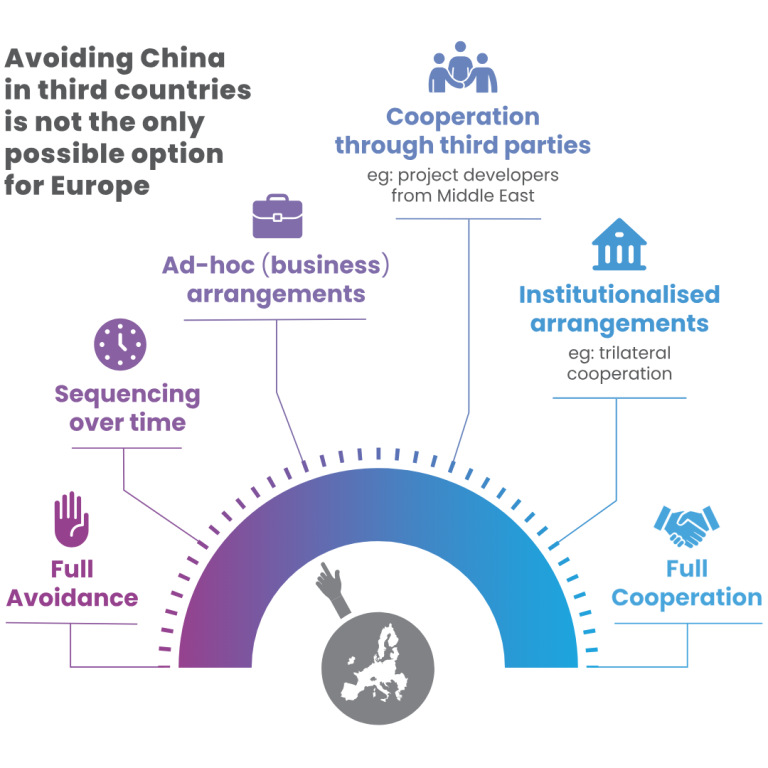
Avoidance or cooperation?
Policy choices must be nuanced. Europe’s real concerns around competitiveness, economic security and a level playing field need to be measured against partner-countries’ political stances, socioeconomic realities and market structures, where China often plays the role of a green development enabler.
This balanced approach can better serve European domestic objectives around green tech development and green industrialisation, as well as preserve the EU’s added value as a credible international player committed to a sustainable green transition in third countries.
The green transition as a competitive frontier
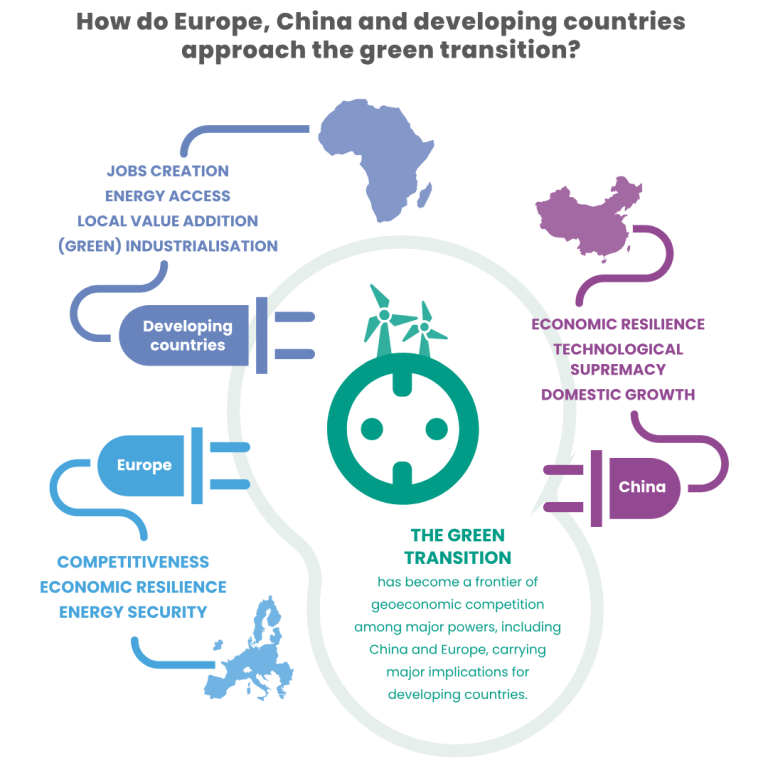
The green transition has become a frontier of geoeconomic competition. This carries major implications for countries in Africa, Asia and Latin America. They heavily rely on external financing, technology or markets to transform their societies and economies, but increasingly face situations where major powers view their relations with these countries solely through the lens of geopolitical competition with other major powers.
For Europe, climate action is deeply intertwined with ambitions around competitiveness and economic security.
For China, green industries sit at the core of its economic resilience strategy and global outreach. China also dominates green tech manufacturing and strategic supply chains, especially critical raw minerals.
Europe considers these developments as both a competitive challenge and a dependency risk.
As bilateral relations have worsened, Europe has grown to see China as a direct competitor to its interests in partner countries. Brussels sees the option of working with Chinese entities in developing countries as de facto ‘off the menu’.
For its part, China's call for alignment is unconvincing, especially given China’s own industrial policies and trade measures.
Developing countries face a different reality
Crucially, great power competition does not resonate with most countries in Africa, Asia and Latin America.
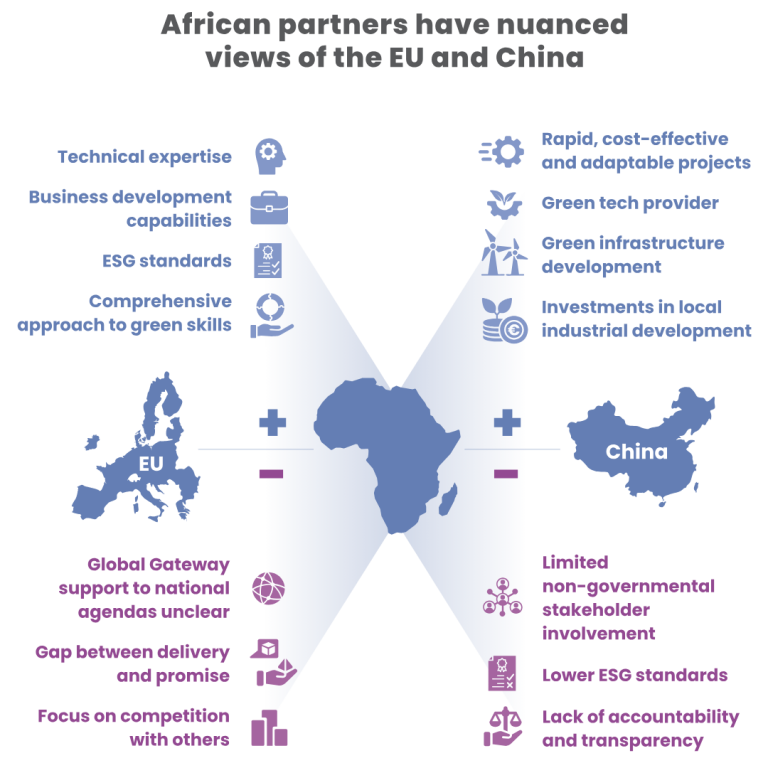
African countries prioritise their development, of which a socioeconomically viable green transition is a part. They see the green transition as an opportunity to create jobs, improve their economic performance, address economic vulnerabilities and reduce inequality within and between countries.
Diverse partnerships are also an opportunity to improve energy access, industrialise sustainably and benefit from natural resources endowments.
ECDPM's contribution


Three key questions for the EU and China in Africa
- How do African countries see the role of European and Chinese partners in the green transition?
- How should the EU engage with African countries on the green transition, given that China is an important development partner as well?
- What are the similarities and differences in the EU and Chinese approach – and is there any space to work together?
Focusing specifically on the EU, China and developing country interactions fills an important gap in research on EU-China bilateral relations or China’s global footprint.
It provides more granular bottom-up insights from African policymakers and businesses operating on the ground.
These insights can directly inform EU policy debates such as the strategic orientations and implementation of the Global Gateway, the external dimension of the EU’s Green Deal, or reimagining EU international partnerships in a multipolar and more complex world.
A specific focus is the somewhat underexplored area of green skills development in Africa – a strategic priority for job creation and local value addition as part of the green industrialisation agenda, as well as green mobility. It is also an important pillar of the ‘soft infrastructure’ development that Europe has long been, and China is, growingly, involved in.
Our findings
Together, these works paint a layered picture of what added value the EU and China bring to African countries’ development. It also questions the extent to which geostrategic considerations drive actual engagements.
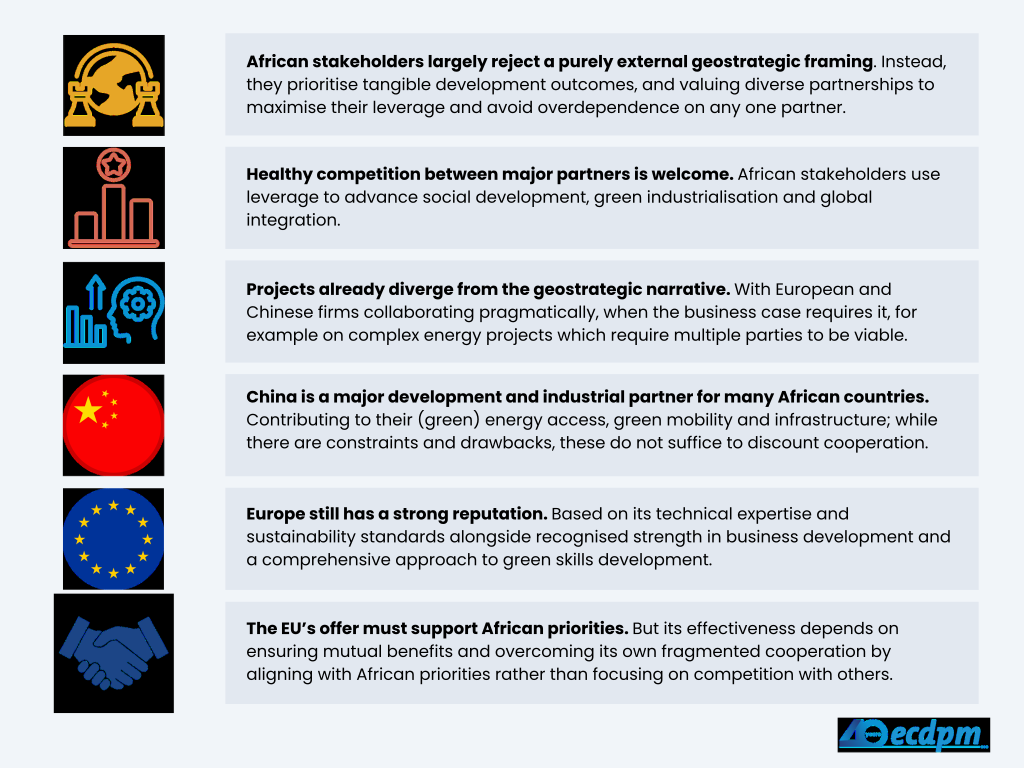
While the EU's concerns about over-dependence on China are justified, diversification does not have to mean disengagement. Many of the partner countries, which the EU envisions as key for its own diversification and economic security strategy, consider China as an indispensable partner for their own, and the global green transition. They often have strong trade and investment relations with China. Thus the EU needs a credible strategy to work with China in those third countries in order to manage, rather than deny, interdependence on China.
Ultimately, a selective and strategic engagement with Chinese entities is the best option for Europe. Further reflection should go into identifying technologies and market niches in which European companies could be competitive or complementary to China’s, and what public policies should enable that.
Moving towards a more effective approach
While research in this project points to the fact that the ‘default (China) avoidance’ strategy is not realistic, future research could outline what a selective and strategic EU approach to Chinese entities in third countries could look like.
Future research may also investigate how African countries navigate geostrategic competition and/or the EU’s de-risking and open strategic autonomy measures and foster complementarity between the EU and China. Questions may include:
When, where and how should the EU preserve or build pragmatic cooperation with China in the Global South, without undermining its competitiveness and economic security agenda?
How do the EU’s economic security and de-risking measures interact with Global South green transition pathways – affecting financing and green tech choices and industrial strategies, given their current reliance on China?
In which areas does Europe need Chinese clean-tech to make the green transition viable in partner countries, and where can Europe have/build a competitive offer?
How can African countries effectively shape major initiatives such as the Global Gateway, the Lobito Corridor or green value chains to secure their long term development?
Failing to address these questions risks leading to misaligned policies and missed opportunities for greater green cooperation between the EU and its partners in third countries. Continued research will remain vital to remain ahead of the curve in a fast-moving political landscape and avoid the EU and its partners being in a reactive mode. This requires strategic thinking about how to design impactful investments aligned with their respective priorities and the principles of a mutually beneficial partnership.