The African Union’s quiet transformation in a turbulent world
Authors

Ueli Staeger returns from Addis Ababa with a sense of the AU’s uneven transformation, arguing that the AU’s contradictions are central to understanding African multilateralism today.
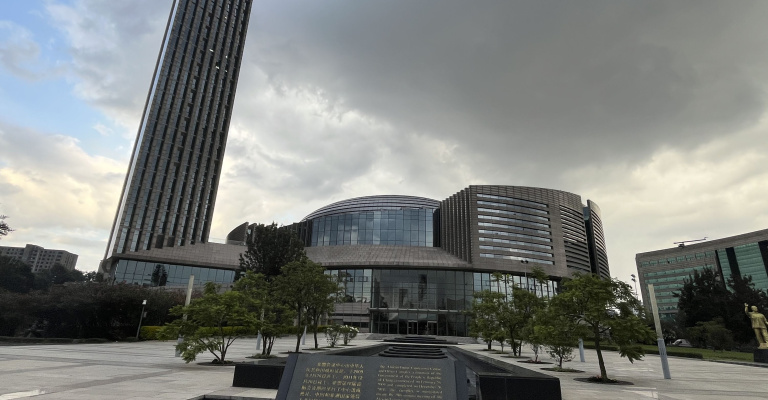
Ten years after my first research trip to the African Union (AU) headquarters, I recently returned from Addis Ababa with my notebook, mind and heart full. The AU I encountered this year is no longer the AU I first studied in 2016. Its diplomatic reflexes are quicker. Its agenda is more global. Its officials are more professional and motivated by a pragmatic Pan-Africanism. Yet the deeper institutional story remains uneven. The AU changes too fast and too slowly alike. Africa Day offers an opportunity to zoom out and assess these contradictions.
This unevenness is central to the AU’s institutional life. The organisation absorbs severe criticism, improvises amid resource scarcity, and maintains fragile unity when member states diverge. And somehow, it still produces more institutional change than its critics usually acknowledge. Its evolution is therefore best understood as progress under constraint: real diplomatic, technical and procedural change taking place inside a political system that remains deeply shaped by sovereignty, uneven political will and external financial dependence.
Failing to deliver full implementation, yet changing fast below the radar
This tension is easy to miss when the AU is assessed only through its failures. There are many, granted. Decisions are implemented slowly, if at all. Upon leaving his function, the former AU Commission chairperson famously chastised member states for failing to implement 93% of their decisions at the Assembly level. Member states regularly protect national room for manoeuvre over continental coherence. Security crises in Sudan, the Sahel, eastern DRC and the Horn of Africa expose the limits of African-led crisis diplomacy. External actors now shape many African crises from inside the conflict landscape, including Gulf states, Russia, Turkey, Europe, China and the US.
Frustratingly for many, African states have not been able to bolster their regional resilience in the face of global energy, food, and fertiliser crises since Russia’s invasion of Ukraine. As such, the AU’s crisis diplomacy on the US-Israel war with Iran shows how difficult continental positioning becomes when African states are divided across trade, security, sovereignty, and international law. The AU Commission’s high-level engagements with the UAE and Saudi Arabia in 2026 also show the growing complexity of Gulf-AU diplomacy. While growing intra-Gulf rivalry in Africa has decreased since the 2026 Iran war, the AU has struggled to deal with fragmented diplomatic engagement from the Gulf.
Yet a deficit-driven analysis misses the institutional work that happens in the background at the AU. Drafting common African positions, coalition-building, norm entrepreneurship, budget reform, technical coordination, diplomatic signalling, and the maintenance of continental arenas in a period of global fragmentation. The AU often appears slow because it carries the contradictions of fifty-five member states. It also moves faster than many observers notice because much of its change occurs through procedure, routine, staffing, and expectation rather than dramatic summit breakthroughs.
Speaking globally
The first striking change at the AU is that speaking to global issues has become normalised. While the AU’s first statements on non-African crises in the wake of Russia’s invasion of Ukraine in 2022 stirred confusion in many capitals, the AU Commission leadership now issues statements on international crises within hours. Beyond this, AU experts help shape UN processes, including on tax cooperation and reparatory justice. African climate diplomacy increasingly sets red lines in global negotiations. EU environmental trade measures, including CBAM and the EUDR, are now openly criticised in African and AU-EU settings as policies with potentially unequal developmental effects. The AU increasingly treats global governance as a site of African agency.
This does not mean the AU acts, or even speaks, with one voice. It rarely does. Its members remain divided on Russia, Israel/Palestine, the Gulf, China, Europe and the US. External actors also actively fan the flames of continental fragmentation. But the expectation has changed: AU silence now requires explanation. The AU Commission is pushed to react, frame, condemn, convene and insert African positions into global debates. This is institutional change, even when it falls short of geopolitical unity.
Slow but steady institutionalisation
A decade ago, there were no peace fund disbursements enabled by member states, no AU membership in the G20, and no African Continental Free Trade Area. Today, each exists. The AU Peace Fund has begun disbursing resources through its Crisis Reserve Facility. The AU became a permanent member of the G20 in September 2023. The AfCFTA has created a continental economic project with institutional weight and substantive adjacent trade facilitation spending, despite slow implementation and uneven national readiness.
These achievements deserve recognition without romance. The Peace Fund does not solve the AU’s dependence on external financing. G20 membership does not automatically produce African influence. The AfCFTA does not remove infrastructure gaps, productive asymmetries, or regulatory fragmentation. But African continental institutions rarely change through clean breakthroughs. They institutionalise slowly, through legal instruments, growing budget lines, technical committees, increased staffing, and repeated meetings that appear modest until they reshape expectations durably.
Pan-African bureaucrats
The third change is the professionalisation of AU diplomacy. Compared to 2016, AU Commission staff and member-state diplomats are more technically capable and more strategic in using Addis Ababa as a diplomatic arena. Within the AU Commission, a long-delayed Skills Audit and Competency Assessment (SACA) is reportedly close to being implemented, opening the prospect of hiring desperately needed new permanent officials.
Across African diplomatic missions, an energetic yet pragmatic Pan-Africanism is visible. It is less declaratory than older summit rhetoric and more oriented toward access, drafting, coalition management, and institutional permanency. Some African states now maintain impressively large AU teams. Others still cover multiple countries, regional organisations, and bilateral files from small Addis representations. Capacity remains uneven, but the diplomatic field has thickened.
The inevitability of Gulf geopolitics
The fourth change at the AU is the role of Gulf states. Ten years ago, Gulf influence was present in African diplomacy, but invisible in AU institutional life. Today, it shapes visibly and vociferously.
Saudi Arabia, the UAE, Qatar, and others are no longer peripheral actors in African multilateral politics. For example, the AU Commission and the UAE held a high-level meeting in Addis Ababa in January 2026, while the AUC chairperson received Saudi Arabia’s Vice Minister of Foreign Affairs in February 2026 to discuss cooperation, peace, security, sustainable development, and the Saudi-Africa Summit process. Qatar’s mediation between the DRC and M23 further illustrates how Gulf actors now operate inside African crisis diplomacy – a role that puts the AU’s political primacy in finding ‘African solutions to African problems’ in question and forces it on a quest for geopolitical complementarity with external ‘power mediators’.
The AU’s uneven change is no longer only an African institutional story. It is part of the reordering of global politics.
The geopolitical implications of slow change at the AU
The AU’s uneven change is no longer only an African institutional story. It is part of the reordering of global politics. China, the US, Europe, Russia, Turkey, and the Gulf all treat Africa as a geopolitical arena, though through different instruments. Africa and the AU are still not a geopolitical stake of the first order for the aforementioned countries, yet noone would dare deprioritise the continent today.
Arguably, this changes the ‘so what’ of AU politics and problems. The question is no longer only whether the AU can implement its own decisions. It is whether the AU can hone its mission of acting as a meaningful continental arena when African states seek infrastructure, finance, arms and public goods. The 2026 Iran war made this particularly visible. It exposed African vulnerabilities around energy, maritime routes, food security, international law, sovereignty and diplomatic alignment. It also showed that Africa’s Middle East politics can no longer be treated as external to African multilateralism. The Gulf, the Red Sea, the Horn of Africa, Sudan, Palestine, Iran, and global energy politics now sit firmly inside the AU’s diplomatic environment.
Faster AU statements, more professional diplomacy, better technical coordination, and more visible Gulf engagement are signs of an African multilateral institution trying to act in a world where Africa is no longer peripheral, yet not automatically powerful. The AU’s challenge is to convert its current global visibility and geopolitical potential into actual leverage over global agendas.
The AU is too often analysed through its deficits, and too rarely through the difficult institutional work it performs in a difficult context. The AU remains slow on implementation, enforcement, financing autonomy and effective crisis response. But it has become fast in diplomatic signalling, discursive global agenda-setting and reinventing its diplomacy in a turbulent world.
With the AU changing at multiple speeds, contradictions cannot be grounds for disengagement. The same can be seen in AU-EU relations, where summitry continues even as the relationship faces a quiet crisis of relevance. Only strategic patience with the AU will pay off for citizens, states, and global actors alike.
The views are those of the author and not necessarily those of ECDPM.