Global Europe and the politics of cutting aid
Authors


The EU claims to want a more substantial and geopolitical foreign policy, but in negotiations on the MFF, its next seven-year budget, the instrument that pays for that policy is losing ground to farming, cohesion and defence.
Polls that show support from citizens and business leaders for development cooperation, yet governments cut it anyway. Our latest podcast asks why, and what needs to change to defend Global Europe.
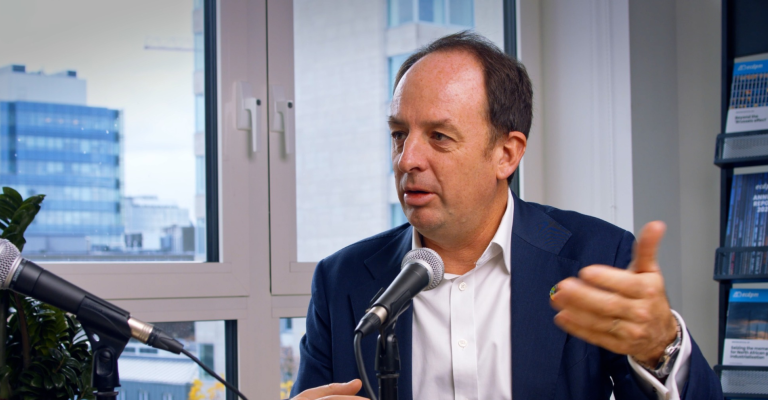
In this episode of Europolis: the global Europe podcast, host Jonathan Hunter is joined by Alexei Jones. Alexei interviews Jean Van Wetter, CEO of Enabel, Belgium's agency for international cooperation, and Barry Andrews MEP, Chair of the European Parliament's Committee on Development. They discuss what the next Multiannual Financial Framework means for development cooperation, and who is prepared to defend it.
There will be no tractors out on the streets of Brussels to defend the Global Europe instrument.
Listen on Apple Podcasts, Spotify and more | Watch on YouTube
Key discussion highlights
Support doesn't mean votes
Alexei cites a survey of 536 business leaders across the 27 member states: 81% say Europe's economic resilience depends on strong ties with developing economies, and 76% want the next seven-year budget to keep or raise the development cooperation allocation. Citizens' polls show similar support. However, both guests say this support carries no electoral weight. Van Wetter recalls that twenty years ago, cuts would have brought people onto the streets. Andrews says member states have cut deeply with no political consequences.
Nobody owns Global Europe
Andrews says no group of member states will spend political capital on the instrument. Farmers and cohesion regions will mobilise to defend their budget lines, and Global Europe has no equivalent constituency. In his view, the Irish Presidency's negotiating box cut the instrument while presenting the figure as an increase, because it ignored inflation and economic growth.
Trade-offs need naming
Alexei argues that presenting development and geopolitics as mutually reinforcing is too rosy. If the EU concentrates on partners that serve its strategic interests, fragile and less strategic countries may lose out. In his view, those trade-offs should be acknowledged openly and decided through transparent mechanisms, with clarity on who makes the call.
Who could defend Global Europe?
| Constituency | In the episode |
| Member states | They write the cheques and send leaders to the European Council. Andrews says the arguments land in Parliament but gain little traction with national governments. |
| Business | The survey shows support. Van Wetter's points to critical raw materials and Africa as Europe's next market. |
| Citizens | They support aid in polls, but do not punish governments who cut it. It will be important to reach audiences beyond the sector in order to rebuild a political constituency. |
| Defence and security | Andrews argues that Europe's future security will be decided in the places where it is cutting aid and pulling back diplomatically. |
| Faith-based organisations | Andrews sees common ground on poverty, migration and climate justice. He says the Commission has been reluctant, citing secularism. |
What it means for Europe
The Commission proposed €200.3 billion for Global Europe for 2028 to 2034, and the final figure will be settled soon. Alexei argues that Europe's security, competitiveness and access to energy and trade all depend on relationships with partners built over the long term. Budget negotiations reward short-term interests, which is where the tension lies. Both guests and Alexei come to the same conclusion: the case for Global Europe has to reach beyond the people already convinced. That means member state governments, business, the security community and the public.
About the speakers
Host: Jonathan Hunter, Communications Expert at ECDPM.
Co-host: Alexei Jones, Senior Policy Analyst at ECDPM.
Guest: Jean Van Wetter, CEO of Enabel.
Guest: Barry Andrews, Member of the European Parliament (Renew Europe, Ireland) and Chair of the Committee on Development.
About the podcast series
Faced with geopolitical and economic turbulence, Europe needs new and better partners to secure its prosperity. Europolis: the global Europe podcast looks at how new dynamics are reshaping relations between the EU and the wider world and how Europe might navigate this new terrain.
Join us as we break down EU policy through insightful conversations with leading policymakers, industry leaders and experts. Discover how the EU could drive innovation, competitiveness and progress in the global arena, and understand how policymakers are thinking about shaping our sovereign future.