What the Russia-Africa summit reveals about Africa+1 diplomacy
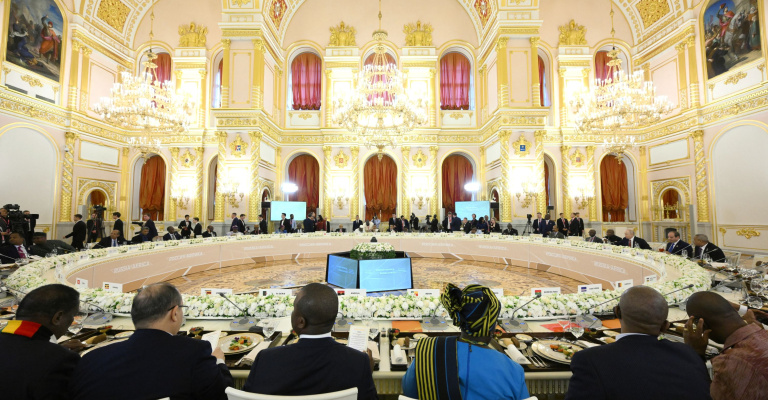

On 28 and 29 October, Moscow welcomed 48 African delegations, of which 22 were led by a head of state. This summit follows the Africa Forward summit by France in May 2026, Italy's Africa summit in February and the 7th AU-EU summit in November 2025. Like other hosts, Russia presented itself as the partner Africa needs to achieve a prosperous future. But what does its narrative reveal about Russia’s geopolitical aims in its engagement with the African continent? And what does this latest round of summit diplomacy tell us about the gap between the rhetoric and the practice of these summits?
What does Russia want, and what does it offer?
More than four years into its invasion of Ukraine, Russia wants to prove it is not isolated. With sanctions still in place, it wants markets, access to raw materials, security footholds and payment channels beyond Western finance. Putin cites military agreements with 45 African countries, and says up to 85% of settlements are in roubles. On the sidelines, the summit was also an opportunity to discuss a stop to Russian recruitment of manpower for its war in Ukraine. It is estimated that more than 3,000 Africans have been recruited into its forces since 2022, often through the false promise of non-military roles.
Moscow offers grain and fertiliser, energy, local production of medicines and vaccines, AI cooperation, support for African seats on the UN Security Council and is a key security partner for governing regimes through its Africa Corps (successor to the Wagner Group) in Mali, Niger, Burkina Faso, Libya, Equatorial Guinea, and Togo, and through Wagner itself in the Central African Republic.
On Russia’s narrative
Russia sells itself as the better alternative without any colonial past, working towards a multipolar, post-Western order. In Putin’s speech at the summit’s Russia-Africa Economic and Humanitarian Forum, he promised delegates that Russian business does “not practice predatory neo-colonial exploitation of natural and human resources”. By claiming the old history of Soviet support to African liberation movements, Putin contrasts Russian cooperation against a selfish colonial or neo-colonial ‘West’.
Beyond establishing Russia’s image against the West, the Russia-Africa summit focused on trade and investment, with a new plan for 2027-2029 to advance through “mutually beneficial ties”. A final declaration and a declaration on artificial intelligence were among the 33 documents signed. The African side pushed its own priority: the AU chair, Burundi’s President Évariste Ndayishimiye, pressed for Russian investment in local manufacturing instead of raw-material exports.
Given Russia’s previous pledges, some scepticism about the new action plan is in order. The last summit in 2023 yielded 161 agreements, and a 2023-2026 action plan on top of the 92 agreed during the previous summit. Yet economic results have not matched Moscow’s promises. As that action plan reaches the end of its final year, Russia’s own trade statistics paint a rather weak story. Trade with Africa reached just $27.1 billion in 2025 against Putin’s $40 billion target set in 2019. Russia still accounts for less than 1% of foreign direct investment on the continent.
The summit offers a chance to spread its geopolitical narrative – another front in its military campaign against chosen enemies in Europe.
Russian trade with Africa is a small fraction of that of its rivals. The offer is political rather than economic. The summit offers a chance to spread its geopolitical narrative – another front in its military campaign against chosen enemies in Europe: promoting trade while casting similar European attempts as illegitimate and dangerous. The Russian offer is framed not as a simple alternative but as a “natural” ally.
Same script, different hosts?
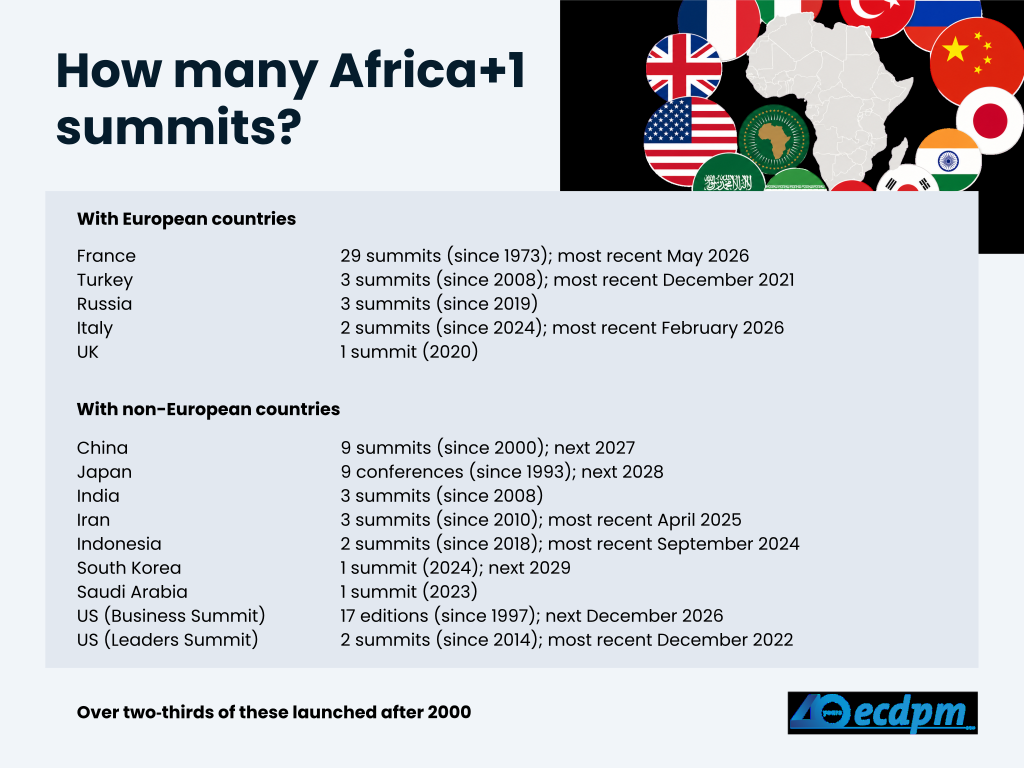
The Russia-Africa summit is only the latest of high-level gatherings between a single country – or bloc of countries – plus the continent of Africa, with each following a familiar script: a partnership of equals, investment over traditional development aid, working together on the international stage, and respect for African sovereignty. Similar phrasing masks different approaches, but always the idea that their approach is better than the one of the others, be it the EU, China or the US, often by framing rivals in familiar stereotypes: slow deliverers, anti-democratic and condescending respectively.
Earlier this year, Italy’s Meloni called its Mattei Plan for Africa “far from any predatory temptation and from a paternalistic approach”. Her rhetoric is interesting. Whereas Meloni blames “Europe and the West” for past “distorted” relations, Italy appears only as the author of a new page, without mentioning its own colonial history in Africa. While she omitted her country, and Putin put his nation on a liberation pedestal, French President Macron took a different path at the May Africa Forward Summit. He rebuked France and its companies for treating Africa as “their backyard”, rejecting the past rhetoric of “we are French, everything is open to us”. However, he presented this point less in relation to a source of harm and more to a lost market share, saying that other countries “have won market share and countries that have developed have given this market share to people who were more competitive than us.”
For African governments, summits offer access, bilateral deals and leverage over other partners. “Diversified non-alignment” offers opportunities and leverage to get the best deal for their countries and continent. Afrobarometer’s 2026 report found that citizens across 38 countries support this approach and do not “see these relationships as a zero-sum contest”. No matter how well a narrative tries to position the host nation as the best choice, they support maintaining relations with different actors depending on how well those actors serve national interests.
The EU should promote itself as a partner who listens
As many before it, the Russia-Africa summit serves multiple purposes and indicates a potential direction rather than a decisive geopolitical conclusion. The real test comes after delegations go home and the speeches end. On that, every host’s record is patchy: Russia’s missed economic targets, the Mattei Plan’s limited involvement of African stakeholders and France’s failure to shift anti-French sentiment and distance itself from a perceived attitude of neocolonialism. And where does this leave the EU?
Russia still ranks lowest among the major powers at 36%, compared with 50% for the EU, behind the US (53%) and China (62%).
After a ‘quiet’ AU-EU summit last year in Luanda – which showed that politics have moved away from the institutionalised AU-EU approach and African states need the EU less, both in substance and symbolism – Moscow's rhetoric in Africa is a growing threat to Brussels. Mainly in the Sahel, where European relations have collapsed: in Mali, 88% of citizens rate Russia’s influence as positive. Russia still ranks lowest among the major powers at 36%, compared with 50% for the EU, behind the US (53%) and China (62%). For now, the EU might still be ahead of Russia, but it is not guaranteed: where the EU fails to deliver, Moscow is ready to fill the gap.
The EU should be careful in replying with more summitry; instead, it should tangibly and transparently deliver on past promises, while proactively and systematically working on rebuilding favourable public opinion by promoting positive narratives, sharing successes that align with Africa’s aspirations for security and prosperity. It should also focus on improving what it is already offering: trade between the EU and Africa is at about €356 billion in goods, far beyond Russia’s number. And most importantly, it should respond to what Africa says it needs: investment, industrialisation, finance and above all a partner that is willing to listen.
The views are those of the author and not necessarily those of ECDPM.
The author would like to thank Jonathan Hunter, Virginia Mucchi and Andrew Sherriff for their editing and review.