‘Mother of all deals’: The path forward for EU-India relations


The announcement of the EU-India deal signals a new era of cooperation between intermediate powers. But Gautam Kamath, San Bilal and Chloe Teevan argue that for this partnership to be truly meaningful, it must move swiftly from political signalling to effective implementation.
Earlier this week, one day after India’s 77th Republic Day, the ‘mother of all deals’ was announced. Not just another free trade agreement, it marks a long-awaited geopolitical shift: the beginning of a ‘new order’ of intermediate powers that Canadian prime minister Mark Carney evoked at the World Economic Forum. The EU-India deal brings together perhaps the world’s foremost intermediate power, India, and the EU, a bloc of intermediate powers, in a spirit of mutual respect and cooperation.
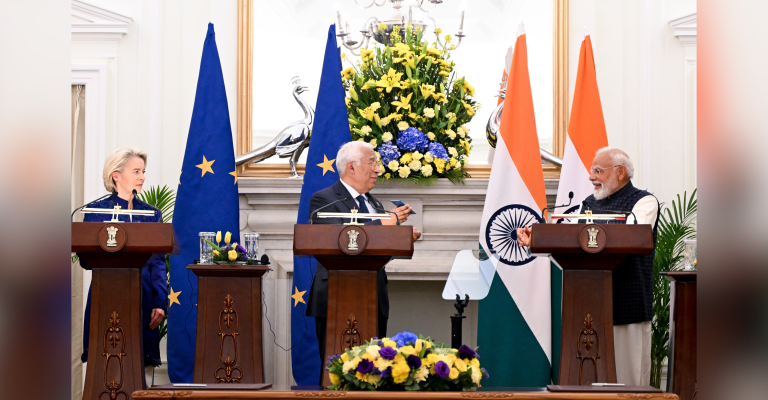
European Commission president Ursula von der Leyen’s speech invoked ‘Makar Sankranti’ at Hyderabad House, a festival celebrating the sun's movement from south to north, or in her words: “a transition from darkness to light”. During his address, European Council president Antonio Costa pulled out his 'Overseas Citizen of India' card, proudly recalling his Goan heritage. Not to be outdone, Prime Minister Narendra Modi noted that Costa was affectionately known as the ‘Gandhi of Lisbon’ due to his track record of public service.
Today’s ‘new order’ should be based not on colonial wars, but on cooperation
This comes at a time when US president Donald Trump is tearing up global trade principles and using tariffs as a coercive instrument of power. This deal represents an attempt to secure stable trade relations between two major economies that share an interest in upholding strong international cooperation. But it also paves the way to a much stronger relationship in a range of other domains.
A partnership rooted in history and autonomy
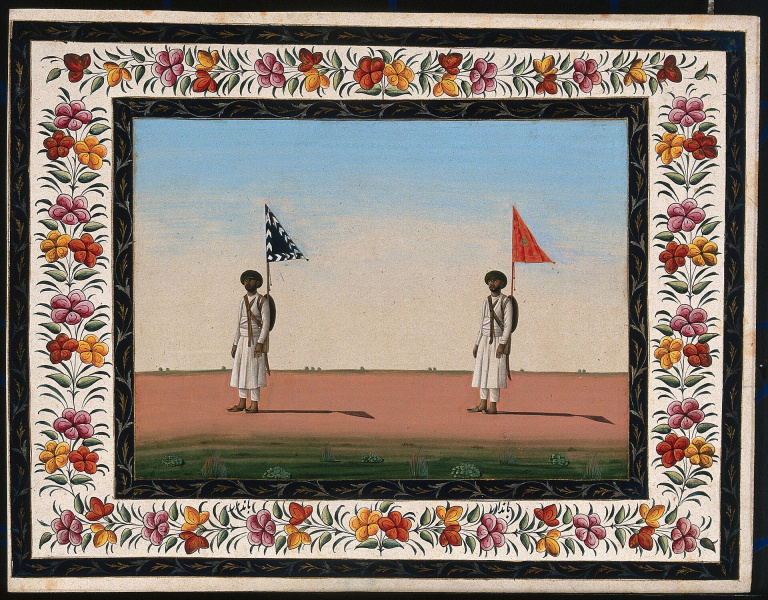
In 1780, during the Battle of Pollilur, Hyder Ali and Tipu Sultan used advanced iron-cased Mysorean rockets to devastate British East India Company forces. This “rockets’ red glare” was based on Indian metallurgy and military innovation, and was later reverse-engineered to create the Congreve rocket, which led to victory in the Napoleonic Wars and set the stage for a new world order at the Congress of Vienna. It was this historic exchange of military technology between India and Europe that led to the evolution of modern rocketry and formed the deterrent basis of Pax Britannica.
Today’s ‘new order’ should be based not on colonial wars, but on cooperation, and such defence technology and industrial cooperation was announced as part of the EU-India summit. By aligning India’s ‘Aatmanirbhar Bharat’ (self-reliance) vision with the EU’s pursuit of strategic autonomy and the Readiness 2030 initiative, both sides aim to integrate supply chains and co-develop future-ready military technologies, thus creating strategic interdependencies. Examples include a new industry-led EU-India Defence Industry Forum and potential Indian participation in the EU’s €150 billion SAFE programme.
The agreement also prioritises maritime security in the Indo-Pacific, underscored by the positioning of an EU liaison officer at India’s Information Fusion Centre . Beyond traditional hardware, this also intensifies joint efforts in cyber-defence, space security, counter-terrorism and artificial intelligence, showcasing the broad nature of the agreement.
The true success of the EU-India partnership lies in its ability to manage these differences through institutionalised, continuous and honest dialogue at all levels.
The human element is perhaps the most vital enabler of this deal. By streamlining visas for students, researchers and tech talent, and launching a pilot European Legal Gateway Office, the agreement aims to bridge the skills gap that often hinders deep technological integration. Establishing permanent secretariats for annual ministerial reviews ensures that the momentum generated at the summit is not lost to bureaucracy. In the strategically vital digital sector, the two intermediate powers want to move toward trusted telecommunications and infrastructural networks and vendors, as they seek to de-risk and reduce dependencies on tech superpowers like the US and China.
This includes the joint development of semiconductors, high-performance computing, 6G standards development and trustworthy digital and ICT supply chains ensuring resilience against external shocks. The Indian ‘techno-legal’ approach resonates with digital sovereignty proponents in Europe, and with a focus on building open source alternatives and sovereign technology stacks, joint cooperation under the Trade and Technology Council (TTC) format could be crucial.
Listen to our podcast on how lessons from the India Stack could revolutionise EU tech policyThe partnership is equally focused on ‘green’ technologies and ‘frontier’ research. The agreement, accompanied by half a billion euros in support, aims to enhance cooperation, including in the energy-intensive steel sector by decarbonising and navigating the complexities of the EU’s Carbon Border Adjustment Mechanism (CBAM) . This funding is intended to drive joint investments in green hydrogen and sustainable mobility, making the green transition a shared success rather than a source of trade friction. There is also focus on private sector development, with discussions on India gaining access to programmes like Horizon Europe, the world’s largest research & innovation fund, and to work on joint breakthroughs in areas like biotechnology and space exploration.
Partnering with ‘honest multi-alignment’
For this partnership to be truly meaningful, it must move swiftly from political signalling to effective implementation. The EU’s Global Gateway strategy, which aims to boost strategic investment by mobilising Europe’s private sector with support from the European Investment Bank and national financial and export institutions, serves as the flagship vehicle here.
Harnessing both private and public forces will be especially critical. The India Middle East Corridor, announced with the Biden Administration, becomes even more geopolitically important in what Amitav Acharya has called the ‘world-minus-one moment’.
Further, the relationship needs strong transport and communications links, paired with meaningful sectoral partnerships across multiple industries. To become a more meaningful platform where Indian and European businesses, think tanks and other partners develop projects together, the EU-India Trade and Technology Council will need to evolve from a technical government-to-government forum. Public and private banks, venture capitalists and export credit agencies will also be needed to uncover opportunities of this strategic partnership.
The EU and India are not just reacting to the world's troubles, but also building the ‘intermediate-powers architecture’ for survival.
However, as both parties navigate this new chapter, each side knows that a stronger relationship does not mean total alignment. The EU and India are redefining their cooperation with key strategic partners in a more uncertain world, but they do so as autonomous actors with distinct interests. While they share a commitment to the rules-based international order and stable trade, they may still diverge on specific geopolitical priorities or regulatory approaches.
The true success of the EU-India partnership lies in its ability to manage these differences through institutionalised, continuous and honest dialogue at all levels – between governments and between citizens and firms – that uncovers mutual interests. It represents a pragmatic recognition that in a portentous world of ‘variable geometry” or ‘multi-alignment’, the most effective way to protect one's autonomy is to build deep links with reliable partners who share a common vision for a rules-based, democratic world order.
This is what Mark Carney meant when he said that “diversification internationally is not just economic prudence, it's a material foundation for honest foreign policy, because countries earn the right to principled stands by reducing their vulnerability to retaliation”. By basing their relationship on mutual respect and moving to joint production and shared innovation, the EU and India are not just reacting to the world's troubles, but also building the ‘intermediate-powers architecture’ for survival.
The epoch-making gravity of this partnership means policymakers on both sides should move towards signing the FTA with haste and pray for its success, perhaps by reflecting on the portion of the Mundaka Upanishad, from which India also borrows its national motto, ‘Satyameva Jayate’. In an inadequate translation of Sanskrit, it reads:
“Truth alone triumphs; not falsehoods.
Through truth the divine path is spread out, by which the sages whose desires have been completely fulfilled, reach to that supreme treasure of Truth.”
The views are those of the authors and not necessarily those of ECDPM.