The EU needs to make its security more feminist
Authors


As the EU redefines its role as a security actor, the question is not only how much it invests in defence, but what kind of security it seeks to build. In the aftermath of the 5th Ministerial Conference on Feminist Foreign Policy (FFP) and ahead of the launch of the new European security strategy, we ask what the EU can learn from the feminist foreign policy debate, and whether it can protect and deepen its existing achievements — from Gender Action Plan (GAP) III to the Women, Peace, Security (WPS) agenda — while redefining its role as a security actor.
Going beyond the feminist branding
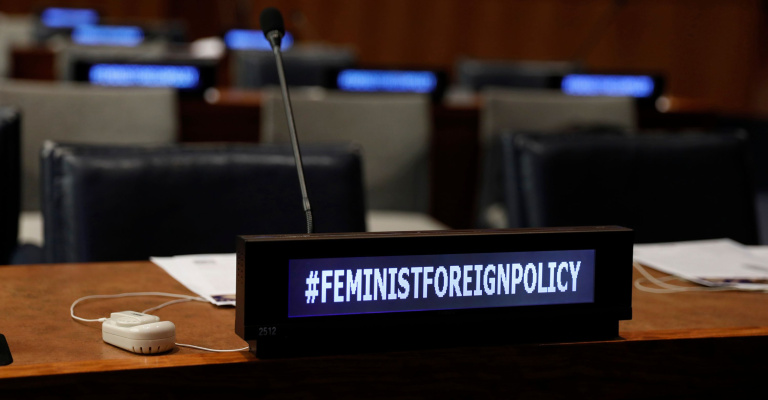
On the 2nd and 3rd of June, the 5th Ministerial Conference on Feminist Foreign Policy took place in Spain, gathering international actors at a moment when anti-rights and anti-gender movements are rising globally. These ministerial FFP conferences have gradually become a high-level diplomatic forum, marked by increased participation from governments and important political commitments.
The 5th edition ended with the adoption of a political declaration. Slightly fewer states than last year endorsed it (27 states, including 9 EU member states, compared to 31 last year), but this declaration is broader and more operational. It moves from a reaffirmation of shared FFP principles to a broader agenda linking FFP with peace, democracy, civic space, accountability, financing, digital governance and care systems.
The principles of feminist foreign policy remain highly relevant today, but promoting a FFP is no guarantee of transformative change on the ground – especially at a time when global politics is increasingly shaped by conflicts, rising authoritarianism, economic insecurity and attacks on rights.
Without adequate resources and sustained accountability, there is a real risk that this framework (and FFP conferences) remains largely symbolic.
The odds are stacked against FFP
The debate on FFP faces severe challenges, both politically and budget-wise. Foreign policy remains largely a national competence of EU member states, and only a few of them – namely France and Spain – have formally adopted a FFP (Sweden and the Netherlands rolled back theirs, and only Germany has an explicitly feminist development policy). At the EU level, gender equality also appears to be losing political weight, as external action is increasingly framed around security, competitiveness, migration, energy and strategic partnerships. This makes the adoption of an EU-wide FFP highly unlikely in the short term.
This does not mean that the EU has no room to act. Rather than aiming for an EU-wide FFP, the Union could deepen its current support to gender equality and women peace and security, as its external action is already being redefined, particularly with regard to security, defence and peace. The upcoming European security strategy is a critical moment to do so.
The European security strategy will enter an already crowded landscape of EU doctrines, roadmaps and strategies. Its added value will not depend on introducing another set of concepts, but rather on providing strategic clarity and coherence. A credible strategy will go beyond military capabilities or defence readiness to include human security, democratic resilience, social cohesion and economic security. This would not require the EU to formally label its security strategy as feminist. But it would require the Union to take seriously some of the core principles associated with feminist foreign policy.
The EU needs a shared understanding and commitment…
While the EU has never formally endorsed a FFP, it has long presented itself as a key actor on gender equality. Frameworks like the EU Gender Action Plans, and specific targets to promote gender equality and support to the WPS agenda in its international cooperation instruments have guided the EU’s engagement on gender equality in its external actions.
Where and how a feminist approach to security and foreign policy would fit in currently misses a common understanding at the EU level.
While the FFP conferences are largely diplomatic, they have increasingly offered a space for states to discuss and shape a consensus on what FFP and (human) security means. This is laudable, including for the EU, as it tries to find a new footing between defence, security and peace and its foreign policy priorities more at large. During the 5th FFP conference, peace and security were a standalone focus topic for discussion.
Shaping a common understanding on the benefits of a feminist foreign policy, covering security and international cooperation, will take time. But there is a core group of member states that have rallied behind these agendas. Several EU member states have maintained gender equality and women’s empowerment (GEWE) principles on their agenda, with some recently adopting clear strategies for FFP frameworks. For example, in March 2025, France launched its international strategy for feminist foreign policy, highlighting that gender equality is an “indispensable lever for sustainable development and the building of peaceful, just and inclusive societies”.
If the proposed instrument moves ahead without gender equality targets, one of the key safeguards that helped keep GAP III alive in EU external action programming could disappear.
…but no money will mean no implementation
The most laudable point of the 5th FFP declaration is that it doesn’t treat funding as a side issue, but as a structural condition for gender equality. In other words, it is not enough to endorse gender equality politically; governments need to change how money for gender equality is allocated, tracked, and governed. Our research on the implementation of GAP III already showed how it suffered from the lack of a dedicated budget. This affects the impact, but also the ability to track results. The WPS agenda is suffering from the same fate, with its implementation being systematically underfunded.
In that context, the current proposal for the next Multiannual Financial Framework (MFF), particularly its Global Europe instrument, is quite unsettling. If the proposed instrument moves ahead without gender equality targets, one of the key safeguards that helped keep GAP III alive in EU external action programming could disappear. The risk is not simply that gender equality receives less visibility, but that the gains made under GAP III — its combination of mainstreaming, dedicated actions and policy dialogue — are absorbed into a broad ‘mainstreaming’ approach with weaker accountability, fewer incentives and no clear guarantee of resources.
This concern is sharpened by the broader reorientation of EU spending towards defence, security and strategic autonomy. The risk is that as defence capabilities become a dominant political and financial priority — through, for example, the proposed expansion of defence-related spending in the next MFF — gender equality may be pushed further into the category of a cross-cutting value rather than a funded objective.
The bottom line for the EU
As the EU gears up for its next MFF as well as its new security strategy, and redefines its role in defence and foreign policy, it needs to agree on what kind of security actor it wants to become. The point is not necessarily to label EU security and external action as a feminist foreign policy, especially if that label remains politically difficult or counterproductive.
The point is to ensure that the principles behind it are not lost as security priorities move up the agenda. In practice, this means building on what the EU has already done well — from the GAP to its WPS commitments. This means ensuring a strong GAP IV, clearer financing commitments and stronger safeguards in external action instruments. This may be the most realistic European contribution to feminist foreign policy globally.
The views are those of the author and not necessarily those of ECDPM.