The EU-India trade deal: Getting concrete on clean tech cooperation
Authors

Poorva Karkare explores how the EU-India free trade agreement can evolve from a geopolitical milestone into a concrete cooperation, with clean tech manufacturing at its core for the partnership.
The conclusion of the EU-India free trade agreement (FTA) is a beacon of hope in an era of great power competition and weaponised supply chains, signalling strategic alignment between two of the world's most significant middle powers. Ambitions on both sides go beyond a bilateral trade deal, touching on the broader role of ‘the EU and India in the world’. However, the real test comes now as the deal must shift from positive narratives to ratification and implementation.
Moving from geopolitics to sector-specific cooperation
Making the most of EU-India cooperation will require getting to know each other a lot better. For India, this could mean effectively navigating the different EU regulatory frameworks while investment identifying opportunities across member states. By the same logic, the EU needs a more nuanced understanding of India’s geopolitical objectives and the genuine structural constraints that are the reality of a middle-income economy. This requires trust-building, with engagements beyond the heavy bureaucratic machinery in New Delhi and Brussels. Sector-specific dialogue, while narrower in scope, can help appreciate these considerations and provide more concrete levers of cooperation to take EU-India collaboration forward.
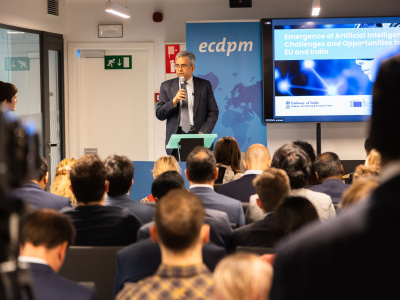
With this in mind, ECDPM and the Embassy of India to the EU organised an event inviting a diverse group of stakeholders from the broader civil society - think tanks, experts and observers, as well as private sector actors - to explore what EU-India cooperation could look like, specifically in the field of clean tech. Several ideas from the discussions stand out, which could also inform the eventual discussions of the EU-India Trade and Technology Council (TTC).
Clean tech manufacturing as an obvious choice
One shared interest is large-scale clean tech manufacturing. The commercial logic here is solid, even as industry players remain clear-eyed about the necessary near-term role of fossil fuels. This comes from not just India’s significant clean energy endowments or its massive market that can proxy future global demand, but also established, and some nascent capabilities in clean tech manufacturing. While its current manufacturing base can not rival China’s, combining European technology with Indian manufacturing capabilities could significantly scale clean tech production.
This convergence of geostrategy and industrial policy presents distinct benefits for both sides.
This convergence of geostrategy and industrial policy presents distinct benefits for both sides. For the EU, this partnership supports efforts to derisk supply chains by reducing reliance on single-source markets through diversification. Simultaneously, it provides India the opportunity to upgrade its domestic manufacturing base and attain technological sophistication. Such cooperation gives the FTA a new strategic outlook - of ensuring economic resilience - than a mere tariff-cutting exercise.
Examples exist across many clean technologies, including solar and wind, where both India and the EU want to reduce dependence on China. Europe offers tech and innovation, while India has leveraged its market to reach a 172 GW solar manufacturing capacity in just 10 years. Hydrogen, green ammonia, and even nuclear energy offer similar opportunities for shared competitiveness, with both economies pursuing similar objectives of energy security through decarbonisation. Linked to the FTA and TTC process, EU-India cooperation offers a range of new or updated technical entry points like the Green hydrogen task force, or the EU-India wind business summit, that can help structure such deep sectoral integration.
Navigating entrenched interests back home
Success, however, hinges on how well both sides manage their internal dynamics. In the EU, the policy landscape is evolving rapidly, increasingly shaped by concerns of economic competitiveness vis-à-vis others. The EU is particularly affected by energy shocks tied to wars in Ukraine and the Persian Gulf while dealing with a second China shock. This comes at a time when the bedrock of the EU’s security and shared values is shaken by deteriorating transatlantic relations, on top of a slow-burning but lurking climate crisis. The bloc needs to balance its twin objectives: managing internal industrial competitiveness while strengthening external relationships with partners like India.
India, likewise, will also have to find ways to align the ambitious rhetoric it projects globally with its internal realities. While there is a case for championing new technologies, confronting the difficult question of decarbonising the industrial sectors that already form the backbone of the economy is exponentially harder.
The Indian steel sector serves as a stark example. There is a compelling imperative for decarbonisation - steel is responsible for 7-11% of global emissions. India is forecast to quadruple its steel production by 2050 given its growth trajectory by 2050, accounting for 20% of global output. Yet, the country’s steel sector is particularly carbon-intensive (30% above the global average). The industry is not monolithic, though: apart from globally competitive industrial giants, it’s also dotted by numerous small producers accounting for 40% of the national production. Moreover, more than 200 plants produce coal-based DRI - a uniquely Indian phenomenon. These small players - unlike large-scale steel plants in Europe - often lack the same access to finance. In many instances, the immediate issue is not just funding, but a fundamental question of technological readiness for decarbonisation. Finding an Indian solution to this problem requires significant investment in domestic research and innovation, a component that has been historically lacking.
Research collaborations could be the missing part of the puzzle.
Research and innovation as a new approach to cooperation
Global research and innovation remains heavily concentrated in developed countries, and is often conducted in contexts that make a simple ‘copy-paste’ of solutions to developing nations impractical. This is where the EU-India collaboration can be most potent and transformative.
Research collaborations, specifically through the massive Horizon Europe funding programme, could be the missing part of the puzzle. At €95 billion in the current Multiannual Financial Framework (MFF), the budget for Horizon Europe is surpassed only by the EU’s agriculture and cohesion funds respectively; within this budget, about €15 billion is dedicated to ‘energy, climate and mobility’. By enabling Indian entities to participate in joint research consortia with EU partners, attention can be drawn to engineering tailored, context-specific decarbonisation solutions. Far from being a philanthropic venture, it directly serves European interests. Breakthrough innovations that work on a mass scale in challenging environments can simultaneously enhance European competitiveness in green technology and contribute to Europe's long-term energy security beyond simply boosting Indian decarbonisation efforts.
As the EU-India partnership moves from a question of 'if' to 'how', there are significant opportunities for strategic dedication to clean tech integration and a practical commitment to tackling complex industrial challenges through intellectual investment in mutual understanding. More such discussions, as the one at ECDPM, are needed to achieve the true ambitions of the EU-India partnership for a stable and sustainable global future.
The views are those of the author and not necessarily those of ECDPM.