At the Ankara summit: Can NATO and the EU finally coordinate on the Indo-Pacific?
Authors

- Sara Gianesello
- Giacomo Arosio
Sara Gianesello and Giacomo Arosio argue that EU-NATO engagement in the Indo-Pacific is fragmented rather than strategic, with both institutions moving in parallel with the same partners. The upcoming Ankara summit must deliver better coordination to secure a meaningful and lasting role in the region’s security architecture.
Euro-Atlantic and Indo-Pacific security are increasingly interconnected – and in many respects inseparable. But while NATO has steadily expanded its cooperation with the Indo-Pacific Four (IP4) – Australia, Japan, the Republic of Korea and New Zealand – the EU has built its own network of bilateral security and defence partnerships with key actors from the region, including blocs like ASEAN (Association of Southeast Asian Nations). Yet this growing web of partnerships is still more fragmented than strategic, with the EU and NATO at risk of moving in parallel.
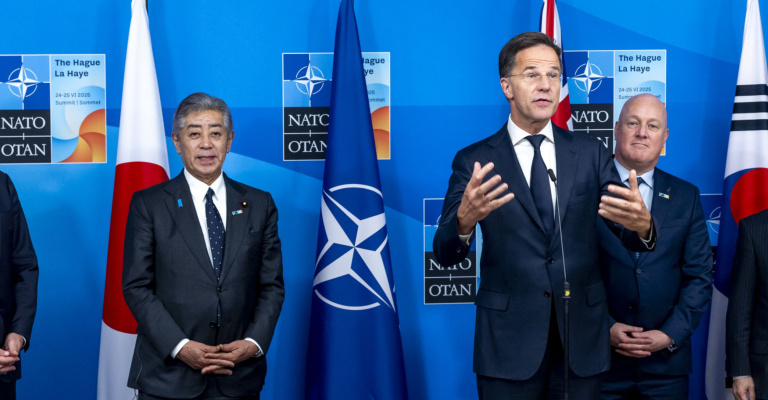
As NATO prepares to transition to a NATO 3.0 – where European partners (EU member states but also Norway, the UK and ideally Canada) assume greater responsibility to compensate for a more conditional US role – its summit in Ankara on 7 and 8 July should set the political direction for better coordination between NATO’s capacity, EU instruments and member states’ initiatives in the Indo-Pacific region.
NATO’s relevant, but limited role
Since the 2022 Madrid summit and the Strategic Concept, NATO has recognised that developments in the Indo-Pacific region can directly affect Euro-Atlantic security. Russia’s war against Ukraine has made this link more concrete. China’s support for Russia’s war economy, North Korea’s direct military assistance to Moscow and the deepening alignment between Russia and China have reinforced the sense that the European and Asian security theatres cannot be treated as fully separate.
Cooperation with the IP4 has become more structured. Australia, Japan, the Republic of Korea and New Zealand participate more regularly in NATO summit diplomacy and ministerial exchanges, while cooperation has moved gradually from political dialogue towards more functional cooperation, particularly around maritime security, emerging technologies and resilience.
Yet NATO’s role in the Indo-Pacific has to navigate a complex web of geopolitical challenges, including the risk of misinterpreting partnerships as regional containment attempts, friction over the diversion of European military resources from Ukraine and the desire to maintain strategic autonomy rather than being locked into an overly rigid bloc logic.
The EU’s broader toolkit and its complexities
The EU’s engagement has developed from a different starting point. Its 2021 Indo-Pacific strategy focused on connectivity, trade, climate, digital governance, maritime security and multilateralism. Since then, the Union’s approach has become more geopolitical and security-focused. Russia’s war against Ukraine, the growing importance of economic security and the need to diversify strategic partnerships have all pushed the EU to treat the Indo-Pacific as both an economic space and a security environment.
The EU’s new security and defence partnerships are the clearest expression of this shift. Designed as tailored political frameworks, they structure cooperation with like-minded partners across information sharing, capacity-building and defence-industrial cooperation. As Europe increases defence spending and seeks to reduce strategic dependencies on the US, Indo-Pacific partners become more important not only as political partners, but also as industrial and technological actors. Such partnerships were very recently signed with Japan (2024), the Republic of Korea (2024), India (2026) and Australia (2026), which bring advanced capabilities, industrial capacity and regional experience that can contribute to Europe’s own defence resilience.
However, the EU’s Indo-Pacific engagement sits alongside national strategies and bilateral initiatives. France, with territories and citizens in the region, has long had its own strategic logic. Germany has gradually expanded its naval and air presence. The Netherlands, the Czech Republic, Lithuania, Italy and others have also developed their own forms of engagement. While these initiatives often support the EU’s broader objectives and present initiatives, they also add layers of activity that can be difficult for partners to navigate, diminishing the EU’s collective influence.
The result is not a lack of European engagement, but a lack of integration. Additionally, internal tensions between the EU Commission and its external action service – the EEAS – highlight disagreements on competencies, strategic direction and heightened expectations around the Union’s foreign policy arm in a time of increased necessity.
Similar challenges also affect NATO’s partnerships: cooperation continues to develop in siloes rather than being embedded under a shared and coordinated approach. This cautiousness ultimately limits results.
EU-NATO coordination matters because the two organisations increasingly work with the same partners on many of the same issues, but through different instruments.
Distinct organisations, overlapping agendas
EU-NATO coordination matters because the two organisations increasingly work with the same partners on many of the same issues, but through different instruments. In principle, the complementarity between the two is clear: NATO provides the main Euro-Atlantic platform for political and military dialogue, as well as practical cooperation with the IP4 on domains such as military interoperability and non-kinetic cooperation (including cyber defense, critical technologies, and countering disinformation), while the EU has comparative added value through its non-military toolkit, including economic, diplomatic and regulatory tools.
Yet complementarity will not happen automatically: without a clearer division of labour and clearer coordination in the region, EU and NATO partnerships risk developing as parallel tracks rather than mutually reinforcing ones.
For example, ESIWA+ – the EU's security cooperation programme for the Indo-Pacific – and NATO’s individually tailored partnerships with the IP4 work on many overlapping domains, including cybersecurity, maritime security, emerging technologies and hybrid threats. Similarly, the EU and NATO both hold bilateral dialogues on defence-industrial cooperation and joint competitiveness. While these are not identical activities, they are often directed at the same partners and focus on the same problems through separate channels.
The risks of parallel engagement
If NATO and the EU run separate conversations with the same partners on similar issues, they consume scarce political attention and reduce the credibility of their offer. They send IP4 partners contradictory signals, create coordination fatigue, and leave important gaps unfilled.
The foundation for EU-NATO coordination already exists through structured dialogues, staff exchanges and regular cross-briefings. Political dialogue has also intensified, even if the relationship is still largely driven by staff-to-staff cooperation.
Yet coordination will have to work around familiar obstacles. The two institutions do not have the same membership, mandate or competencies, and this continues to shape what can be discussed formally, what can be shared and how far joint planning can go. NATO planning also remains only partly accessible to EU structures, which makes capability coordination more difficult even where both organisations are working towards similar objectives.
This is particularly relevant in defence-industrial cooperation, where NATO can help define standards and interoperability needs, but defence industry development, procurement incentives and industrial policy sit largely with the EU and its member states.
The road to the Ankara Summit
NATO and EU member states are meeting on 7 and 8 July in Ankara to discuss a range of priorities. This will be a perfect opportunity for NATO members to shift from visibility to delivery on partnerships, and from general declarations of Euro-Atlantic–Indo-Pacific interdependence to more disciplined coordination among the institutions and states already active in the region.
Outside of the summit, coordination could begin in the areas where overlap is already most visible and the costs of fragmentation are highest. Defence-industrial cooperation is one of them. NATO’s interest in military standardisation and interoperability increasingly intersects with the EU’s role in procurement incentives, industrial policy, research funding and supply-chain resilience. Indo-Pacific partners are relevant to both agendas, but without better coordination, parallel dialogues risk producing competing expectations.
Looking ahead, NATO and the EU must move in concert if they wish to secure a meaningful and lasting role in the Indo-Pacific security architecture.
Similarly, NATO’s IP4 partnership programmes and ESIWA+ are already active on overlapping themes, yet operate without shared planning or lessons-learned mechanisms. The establishment of joint, sector-specific dialogue platforms can unify policy exchange and operational cooperation around shared priorities such as information-sharing. A more systematic exchange of threat assessments with Indo-Pacific partners would strengthen both Euro-Atlantic and regional resilience, especially since hybrid threats increasingly move across regions, whether through disinformation, cyber operations, or infrastructure sabotage. Centres of Excellence could also play a larger role by involving Indo-Pacific partners more consistently and, where appropriate, by developing joint Indo-Pacific-based counterparts.
Looking ahead, NATO and the EU must move in concert if they wish to secure a meaningful and lasting role in the Indo-Pacific security architecture. The political foundations are already in place: Indo-Pacific partners have demonstrated sustained commitment, and cooperation frameworks already exist on both sides – but redundant initiatives risk damaging their credibility. The task is thus to translate this commitment into structured coordination across NATO, the EU, and member states, starting from defence-industrial interoperability and joint research in emerging technologies to shape a Euro-Atlantic contribution to Indo-Pacific security that is cumulative rather than fragmented.
The views are those of the authors and not necessarily those of ECDPM.
Giacomo Arosio is a Junior Policy Analyst at the European Institute for Asian Studies.