Financing the Mediterranean energy transition: Four priorities for Europe


European finance for the Mediterranean energy transition is still largely project-based, and in this brief, Karim Karaki and Alfonso Medinilla set out how the next EU budget and European financial institutions can mobilise private capital, finance whole industrial ecosystems and build ‘Made with Europe’ partnerships that serve both European and partner-country interests.
Summary
Investment in renewable energy, electricity interconnections, hydrogen value chains and industrial ecosystems across the Mediterranean is increasingly part of the EU’s competitiveness, energy security and industrial transition agenda. These objectives often align, but not automatically, and European financing instruments are not yet equipped to contribute to some of these objectives and manage the trade-offs.
Drawing on consultations and a closed-door roundtable, this brief sets out four priorities for the next generation of Mediterranean energy finance instruments (including those related to public procurement), including under the 2028-2034 multiannual financial framework.
(1) Mobilising investment at the required scale demands a shift from balance-sheet lending toward capital-recycling mechanisms, including originate-to-share models and securitisation. Developing a common MENA energy-transition asset class, with shared standards and metrics, would deepen secondary markets and attract private finance at scale.
(2) Moving from single-project to ecosystem financing is equally essential: hydrogen, grid infrastructure and industrial development cannot be addressed in isolation, and European institutions need more integrated, portfolio-based investment approaches.
(3) Coordination platforms such as the Trans-Mediterranean Renewable Energy and Clean Tech Initiative (T-MED) hold real promise, but their effectiveness will depend on integrating lessons from good practices, sustained policy dialogue, early political commitment and coordinated pipeline development, while adapting to the different circumstances of other partner countries.
(4) On European content and procurement rules, the EU must clarify its requirements and provide a predictable transition, as regulatory ambiguity already imposes costs. The EU should explore additional public procurement tools such as strategic project origination beyond eligibility restrictions.
Introduction
The Mediterranean basin sits at the convergence of three structural shifts in the EU’s external energy and industrial partnerships: an accelerating renewable energy deployment in North Africa and the Middle East, European industry’s growing need for secure and competitively priced clean energy and hydrogen derivatives, and new strategic partnerships for clean tech and green industrialisation.
In this context, the region is no longer viewed only through the lens of neighbourhood or development policy, but increasingly as an integral component of Europe's industrial strategy, economic security and clean energy transition. Investment in renewable energy, electricity interconnections, hydrogen value chains and industrial ecosystems across the Mediterranean is increasingly part of the EU's competitiveness and economic security agenda, alongside its neighbourhood policy and development cooperation objectives. Yet, while these objectives are often mutually reinforcing, they are not automatically aligned. These trade-offs include how to balance European sourcing preferences with project costs, and export opportunities with domestic energy and industrial priorities. Recognising and managing these trade-offs should be central to the design of next-generation European financing instruments, rather than treated as an implementation challenge.
The EU's Pact for the Mediterranean, adopted in late 2025, together with the Trans-Mediterranean Renewable Energy and Clean Tech Initiative (T-MED) and its investment platform, forms part of the EU's response to these structural changes, alongside the broader Global Gateway architecture.
Figure 1: T-MED: Components of the new EU strategy
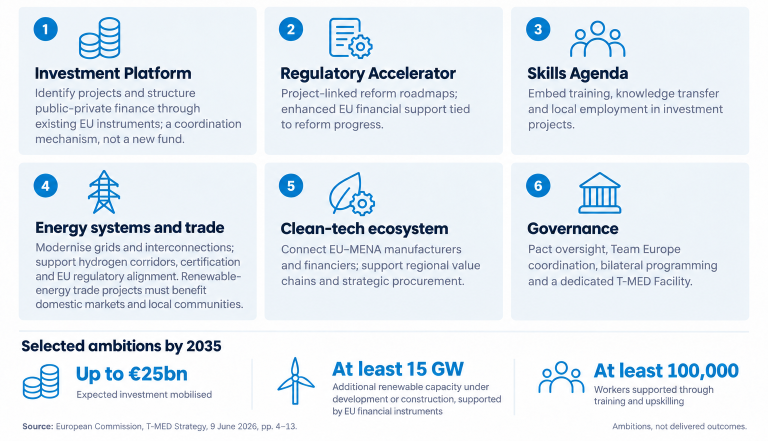
The success of these initiatives, however, will ultimately be judged not by their institutional design but by their ability to mobilise investment at scale, strengthen economic partnerships and deliver tangible benefits for both the EU and its Mediterranean partners. This is essential in a context where the geopolitical salience of the MENA region for European energy security has grown markedly, reinforced by recurring volatility in fossil fuel markets and the strategic logic, echoed in the Draghi report, of importing renewable electricity and green molecules from regions with superior solar and wind resource.
This brief draws on structured consultations and a closed-door roundtable in spring 2026, bringing together representatives from European financial institutions, EU institutions, institutions of EU member states and partner countries, private sector representatives and a range of experts involved in EU-MENA finance. It identifies priorities for the design of future European financing instruments, including the 2028-2034 Multiannual Financial Framework (MFF).
The following sections examine four priorities: mobilising private capital, financing industrial ecosystems, improving coordination through T-MED, and designing European content and procurement requirements. Local industrial development is addressed across these priorities. The brief concludes with recommendations for EU and member-state policymakers and financial institutions.
1. Key issues
1.1 Mobilising private capital at the scale the transition requires
While European financial institutions for development have played a catalytic role to date in financing the Mediterranean energy transition, their current approaches will not be sufficient given the current needs. Instead, mobilising investment at the required scale will depend on financial structures capable of attracting European and local institutional investors, including pension funds, insurers and reinsurers, sovereign wealth funds, Gulf investors and commercial banks alongside the public capital that has so far anchored investment. Securitisation could help financial institutions to redeploy a fixed pool of capital across a far larger pipeline of projects and mobilise private investors at scale, rather than holding exposure to maturity. IFC’s emerging markets ‘collateralised loan obligation’, which was repeated in June 2026, offers a potential reference. Making this shift raises five issues:
- Mobilising capital should be done in a strategic manner: Different European and regional investors could invest in different sectors and stages of the project cycle - from project preparation, where capital is scarce, to construction and operation, as risks progressively decline, depending on their nature (impact vs. institutional investors), mandates and risk–return appetite. The T-Med approach has led with a market intelligence exercise, complemented by calls for expression of interest, to better capture market needs. This is key to facilitating effective solutions that can attract private capital at scale. Such an iterative approach will also be key to connect with Gulf investors, who often engage much earlier in projects and are not waiting for the EU and its financial institutions to engage.
- Financial institutions should rethink their approach to project origination, with a clear intent to shape it with a view to mobilising private capital, and consider originate-to-share models. This would require changing their business models – which needs shareholder backing – and how they identify and originate projects. The project pipeline should be designed around different risk-return profiles of private investors (given that impact and institutional investors, for example, will have very different requirements re. risk-return profiles, volume, impact).
- Financial institutions should consider working together to create a MENA energy transition asset class, building on efforts within the EU. Common standards, definitions and metrics could help mobilise private capital and support deeper secondary markets, whose limited liquidity often constrains private investment. Working with a coalition of the willing, anchored around one or more multilateral development banks such as the European Investment Bank (EIB) or the European Bank for Reconstruction and Development (EBRD) could be a pragmatic starting point, which could expand over time.
- Engaging export credit agencies, insurers, reinsurers, and commercial banks providing trade finance is essential to ensure that the European financial architecture mobilises private capital that can both accelerate renewables deployment and serve European competitiveness and geostrategic interests, by directly engaging European businesses. This should be seen as part of the broader EU economic statecraft.
- Public support in the form of guarantees and/or grants is often essential to securitisation, as shown by the IFC’s collateralised loan obligation. Different types of guarantees should be explored, including those addressing local currency fluctuations and/or uncertainty over offtake and volatility of energy/electricity prices (through, e.g., contracts for difference). Grants targeting pipeline development and early-stage project preparation will remain important, particularly for projects serving both developmental and EU competitiveness interests. Originating such strategic projects often involves more transaction costs and may impact the overall cost of transactions. The EU should also consider using more reimbursable grants in the context of the next MFF, as a tool for recycling scarce resources.
1.2 From single projects to industrial ecosystem financing
Just as mobilising private capital at scale requires moving from project to portfolio types of approaches, contributing to integrated industrial ecosystems requires moving from single transactions to considering a broader set of coordinated investments, matching the EU development objectives and its geostrategic interests. For green hydrogen, for example, commercial viability depends on investment in renewable electricity, transport and port infrastructure, alongside demand from industrial users. Similarly, additional renewable generation capacity can only be fully used if accompanied by investment in transmission and distribution networks.
Morocco's experience, where local-content requirements under its EU free trade agreement helped its automotive industry, illustrates that durable industrial linkages require globally competitive investment across an industrial ecosystem, rather than market-specific or single-project support.
While other global powers can offer integrated support across different sectors and activities, Europe – despite considerable efforts – still struggles. Several factors can explain why such ambition is difficult to realise in practice: for instance, financial institutions are structured to assess and finance single projects. Risk assessment methodologies are built around individual operations, making it structurally difficult to assemble or finance several interdependent projects as a single package, even where this would be more efficient.
Working on approaches that can help coordinate investments – within current constraints – will be key for upgrading the EU offer. The implementation of the EBRD’s low-carbon pathways initiative in Turkey could provide valuable lessons on how financial institutions can better support such processes and contribute to industrialisation processes.
1.3 Coordination platforms: lessons for T-MED
T-MED's value proposition therefore extends beyond investment to the broader industrial ecosystem, as illustrated by its regulatory accelerator and skills development pillar. This is not a new approach: the EFSD and the Global Gateway 360-degree approach both emphasise the need to better combine policy dialogue, technical assistance and investment. Yet, their implementation has been more ad hoc than systemic – a gap that T-Med will need to address.
Among existing country-level initiatives, Egypt's Nexus of Water, Food and Energy (NWFE) platform stands out as the clearest example of a systemic, coordinated approach, offering a useful reference point for T-MED. NWFE combines the decommissioning of five gigawatts of inefficient fossil fuel capacity with the deployment of ten gigawatts of renewables, alongside dedicated grant financing for grid investment, a just-transition component, and support for domestic supply chains and skills. Its effectiveness rests on a few factors:
- It built on years of policy dialogue and strong engagement with local authorities that reflects the latter’s priorities. This was key to unlocking reforms needed to catalyse investments, which require strong political backing;
- It benefited from early, visible political commitment with a headline gigawatt target. This gave developers clarity and confidence to invest at scale as reforms were being implemented; and
- The Egyptian government was able to leverage and coordinate the different types of financing available (from grants, to debt, equity and guarantees coming from local and international public and private actors). This helped develop a pipeline of sufficiently mature projects (instead of approaching operations on a case-by-case basis), for financial institutions to invest in.
NWFE's transferability should not be assumed, however. First, Egypt's shift from net gas exporter to importer, combined with acute foreign-exchange pressure, gave renewables an immediate fiscal as well as a climate logic. These conditions may not be easily replicated elsewhere. Second, investment platforms will need to take account of countries’ unique industrial capabilities and decarbonisation perspectives.
A rushed shift toward mandatory European content risks being counter productive.
1.4 Strengthening European competitiveness without undermining it
A key issue, as highlighted by Bilal and Karaki (2026), concerns European content requirements and strategic procurement policy. Many European clean tech supply chains are not yet competitive enough across the board to support a blanket “Made in Europe” mandate. A rushed shift toward mandatory European content therefore risks being counterproductive: developers facing such requirements could prioritise alternative non-European sources of capital. This would erode rather than strengthen the European position the policy aims to protect.
A useful distinction can be drawn between the competitiveness of European components and that of European companies and capital more broadly. Even where European hardware is not currently competitive, the presence of European developers, financiers and engineering, procurement and construction (EPC) firms in MENA markets generates value that returns to Europe.
One example is the Commission’s guidance restricting EU funding for energy projects using inverters from high-risk suppliers, including Chinese companies. Introduced on cybersecurity grounds, the restrictions also extend to EU-backed projects outside the EU electricity grid, with a later phase-out deadline of 15 April 2027. Although not a European-content requirement per se, the measure illustrates how economic security conditions can raise costs and complicate procurement for European developers and financiers. Industry criticised the absence of prior consultation and an impact assessment, warning that uncertainty over the measure’s scope was already delaying projects. These concerns underline the need for clear funding conditions and transition arrangements that reflect the availability, cost and technical suitability of alternative suppliers.
These tensions point to the benefits of a phased, rather than a binary approach: a gradual transition combining targeted industrial support, research and development funding, upstream procurement assistance, and temporary, time-bound subsidies. Where relevant, stricter procurement conditions could be introduced once European manufacturers become genuinely competitive on price, delivery time and capacity.
Requirements could also differ by project category: stricter conditions could be applied to projects with a direct link to the EU market, such as electricity or hydrogen exports, while electricity generation for domestic consumption could warrant a lighter-touch approach.
Regulatory uncertainty itself also imposes costs: project delays and pauses linked to uncertainty over the EU's eventual procurement stance demonstrate that ambiguity is, in the near term, more economically damaging than the substance of any reasonable policy eventually adopted.
The Mediterranean energy transition is a strategic priority for Europe's competitiveness, energy security and industrial transformation, as well as an international cooperation concern.
Conclusion and recommendations
The Mediterranean energy transition is a strategic priority for Europe's competitiveness, energy security and industrial transformation, as well as an international cooperation concern. Advancing these objectives
requires a financing architecture capable of mobilising private capital at scale, strengthening coordination across institutions, developing a more pragmatic and strategic approach to competitiveness, supporting integrated industrial ecosystems, and maintaining open, globally competitive partnerships across the region. The EU and its public development banks are not yet fully equipped to deliver this: instruments and approaches remain largely project-based, T-MED's value proposition and governance are still under construction, and European procurement policy needs clearer sequencing, greater differentiation between project types, and a more nuanced approach than one based on eligibility conditions.
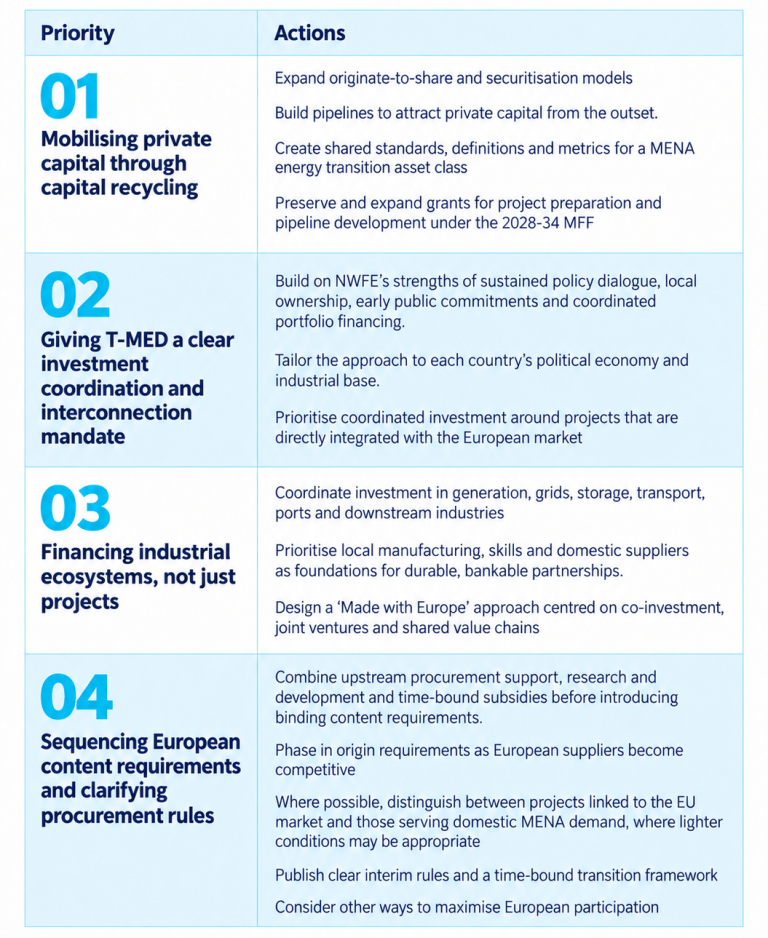
Four priorities should guide EU policymakers and public development banks in shaping the next generation of Mediterranean energy finance instruments, including under the 2028-2034 Multiannual Financial Framework:
- Mobilising private capital through capital recycling. Expand originate-to-share and securitisation models, drawing on the IFC’s collateralised loan obligation experience. Financial institutions should build pipelines to attract private capital from the outset. Shared standards, definitions and metrics for a MENA energy transition asset class would help deepen secondary markets and attract institutional investors. The next MFF should preserve and expand grants for (strategic) project preparation and pipeline development, particularly where development and competitiveness objectives overlap.
- Giving T-MED a clear investment coordination and interconnection mandate. Build on NWFE’s strengths: sustained policy dialogue, local ownership, early public commitments and coordinated portfolio financing. Adapt this approach to each country’s political economy and industrial base. T-MED should also coordinate projects that are directly integrated with the European market, for hydrogen, electricity and industrial goods, and share pipeline information across institutions to reduce duplication.
- Financing industrial ecosystems, not just projects. Coordinate investment in generation, grids, storage, transport, ports and downstream industries, drawing on the EBRD’s low-carbon pathways experience in Türkiye. Financing and procurement should support local manufacturing, skills and domestic suppliers as foundations for durable, bankable partnerships. A ‘Made with Europe’ approach centred on co-investment, joint ventures and shared value chains should guide instrument design.
- Sequencing European content requirements, clarifying procurement rules and exploring additional public procurement tools beyond eligibility restrictions. Combine upstream procurement support, research and development and time-bound subsidies before introducing binding content requirements. Phase these in as European suppliers become competitive, limiting incentives for developers to turn to non-European lenders. Where possible, distinguish projects linked to the EU market from generation serving domestic MENA demand, where lighter conditions are appropriate. Publish clear interim rules and a time-bound transition framework to address uncertainty already delaying projects and financing decisions. Consider other tools than EU eligibility restrictions to support European participation in public procurement, including early market engagement and strategic project origination approaches.
Figure 2: Four priorities for Mediterranean energy finance
Acknowledgements
The authors would like to thank all institutions and experts who participated in this consultation process for their invaluable input and constructive feedback. The views expressed in this brief are those of the authors and do not necessarily represent those of ECDPM or any other institution. Any errors or omissions remain the responsibility of the authors. For comments and feedback, please contact Karim Karaki.
A full reference list is available in the PDF version of this brief.