Financial additionality: The untapped catalyst for global development

Paul Mudde explains how financial additionality can help ensure that public funding supports projects that cannot obtain sufficient financing elsewhere, rather than replacing funding that is already available. He proposes a common ‘commercial viability test’ to reduce unnecessary subsidies, attract private investment and direct public resources towards the projects and countries that need them most.
Summary
The central challenge facing development finance is no longer only how to mobilise more public or private capital, but how to use scarce public resources more effectively and efficiently. Developing countries face enormous investment needs, rising debt vulnerabilities and a multitrillion-dollar SDG financing gap, while donor budgets are under pressure.
This brief argues that a rigorous application of the concept of financial additionality should become the overarching organising principle for all forms of official finance, covering the cross-border trade and investment operations of Multilateral Development Banks, Bilateral Development Banks, ODA Aid Agencies and Export Credit Agencies. These agencies currently operate in fragmented silos, which lead to unintended ‘subsidy competition’ and to public resources crowding out private capital or other sources of public finance requiring no or less subsidies. The international community has to find innovative ways to do more with less.
Applying a ‘least-subsidy’ principle to financial additionality – across both public- and private-sector projects – would reduce official finance competition and ensure that scarce (semi-)concessional resources are reserved for situations where they are genuinely needed.
A practical solution is a ‘Commercial Viability Test’, building on the established approach to tied aid as regulated in the OECD Arrangement on officially supported export credits. Concessional resources would then be concentrated on projects and countries where such financing is genuinely unavailable or insufficient.
Applying financial additionality systematically would help to mobilise more private capital, reduce official finance competition, improve debt sustainability, strengthen alignment among official financiers and increase the development impact of every public dollar. The proposed approach is therefore not about reducing development finance, but about ensuring that scarce (semi-)concessional resources are used where they are genuinely additional and can achieve the greatest impact.
Introduction
In an era marked by severely tightening development budgets, escalating geopolitical uncertainties, and increased climate change vulnerabilities – coupled with mounting debt sustainability challenges for many Emerging Markets and Developing Economies (EMDEs) and a staggering $4.2 trillion annual financing gap for the UN Sustainable Development Goals (SDGs) – the global community faces a stark reality: we must do significantly more with less.
Yet, the current architecture of official finance involved in financing the SDG investment needs of EMDEs – comprising Multilateral Development Banks (MDBs), Bilateral Development Banks (BDBs), ODA Aid Agencies, and Export Credit Agencies (ECAs) – remains fragmented and operates in silos with different mandates, oversight structures, pricing practices, incentives, and regulatory frameworks.
Too often, this fragmentation leads to unintended “subsidy competition,” where scarce taxpayer-funded resources are deployed inefficiently, crowding out private finance or other sources of public finance requiring no or less “subsidies”. To break this cycle and achieve a greater development impact, the international official finance community should embrace a rigorous, harmonised commitment to financial additionality.
1. The heart of the matter: Defining financial additionality
Financial additionality is not merely a bureaucratic buzzword; it is the cornerstone of an effective and efficient use of scarce public capital. It applies in principle to all official finance agencies. The problem, however, is the absence of a common, comprehensive definition, divergent practical interpretations, and inconsistent implementation within the official finance community.
In mainstream official finance, additionality is primarily defined through the lens of the private sector. The harmonised blended finance framework, for example, adopted by Multilateral Development Banks (MDBs) and Bilateral Development Finance Institutions (DFIs) dictates that an intervention is financially additional if it provides funding that is “beyond what is available, otherwise absent from the market, and should not crowd out the private sector”. Furthermore, “blended finance should contribute to catalysing market development and mobilisation of private sector resources, with concessionality not greater than necessary”.
This DFI blended finance framework has two major limitations:
- Application only to private sector operations: The harmonised DFI framework applies exclusively to blended finance for private sector projects, leaving out public sector projects, while many public sector projects financed by Multilateral and Bilateral DFIs1 with (semi-)concessional loans benefit from substantial explicit or implicit subsidies.
- No assessment of (potential) lower-subsidy public financing alternatives. The harmonised blended finance framework does not require an assessment of whether alternative forms of official financing without or a lower level of “subsidy” are available. Such alternatives may include market-based MDB guarantee instruments (such as MIGA political risk insurance), officially supported export credits provided under the OECD Arrangement on Officially Supported Export Credits, and market-based loans from MDBs or bilateral DFIs. Consequently, the framework does not assess whether these alternative financing instruments could achieve the same development objective with a lower level of public support. As a result, it does not ensure that the least-subsidy form of official finance is selected.
Moreover, the current focus on the availability of private finance is more restrictive than the founding statutes of many MDBs themselves. The statutes of most MDBs require them to assess whether a prospective borrower – public or private – can "obtain sufficient financing or facilities elsewhere on terms and conditions that the Bank considers reasonable". The term “elsewhere” is not confined to private sources of finance or to prevent the crowding out of private capital; it may also encompass alternative sources of official finance. In practice, however, MDBs and bilateral DFIs rarely undertake such a broader assessment when appraising financing options.
Consequently, the current application of financial additionality suffers from a serious structural gap: it focuses exclusively on preventing the displacement of private finance within private sector projects. By ignoring the risk of crowding out other public sources of capital, the global financial architecture overlooks a critical inefficiency: using highly (semi-)concessional public funds for projects that could have secured alternative, less-concessional public financing (i.e., over-subsidisation). The absence of a clear “least-subsidy-principle” for official finance is especially problematic in financing for public sector projects, which includes multilateral and bilateral (semi-)concessional development loans to sovereign borrowers in EMDEs.
2. The EU approach: A stricter, multi-layered definition
In theory, European Union legislation addresses this structural gap. Under EU regulations, financial additionality is explicitly designed to prevent the displacement of both private market-based finance and other available public finance. This comprehensive approach is codified across three core legal and operational pillars of the EU's financial architecture.
Pillar 1. The EU financial regulation
The overarching EU Financial Regulation, which governs the implementation of the Union budget, establishes strict rules for the use of budgetary guarantees and financial instruments. It mandates that EU-backed interventions must address market failures or sub-optimal investment situations, and it applies to both private sector and public sector operations. This is one area where it differs from the DFI harmonised blended finance principles. In addition, it defines additionality as ensuring that Union funding does not replace support that could be provided not only by private market actors, but also by other public authorities or existing public schemes. So, the scope of the “additionality test” covers both private and other public sources of capital.
|
Article 212 of the EU Financial Regulation describes key principles and conditions applicable to financial instruments and budgetary guarantees and stipulates, among others: “Financial instruments and budgetary guarantees shall be used in accordance with the principles of sound financial management, transparency, proportionality, non-discrimination, equal treatment and subsidiarity, and in accordance with their objectives. |
Pillar 2. The EFSD+guarantee (external action)
The second pillar of EU regulations on additionality is designed under the European Fund for Sustainable Development Plus (EFSD+). This is the financial engine of the EU’s Global Gateway strategy and reconfirms the requirements for additionality as defined in the EU Financial Regulation. To prevent the misallocation of scarce development resources, the EFSD+ legal framework requires that guaranteed operations.
- Must not crowd out private sector investments.
- Must not displace other public development finance or duplicate existing public lending programs.
- Must prove that the specific development impact could not have been achieved by other public or private financiers operating under market or standard promotional terms.
Pillar 3. The EIB statute
As the EU's policy bank, the European Investment Bank (EIB) benefits from the EU External Action Guarantee under the EFSD+ facility for its lending operations outside the European Union. Under the Neighbourhood, Development and International Cooperation Instrument (NDICI – Global Europe), the EU may provide guarantees for operations covered by the External Action Guarantee of up to €53.5 billion under guarantee agreements signed during the period from 1 January 2021 to 31 December 2027. Within this framework, the EIB has obtained EU guarantees for approximately €26.7 billion, of which approximately €16 billion is earmarked for sovereign and public sector infrastructure operations, with the remainder supporting commercial sub-sovereign and private sector investments.
The EIB Statute reinforces the dual crowding-out requirements contained in the EU Financial Regulation and the EFSD+ framework. Article 16 of the Statute provides that the EIB “shall grant finance, in particular in the form of loans and guarantees to its members or to private or public undertakings for investments to be carried out in the territories of member states, to the extent that funds are not available from other sources on reasonable terms”.
The second sentence of this article grants a mandate to EIB to operate outside the European Union.
The European three-pillar additionality test applies to both public and private sector projects. In principle, it requires that EU support be provided only where financing is not available on reasonable terms from alternative private or public sources.
In practice, however, the assessment appears to focus primarily on the availability of private finance, with little consideration given to alternative public sources of finance that may involve a lower level of subsidy. This suggests that, also within the EU, a gap exists between the principle of additionality and its practical application.
3. Financial additionality and development additionality.
Although multilateral and bilateral DFIs generally assess financial additionality as part of their project appraisal process, these assessments are often not sufficiently rigorous nor transparent to allow external verification. And, as mentioned, it only refers to additionality to the private market, ignoring other public sources of capital, and in practice the financial additionality test is hardly done in (semi-)concessional lending to sovereign borrowers.
Within the development finance community, multilateral and bilateral DFIs increasingly emphasise development additionality rather than financial additionality. Development additionality is frequently associated with the application of high Environmental, Social, and Governance (ESG) standards. However, such standards are not unique to DFIs. The Equator Principles, adopted by many commercial banks engaged in project finance, are based directly on the IFC Performance Standards, while OECD ECAs apply the OECD Common Approaches, which are closely aligned with the same IFC and MDB ES standards. Consequently, the application of internationally recognised ESG standards cannot, by itself, be regarded as a distinctive source of development additionality.
Development additionality is also commonly associated with technical assistance, project preparation and structuring, capacity building, policy dialogue, the demonstration effect of MDB participation, and the mobilisation of additional private capital. These are indeed all very important development activities of MDBs and bilateral DFIs, but these activities do not necessarily require that a project is financed on (semi-) concessional terms or with high levels of subsidy. They can equally be provided in conjunction with financing on market-based terms. Development additionality should therefore be clearly distinguished from the provision of financial subsidies.
The provision of subsidies should, in turn, be subject to careful scrutiny. Since subsidies may distort competition and crowd out commercial finance or public finance involving no or less subsidies, and hinder mobilisation, they should be limited to what is necessary to address identified market failures or achieve clearly defined policy objectives. Accordingly, and in line with DFI blended finance principles, the greater the subsidy element in a financing operation, the stronger the justification and the more rigorous the scrutiny should be.
4. A rigorous assessment of financial additionality.
This idea for a more in-depth and rigorous assessment of financial additionality is not new; it was already recommended in 2018 by the so-called Eminent Persons Group (EPG) in their G20 report ”Making the Global Financial System Work For All”. This report recommends, among others, the following: “IFI governance must place rigorous emphasis on additionality - ensuring that guarantees and concessional resources are deployed where they have the greatest catalytic role in attracting private capital and addressing market failures. Importantly, they must use their risk-mitigation tools to attract private investment to the least developed countries, in addition to the middle-income countries in which blended finance has been heavily concentrated so far.” The report even suggests the convergence of pricing standards among MDBs and bilateral DFIs to reduce pricing competition in development finance. In this area, the development finance community could learn a lot from OECD ECAs, which jointly developed important key standards, among others, minimum interest rates, minimum risk-based premiums, maximum credit and grace periods for their officially supported export credit operations.
Also, in a recent statement of G7 Finance Ministers, it is mentioned that concessional funds should be used for the poorest countries and “preserve debt sustainability, additionality and avoid crowding out private capital, which also contributes to preventing undue distortions to competition among concessional finance providers, and among private investors and other project participants”.
More specifically regarding blended finance, a recent study of the OECD states that it is “difficult to ascertain if blended finance interventions are additional and have mobilised additional finance beyond traditional development interventions. Lack of transparency, particularly around additionality, concessionality and financial performance has challenged accountability and the integrity of blended finance and has hampered the entry of private investors into EMDEs".
In conclusion, there is broad recognition that ensuring and demonstrating financial additionality is important, but it remains a significant challenge. The next question is how this challenge can be addressed through a more rigorous and operational assessment framework.
5. A universal solution: The commercial viability test
In December 1991, the Participants to the OECD Arrangement agreed on the so-called Helsinki rules on tied aid credits aimed at limiting the use of concessional financing for projects that should be able to support commercial financing (i.e. those which are “commercially viable”) and to target concessional finance to projects and countries with little or no access to market financing, including regular OECD export credits. This is basically a “financial additionality test” for tied aid credits to ensure that they do not crowd out market-based or Arrangement-based financing.
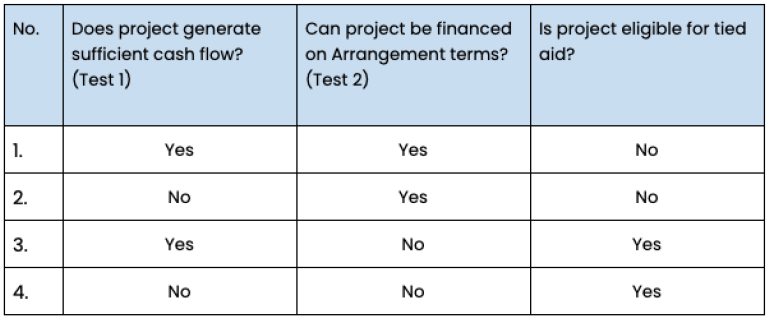
The rules went into effect on 15 February 1992 and include a project eligibility assessment for tied aid, which is known as the “commercial viability test”9 and covers two key tests, namely:
- whether the project is financially non-viable, i.e., does the project lack capacity, with appropriate pricing determined on market principles, to generate cash flow sufficient to cover the project's operating costs and to service the capital employed, i.e., the first key test; or
- whether it is reasonable to conclude, based on communication with other Participants, that it is unlikely that the project can be financed on market or Arrangement terms, i.e., the second key test.
The first key test basically implies an assessment of whether a project is able to generate sufficient cash flow to repay Arrangement-based loans that can be used to finance the project. Projects that generate sufficient cash flow are deemed financially self-sustainable and do, in principle, not need any (tied aid) subsidy.
In the context of the second key test – whether it is unlikely that a project can be financed on the basis of (regular) Arrangement terms – it is a common practice among Participants to investigate the OECD country risk rating and relevant country cover policies of OECD ECAs. Many OECD ECAs are off-cover for sovereign borrowers in various countries rated in the highest OECD country risk category 7, which is an indication that Arrangement-based export finance will not be available for a public sector project in such a country. In such a case, tied aid is allowed, provided that it meets other tied aid criteria as defined in the OECD Arrangement (e.g., on minimum grant element, which currently varies by UN and/or WB country classifications). If a substantial number of OECD ECAs are on cover and able to support a project through a “regular export credit”, then tied aid is in principle not allowed. The commercial viability test can therefore lead to 4 different tied aid project eligibility assessments, whereby in two cases tied aid is allowed and in two other cases it is not.
Table 1: Possible outcomes of commercial viability test and tied aid eligibility
To align the current fragmented official finance practices, it is suggested to apply the commercial viability test to all forms of (semi-)concessional finance, both tied and untied, and including blended finance. By implementing this test across all multilateral and bilateral DFIs, ECAs and ODA agencies, a practical, disciplined framework can be created that prevents unnecessary "over-subsidisation" and ensures that explicit or implicit subsidies are reserved for projects in countries that truly need them.
To avoid misunderstandings and to ensure this commercial viability test is implemented effectively, several parameters must be clearly understood:
- Scope of Application: The commercial viability test is intended to apply only to all forms of official finance supporting cross-border trade (imports and exports) of capital goods and construction/engineering services for infrastructure projects, as well as cross-border inward and outward investments. It includes, therefore, official export credits, trade-related aid (tied or untied), untied investment or development finance whereby funds are wholly or partially used to import goods and services or support cross-border investments in EMDEs.
- Exemption for true “lender of last resort” operations: The test would not apply to typical "Lender of Last Resort" operations of official finance agencies, such as emergency assistance, sovereign liquidity support, crisis response (e.g., COVID), or financing to mitigate debt distress.
- No Agency Exclusion: The commercial viability test does not determine which agency (MDB, bilateral DFI, ODA agency, or ECA) is allowed to finance a project. If a project is deemed viable on OECD Arrangement terms – with relevant Minimum Interest Rates, Minimum Risk-Based Premia, Maximum Tenors, and Grace Periods – DFIs are not expected to exit the project. Rather, the DFI should simply finance the project using standard OECD Arrangement terms and conditions instead of providing subsidised or highly concessional terms.
6. Key benefits of the proposed approach
The move toward a joint approach on financial additionality for official finance and a system-wide application of the commercial viability test combined with the use of OECD Arrangement terms and conditions as an official finance benchmark offers transformative potential:
- Doing more with less: By reducing unnecessary subsidies, scarce taxpayer resources can be preserved for the poorest and most vulnerable countries and for projects where concessional support is genuinely needed. This would substantially improve both the efficiency and effectiveness of development assistance.
- Reducing unintended competition between official finance providers: A common approach to financial additionality, including the application of a least subsidy principle, would reduce distortions arising from different subsidy levels and help prevent unnecessary competition between ECAs, MDBs, bilateral DFIs and ODA aid agencies. Instead, different terms and conditions of official financing – concessional, semi-concessional, blended, risk-based or market-based – would complement one another according to the needs of a project.
- Mobilising more private capital: Applying the commercial viability test would encourage commercially viable projects to seek market- or arrangement-based financing wherever feasible, thereby enhancing cooperation with private financiers and mobilising substantially more private capital. This, in turn, would free concessional resources for countries and projects with little or no access to commercial or Arrangement-based finance.
- Increasing development impact: Closer coordination and alignment between ECAs, MDBs, bilateral DFIs and ODA aid agencies would reduce fragmentation and duplication, creating synergies that increase the overall effectiveness and development impact of official finance.
- Improving debt sustainability: Better targeting of (semi-)concessional finance would reduce unnecessary subsidised borrowing in countries with adequate access to market- or Arrangement-based finance while preserving concessional resources for countries facing debt vulnerabilities or non-concessional borrowing restrictions under IMF and World Bank policies.
- Creating a more coherent international architecture: A common approach to financial additionality would strengthen cooperation between ECAs, MDBs, bilateral DFIs and ODA aid agencies, enabling governments to deploy official finance as a coordinated system rather than through fragmented institutional approaches. This would improve policy coherence and maximise the collective impact of scarce public resources.
- Optimising the use of MDB capital: Reducing unnecessary subsidised lending for commercially viable projects would allow MDBs to deploy their scarce capital more strategically, increasing their capacity to support higher-risk countries, climate investments and fragile states without requiring additional shareholder capital.
- Strengthening compliance with institutional mandates: A broader assessment of financial additionality would align operational practice more closely with the founding statutes of many MDBs and, within the European Union, with the principles of the EU Financial Regulation and the EFSD+ framework, which require support to complement rather than replace available public or private finance.
- Restoring public trust: Greater transparency regarding financial additionality and subsidy use would strengthen public confidence that scarce taxpayer resources are being used efficiently, proportionately and where they create the greatest development impact.
7. A call to action
The global landscape of official finance is evolving rapidly. As recognised in the Seville Outcome Document of the 4th International Conference on Financing for Development, there is an urgent need for closer cooperation and a better alignment among ECAs, MDBs and other public and private financial actors. It is essential to maximise the development impact of scarce public resources. Adopting a universal commercial viability test would be a practical and achievable step in that direction. It is consistent with the G20's call for greater financial additionality and the G7's emphasis on the disciplined, transparent, and targeted use of concessional finance. It fits naturally in existing complementary mandates of MDBs and other official finance agencies. It also provides a practical tool to overcome existing OECD concerns on blended finance.
Modernising the current framework, harmonising approaches across institutions, and ensuring that subsidies are used only where they are genuinely needed would significantly strengthen the effectiveness of official finance.
The future of development finance depends not on increasing development finance or ODA but on mobilising all available private and other public resources, and on deploying scarce public funds more intelligently. Every public dollar should maximise development impact, complement rather than displace private finance or public finance with less subsidies.
These and other ideas are explored in greater depth in the study, “Financial Additionality: The Key for a Better Alignment of Official Finance and a Greater Development Impact”.
Read the in-depth report hereBuilding on current policy discussions, the study examines how the architecture of official finance can better realise its full potential and presents eight practical proposals for strengthening the alignment of ECAs, MDBs, DFIs, and ODA agencies. By offering a perspective on the evolving international debates around ODA, MDB reform, capital mobilisation, debt sustainability and achieving greater impact with limited resources, the report seeks to contribute to a constructive dialogue and encourage further reflection on how official finance can deliver stronger development outcomes.
Acknowledgements
The author would like to thank Karim Karaki, head of ECDPM's economic recovery and transformation team, for his valuable input and constructive feedback. The views expressed in this briefing note are those of the author and do not necessarily represent those of ECDPM or any other institution. Any errors or omissions remain the responsibility of the author. For comments and feedback, please contact paul.mudde@live.nl
A full reference list is available in the PDF version of this brief.