CBAM turns inward: What developing countries need to look out for

Authors


Over the summer, the EU kicked off a much-anticipated review of the Carbon Border Adjustment Mechanism (CBAM). European member states and the Parliament have set out their negotiating positions to reach a final text. As the EU changes its rules with its own competitiveness concerns in mind, third countries – and their industrial development priorities – remain an afterthought.
A CBAM review driven by European competitiveness
CBAM was introduced with a dual objective: avoiding carbon leakage by ‘levelling the playing field’ between domestic and foreign producers, and ‘leading by example’ by using market access to incentivise decarbonisation globally.
The prospect of Article 9 – which allows for the deduction of a carbon price paid at the source – has had a global spillover effect on carbon pricing, including in countries like Türkiye, Brazil and China. The Commission’s proposal to allow Paris Article 6 credits for CBAM compliance (later rejected by both co-legislators) further reinforced the narrative of the mechanism as a climate diplomacy tool.
The latest developments, however, are turning the debate inwards, where European industrial competitiveness takes the centre stage. The Commission is now proposing a Temporary Decarbonisation Fund (TDF), a significant expansion of CBAM coverage to downstream products and tighter anti-circumvention rules.
CBAM review(s) timeline
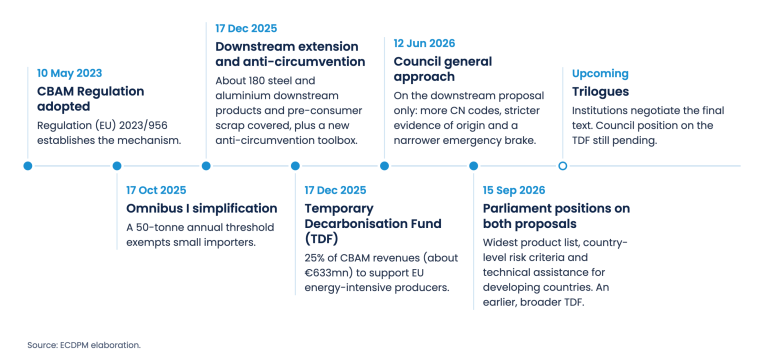
These changes reflect a wider push to protect European industry. Third countries, especially emerging and developing economies, should prepare proactively, assessing how a stricter CBAM could affect their own industrial development trajectory.
CBAM reform:
What could change for developing countries?
More downstream products covered
More exports exposed to CBAM; more firms required to track and report emissions
Inclusion of pre-consumer aluminium and steel scrap
Lower carbon advantage of recycled inputs and higher compliance costs
Stronger measures against circumvention and “resource shuffling”
Greater scrutiny of emissions claims. Country-level risk criteria could limit the use of actual emissions data
Explicit limits on exemptions through trade agreements
Confirms the lack of negotiating space
Temporary suspension clause (proposed Art. 27a)
Could provide temporary exemptions for fertiliser producers in case of severe inflation that harms the EU market, but also weaken decarbonisation incentives. Council and Parliament disagree.
A Temporary Decarbonisation Fund (TDF)
CBAM revenues would directly support European energy-intensive industries and exports.
Assistance for developing countries
Support to developing countries is not prioritised. Technical assistance for LDCs is proposed by the Parliament, but only within existing tools and budget.
More flexibility for candidate and conflict-affected countries.
Targeted relief on the use of punitive mark-ups, primarily for Ukraine
Revised electricity rules.
More flexibility to claim actual emission values, only for neighbouring electricity exporters. This is subject to strict requirements under negotiation
Downstream and scrap extensions will increase exposure
Analysts already noted that carbon price levels are unlikely to cause downstream carbon leakage in the near future, reinforcing concerns that widening CBAM might be more driven by trade protection than climate concerns. Yet, the co-legislators went beyond the Commission’s proposal, extending coverage to 457 products with high steel or aluminium content. CBAM is also set to include pre-consumer aluminium and steel scraps, with emissions attribution based on the original material.
These extensions will raise costs and complicate EU market access for developing countries. The think tank Bruegel estimates that the percentage of North African exports to the EU covered by the wider CBAM could almost triple from 8.85% to 23.77%. The climate think tank Sandbag’s simulator suggests that accounting for pre-consumer aluminium scrap would push Mozambique's net CBAM cost to €25.2 million, a 276% increase.
The inclusion of pre-consumer scrap could impact steel decarbonisation in developing countries, as recycling remains the most affordable low-carbon route available. The alternative near-zero emission primary steel production costs 30–75% more than conventional steel and most projects in developing countries face major financing delays due to offtake and revenue uncertainty.
Every extension of CBAM’s scope pushes reporting requirements further down supply chains. Even before the current review, an estimated 3000–4000 Indian MSMEs were directly affected by CBAM and 25000–30000 indirectly, while 57% lacked emission accounting capabilities. While Monitoring, Reporting and Verification (MRV) capacity varies significantly across economies, CBAM rules remain uniform. In case of data inaccuracy, firms will be penalised with default values that carry a mark-up of up to 30%. For Indian downstream steel, this could raise costs from €80–120/t to €250–300/t.
Companies could be assessed on their country’s reputation as well as their own environmental performance.
Anti-circumvention rules will target ‘high-risk’ countries
The proposed anti-circumvention rules (penalising behavior that seeks to artificially reduce or eliminate CBAM obligations without a genuine emissions abatement) mark a shift from targeting facilities to using product-country combinations to assess high risks for circumvention and trigger additional conditions for claiming actual emissions values. The European Parliament goes even further by proposing to flag high-risk origins based on countries’ climate commitments (including on carbon pricing) and compliance with market-economy rules. This means that companies could be assessed on their country’s reputation as well as their own environmental performance.
The EU wants to curb supply chain adjustments made to exploit lower country-specific default values, as well as resource shuffling, where firms route their cleanest output to Europe without reducing overall emissions. It is unclear what this would mean for some of the investments under way in developing countries, where lower energy prices make greener facilities more economically viable. Companies may now need to provide extra evidence of an economic rationale beyond CBAM savings, or fall back on their home country’s default values.
Capacity-building is planned to fall on existing instruments, such as TAIEX, with no additional funds allocated.
No real change on technical support and developing countries
All these changes illustrate that CBAM is becoming a more sophisticated carbon leakage and trade protection instrument, overshadowing its climate diplomacy objectives. The CBAM review does little more than pay lip service to supporting developing countries. The Commission is required to monitor the mechanism’s impact on low-income economies and provide technical assistance for emissions accounting and MRV. But capacity-building is planned to fall on existing instruments, such as TAIEX, with no additional funds allocated. The Parliament proposed simplified reporting requirements for Least Developed Countries, but during trilogues the topic risks being overlooked in favour of the most-favoured-nation approach of CBAM.
EU carbon diplomacy remains focused on harmonising existing Emissions Trading System (ETS) jurisdictions (e.g. Florence Process, Task Force on International Carbon Pricing, Open Coalition on Compliance Carbon Markets) rather than supporting developing countries, and bilateral attempts failed to go beyond evasive statements and promises of technical assistance, as in the EU-India FTA political agreement or the CTIP with South Africa.
Developing countries need solid technical support for CBAM compliance and - most importantly - additional climate finance to accelerate their green industrialisation. Yet the CBAM review offers little on both accounts. The proposal could even set a precedent for using CBAM revenues to directly support European exporters, with the – admittedly very limited (€633 million) – TDF.
The co-legislators also backed away from including international carbon credits in CBAM’s Article 9 provisions. Much now hinges on the ETS review, where the Commission plans to purchase 260 million tonnes of international credits between 2036 and 2040. While this could mobilise adaptation and mitigation finance for developing countries, concrete standards are lacking, and both Brussels’ policymakers and the market are lagging behind.
The EU is moving to a wider and stricter CBAM that responds to EU competitiveness concerns, while support for developing countries remains an afterthought.
What’s next for emerging markets and developing countries?
The EU is moving to a wider and stricter CBAM that responds to EU competitiveness concerns, while support for developing countries remains an afterthought. Its impacts will vary depending on export exposure, industrial capabilities and MRV capacity. But the direction of travel in Brussels is clear. Strategies built around reducing short-term CBAM costs will become less effective, while scope extensions steadily increase firm exposure to EU carbon emissions rules.
Developing countries therefore need to look beyond managing immediate compliance. Emission intensity is becoming a major factor influencing market access to the EU and this is accompanied by a growing toolbox of trade protection instruments. Countries need to assess how these measures affect their longer-term industrial development: which sectors remain competitive, where low-carbon production creates a reliable advantage, and where EU rules could constrain emerging value chains.
Yet the case for green industrialisation in low- and middle-income economies goes beyond EU politics and should be shaped by their own resources, capabilities and development priorities. Europe may lead on CBAM but as decarbonisation picks up speed, others are doing the same.
This creates the case for stronger coalitions among developing countries, moving beyond seeking ad-hoc flexible treatments. Rather than simply opposing CBAM, these countries should work together to shape the rules for future low-carbon trade, push for interoperability of standards and MRV approaches and call for international climate finance to support industrial decarbonisation. This includes designing carbon pricing systems that can work for economies at different stages of industrial development and decarbonisation.
The views are those of the authors and not necessarily those of ECDPM.