Shaping multilateral peace and security reforms: The role of Africa and Europe
On 24 February, from 14:30–16:00 CET, ECDPM and SAIIA, in partnership with the Global Challenges Foundation, are organising a public webinar to discuss how strong African Union–European Union relations can contribute to reforming multilateral peace and security governance, with a particular focus on the United Nations Security Council.
Background
The global multilateral system is facing a crisis of legitimacy, effectiveness, and inclusiveness. Ongoing and recent conflicts, including in Sudan, the Democratic Republic of Congo, Ukraine, and Israel-Gaza, alongside intensifying geopolitical rivalries and asymmetric responses to global crises, have exposed long-standing structural divides between the so-called ‘Global North’ and ‘Global South’. These dynamics have placed renewed strain on multilateral peace and security institutions, particularly the United Nations Security Council.
While the United States has never been a consistent multilateral actor, its withdrawal from several international frameworks under the second Trump administration has further diluted Western influence within the multilateral system. At the same time, the expansion of groupings such as BRICS and the growing prominence of ‘minilateralism’ reflect increasing difficulties in reaching global consensus and a demand for alternative pathways for cooperation. Against this backdrop, the Pact for the Future has underlined the need for urgent reforms, including of the UN Security Council.
Africa and Europe are reassessing their respective roles within this evolving global order. African states and institutions are increasingly asserting their agency in multilateral fora, illustrated by the African Union’s accession to the G20, sustained advocacy for Security Council reform based on the Ezulwini Consensus, and broader efforts to promote African-led solutions to peace and security challenges. Europe, while remaining a strong proponent of rules-based multilateralism, is navigating internal political pressures, shifting security priorities, and debates over its global role and partnerships.
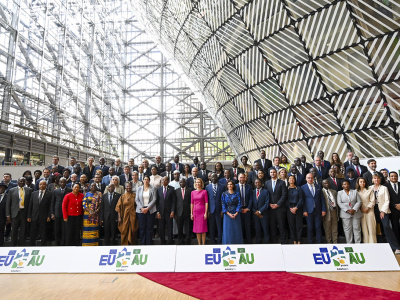
Both continents continue to express a shared commitment to multilateralism, reaffirmed at the 7th AU–EU Summit held in Luanda (Angola) in November 2025, which reiterated a joint Africa–Europe call for a more representative, inclusive, transparent, and accountable UN Security Council. However, recent developments, including uncertainty around US engagement with multilateral institutions and the liquidity crisis affecting the UN, have raised urgent questions about the future of global peace and security governance and the scope for joint EU–AU action.
Webinar
This public webinar aims to contribute to ongoing debates on the reform of multilateral peace and security governance, with a particular focus on the UN Security Council and the role that strong AU–EU relations can play in advancing reform.
During this webinar, ECDPM and SAIIA will launch their co-authored policy brief, presenting key findings and policy recommendations on multilateral peace and security reform. This policy brief is the result of a joint ECDPM-SAIIA initiative, supported by the Global Challenges Foundation, to explore how Africa and Europe can work together to reform multilateral peace and security structures. A high-level closed-door roundtable held in Addis Ababa in November 2025 brought together senior policymakers and experts to identify areas of convergence, divergence, and potential collaboration. The insights from this process informed the development of this policy brief.
Agenda
14:30–14:40
Welcome and opening remarks
Sophie Desmidt, Associate Director, ECDPM
Steven Gruzd, Head of African Governance and Diplomacy, SAIIA
14:40–14:50
Presentation of the ECDPM–SAIIA policy brief, by Gustavo de Carvalho, Senior Researcher at SAIIA
14:50–15:30
Conversation between Richard Gowan and Gustavo de Carvalho
Moderated by Sophie Desmidt
15:30–15:50
Q&A with participants
15:50–16:00
Closing remarks and key takeaways by Steven Gruzd, Head of African Governance and Diplomacy, SAIIA
Speaker bios
Richard Gowan
Program Director, Global Issues and Institutions at the International Crisis Group and a long-standing analyst of multilateral diplomacy. Between 2013 and 2019, he authored the weekly column “Diplomatic Fallout” on multilateral affairs for World Politics Review. He brings extensive expertise on the functioning, politics, and reform prospects of the UN system and multilateralism as a whole.
Gustavo de Carvalho
Senior Researcher at SAIIA and a leading analyst of African multilateral diplomacy and peace operations. He has worked extensively on the evolving role of African institutions in global governance, with a particular focus on the African Union, UN-AU cooperation, and conflict management on the continent. He brings deep expertise on the reform of multilateral institutions, and the intersection between regional and global governance frameworks.