What place for trade partners in the EU's Industrial Accelerator Act?

Authors

- Alfonso Medinilla
- Genís Gomà
Europe's industrial policy has entered a more assertive era. The Industrial Accelerator Act (IAA), proposed in March 2026, would steer selected public procurement and support towards European production, in response to Chinese manufacturing dominance, high production costs and strategic dependencies. It also raises the question of what place is left for trade partners whose industries pose no direct threat to Europe's. As currently debated, the IAA's conditions risk sidelining partners in emerging and developing economies (EMDEs), deterring investment in alternative suppliers and straining relations the EU needs.
So far, the debate has centred on the UK and major automotive hubs such as Japan, South Korea and, more recently, Türkiye. Yet the implications extend to other EMDEs seeking to build their industries and supply the European market. Many target the very same technologies that Europe wants to promote and may face new constraints on access to publicly supported European demand, even if they are not the IAA’s primary target.
The IAA may set a precedent for how the EU uses public demand to anchor production at home. For EMDEs, the question is therefore not simply which trading partners the IAA recognises, but whether its conditions and their long-term evolution leave room for investment and industrial upgrading.
Understanding the EU's 'lead market' instruments
The core proposition of the IAA is to use European market demand to boost European manufacturing in sectors that are particularly strategic or exposed to global competition. It does so through public procurement, public support schemes and net-zero technology auctions, aiming to create lead markets for European clean technologies, with a focus on electric vehicles (EV) and low-carbon industrial products such as steel. Its two main tools are Union-origin (or ‘made in Europe’) requirements and low-carbon requirements. These vary across product categories and may become stricter over time.
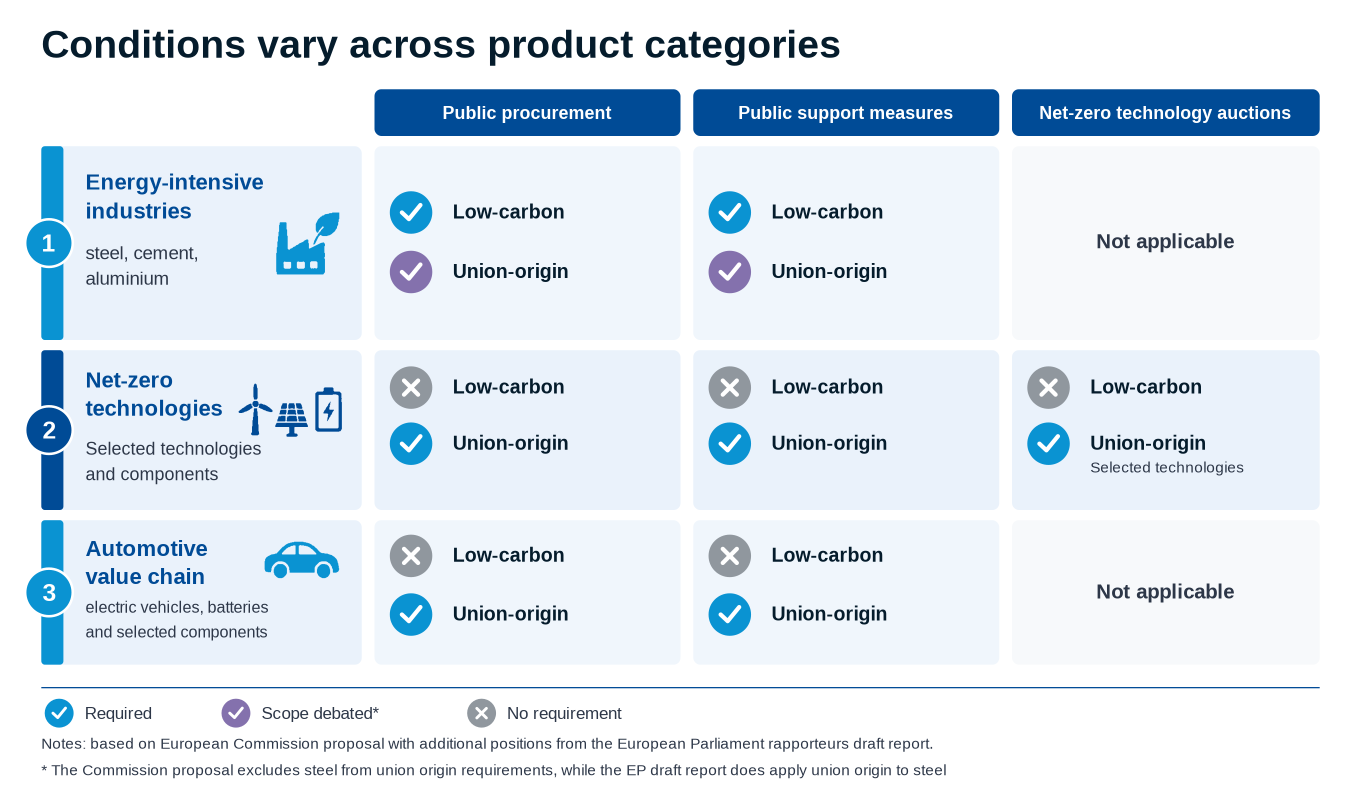
Since the IAA only targets direct public procurement markets and public support measures like subsidies or tax breaks, its reach varies widely by product category. For products like steel, cement and aluminium, the instrument covers less than 10% of the total EU market, yet more than 80% for electric vehicles due to widespread use of fiscal incentives for personal and company vehicles.
Beyond demand-side measures, the proposal would also tie certain large foreign (Chinese) investments in strategic sectors to their contribution to European production, employment and technological capabilities. The current draft criteria that trigger these conditions only apply to China.
‘Made in Europe’ or ‘Made with Europe’?
The IAA debate is ultimately about the boundaries of the EU’s industrial strategy and how far ‘made in Europe’ should extend to its trading partners and on what terms.
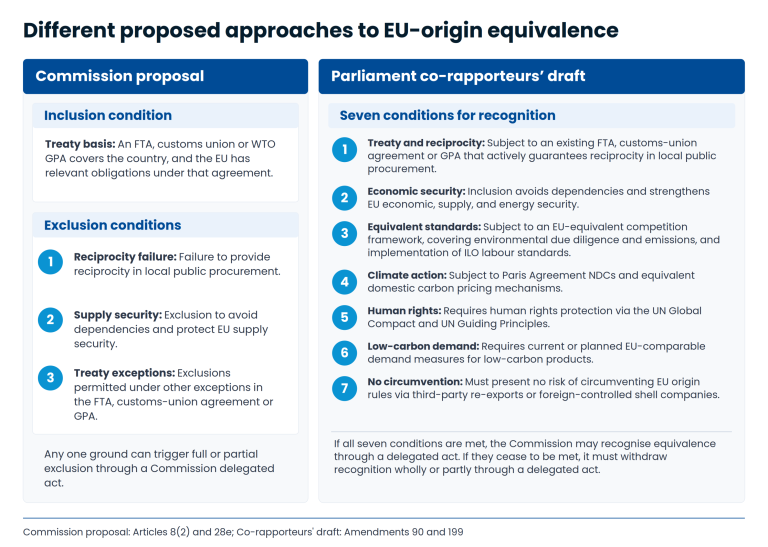
The initial Commission proposal was relatively open, recognising content from free trade agreement (FTA) and customs-union partners, as well as WTO Government Procurement Agreement parties as potentially equivalent to EU-origin, provided there are binding market-access commitments under such agreements. Grounds for full or partial exclusion would include failure to reciprocate or a specific threat to the EU's own economic security. The September European Parliament draft report led by Renew, S&D and the Greens is more cautious, making equivalence strictly opt-in under seven conditions for recognising foreign content, while tightening European-content and low-carbon requirements. Part of the EPP even rejected the proposal outright.
From an industry perspective, strict 'made in Europe' requirements can still create new barriers, especially for sectors relying on foreign inputs. However, a approach that is too open risks diluting the effect of public procurement measures. France and Germany recently converged on a more exclusive approach. Spain instead proposed a pragmatic middle ground consisting of three geographical tiers covering the EU27, the EEA and trusted partners, and countries with free trade agreements, customs union or procurement agreements, subject to reciprocity, with inclusion varying across sectors. The Irish Council presidency's fourth compromise text (23 November 2026) sets up a separate regime for cars: vehicles assembled in the EEA, Switzerland and the UK would count alongside EU production, and Japanese and South Korean components would also qualify, subject to reciprocity.
Is equivalence within reach for EMDEs?
Although equivalence debates centre largely on established OECD partners, their outcome also matters for EMDEs. Türkiye and Morocco, for example, are both important automotive suppliers to the European market. Cars built there accounted for 5% and 4% of EU new car sales in 2025, while in both countries automotive is the largest export sector. Under the Commission proposal, Turkish and Moroccan components might have counted as EU-origin, through the customs union and the free trade agreement respectively, though vehicles still had to be assembled in the EU. Yet neither country appears on the Council's November 23 draft list of countries eligible for motor vehicles. This could significantly alter investment conditions for new automotive projects. Morocco has also attracted new investments in both battery and EV manufacturing, partly building on its access to the EU market. For this reason, predictable market access and a credible path for technological upgrading remain critical.
Some provisions set out in the EP draft report’s approach could also prove particularly demanding for EMDEs, with expansive requirements including labour standards, emissions reporting, carbon pricing and comparable low-carbon demand policies.
Although the final rules remain unsettled, three issues already warrant attention from partner governments and firms.
Drop-down list: What should EMDEs pay attention to now?
1. Inclusion and exclusion through implementing acts
Broad inclusion of trade partners has become a less likely scenario. While the Commission proposal allowed for default inclusion, the EP rapporteurs propose conditional opt-in recognition. Access to EU public procurement and subsidised markets will likely be highly conditional and based on both bilateral and multilateral agreements, as well as European economic security concerns. Draft provisions also imply that recognition could later be withdrawn, which can create uncertainty and weaken investment predictability.
2. From reciprocity to broader policy alignment
The different proposals converge on reciprocal treatment as a key condition for determining EU origin equivalence. Reciprocity means national treatment for EU products and firms, not equal market size or spending. The EP draft report, however, also calls for comparable low-carbon demand policies, or at least a commitment to adopt them within a defined timeframe. For EMDEs with emerging clean-tech industries, limited fiscal and administrative capacity, reciprocity may be out of reach.
The recent Franco-German shared position on automotive industries goes even further by requiring the adoption of the relevant European-preference scheme and dynamic alignment with EU third-country investment conditions and relevant trade-defence measures, to prevent circumvention. Inclusion would in this case require difficult policy choices, even for countries such as the UK. If applied to partners like Morocco, such conditions could raise investment barriers and threaten emerging production.
3. Anti-circumvention beyond product origin, targeting company ownership
Both the Commission proposal and the EP draft report seek to prevent companies from using a partner country to bypass European production requirements. The Commission relies on customs origin rules and country-exclusion powers. The co-rapporteurs explicitly identify another circumvention risk: firms established in recognised partners but owned and controlled from non-recognised countries. A recent Franco-German non-paper reinforces this direction, calling for cooperation with FTA partners against circumvention, proposing that dependency assessments consider company and shareholder nationality. The Council presidency's latest compromise includes similar provisions linking ownership to the status of host country production: shifts in investment or sales by firms whose beneficial owners are from non-partner countries could be used as grounds for exclusion.
A Chinese-owned battery factory in Morocco could support local industrial development, yet its status vis-à-vis EU measures would remain uncertain. Genuine local production might not guarantee eligibility, and the investment itself could count against the host country. Such ambiguity could deter investment in similar partner countries.
European preference needs a credible pathway for partners
The IAA does not govern access to the European market as a whole and its immediate reach varies across sectors. Yet its significance extends beyond the spending it directly covers.
Lead-market instruments are becoming part of a wider EU architecture for supply-chain diversification and stronger, more pre-emptive trade protection. While the rules are far from final, third-country governments and producers should expect access to publicly supported European demand to become conditional not only on where goods are produced, but also on broader alignment with the EU’s trade policy agenda, and on who owns and controls production.
For EMDEs, securing EU-origin equivalence is only part of the question. Its conditions must also leave a credible pathway for investment and industrial upgrading. Governments and firms should engage now to clarify sectoral eligibility, the treatment of foreign-owned production and the circumstances in which recognition could be withdrawn. Otherwise, uncertainty could deter precisely the investments needed to become alternative suppliers.
Europe needs dependable partners to diversify its supply chains, but stricter conditions could make it harder for them to participate. Sector-specific rules, clear eligibility criteria and realistic timelines would make the IAA a sharper tool. Cooperation should also support investment, skills and technological upgrading in partner countries. A credible ‘made with Europe’ offer must leave room for partners to build their own industries, not simply align with Europe’s rules.
The views are those of the authors and not necessarily those of ECDPM.