Notes from Kasumbalesa: Where 25km of trucks meet bikes on the Lobito corridor
Authors

Bruce Byiers went to the Kasumbalesa border between Zambia and the DRC to find out what trading at the crossroads of the Lobito and North-South corridors looks like. Drawing on field observations, he shows why real incentives and everyday practices at the border matter as much as grand corridors and AfCFTA ambitions.
The Kasumbalesa border connects not only Zambia and the Democratic Republic of Congo (DRC), but also a whole region and beyond. A recent trip with the FIRST Project offered the opportunity to see ‘real trade’ on the ground and get an idea of the degree to which Kasumbalesa is at the centre of not just two economies but two corridors and wider climate and mineral geopolitics. Up close, it offers a good reality check for all the policy discussions in Accra, Addis or Brussels.
|
Where the Lobito and North-South corridors meet |
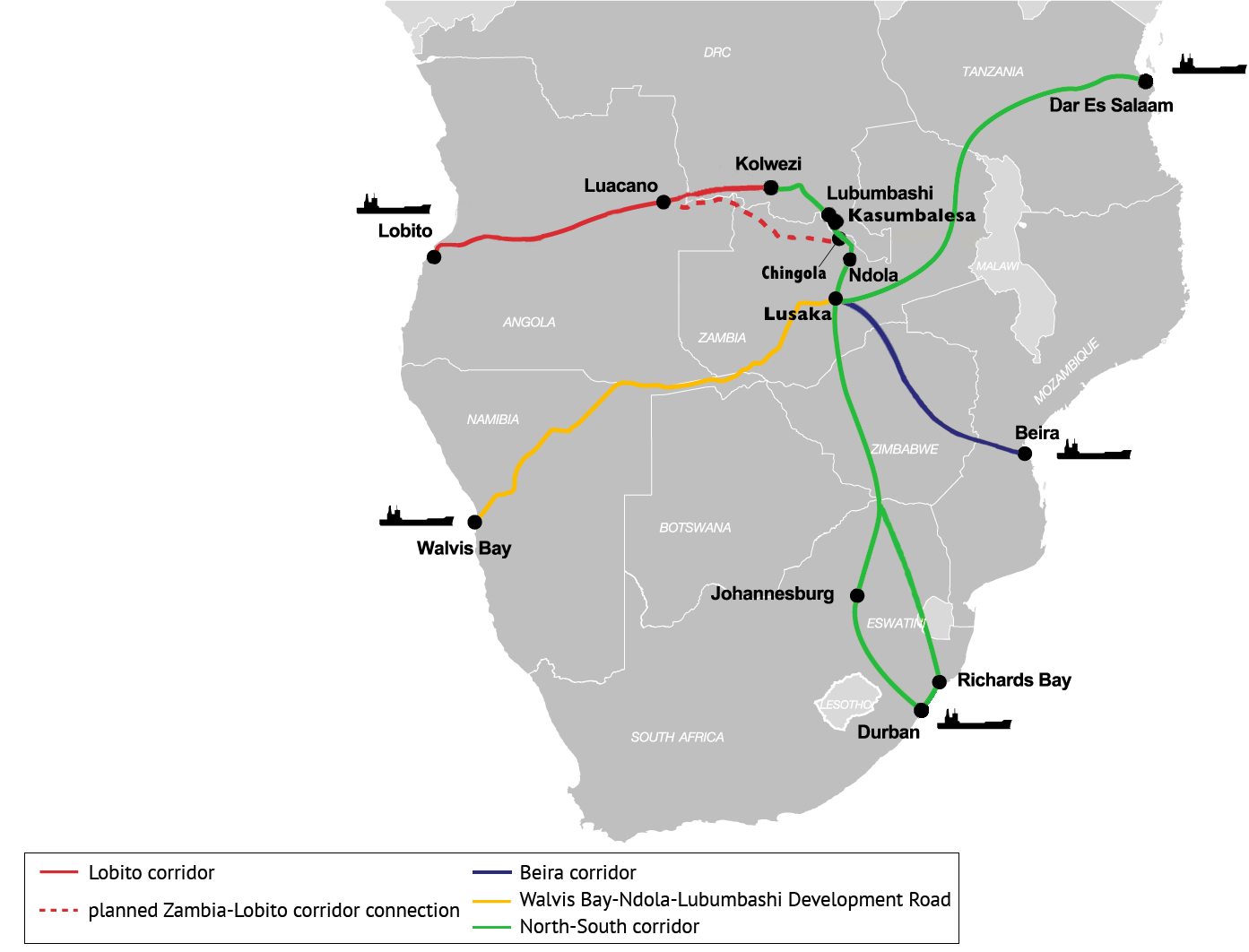
On the ground, the practice reflects both the challenges and the opportunities of realising these policy ambitions, whether through the AfCFTA or otherwise.
Even if AfCFTA negotiations are not yet fully completed, the AfCFTA offers the potential for both tariff reductions and resolving non-tariff barriers (NTBs). How much would that affect current trade dynamics at the Kasumbalesa border?
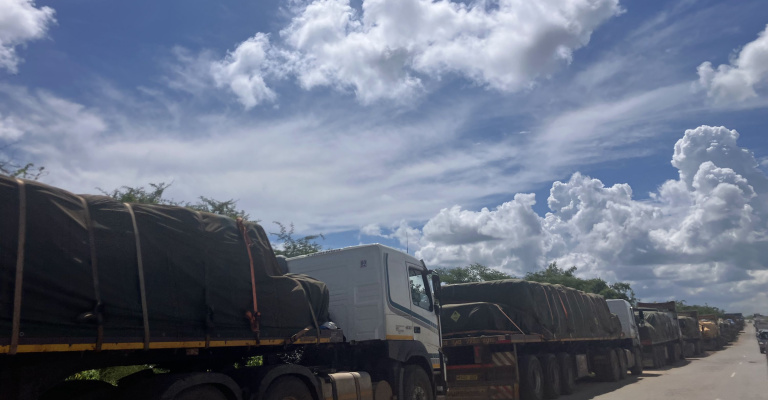
Queues of trucks stretch over 25km from Kasumbalesa, dominating the drive there. Many of them are Tanzanian, most ostensibly carrying industrial goods in transit from Dar es Salaam port to DRC. These trucks sit in an orderly queue, sometimes single, sometimes double, with traffic police managing the gaps to avoid congestion at towns. And this is after all fuel transport has been diverted to use the separate Sakania border.
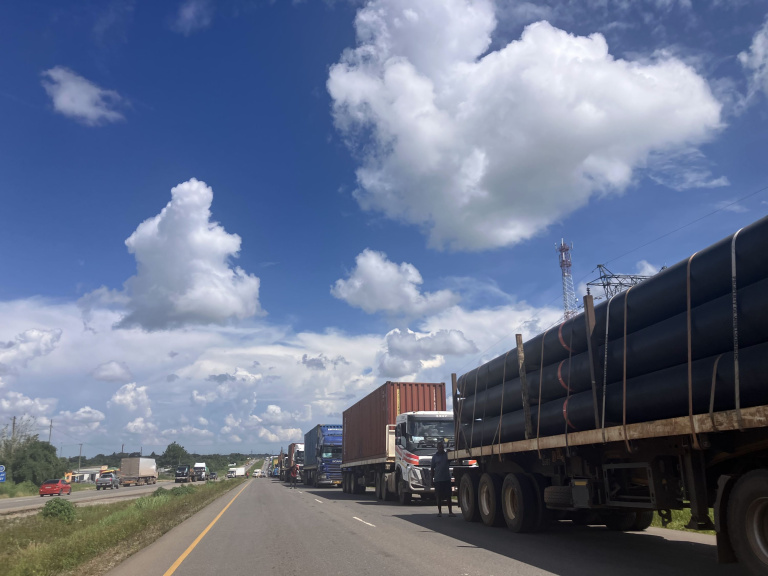
Drivers sit around in the shade of their trucks, chatting, cooking, sleeping - without any basic facilities. Anecdotally, they take some five days to get from the back to the front of the queue.
Drivers sit around in the shade of their trucks, chatting, cooking, sleeping - without any basic facilities. Anecdotally, they take some five days to get from the back to the front of the queue.
Given these are transit goods from outside the region, Zambian customs have very little interest in controlling them, and in fact, given the congestion, every interest is in passing them through. The road to Kasumbalesa is new and in very good condition. The truck-parks are muddy but large. That is not the problem.
From discussions at the border, the bottleneck - where trucks eventually file into car parks on either side of the border, with a single gate between them - is the speed at which the DRC customs can clear the trucks. In 2025, delays on the DRC side were put down to the introduction of the Electronic Seals Clearance System and management changes. Others attributed this to too short opening hours. At the time, the delays were resolved by extending opening hours. The bureaucratic interest is legitimate (to inspect the goods, ensure correct invoicing and tariff applications), but inefficient - for many goods, there should be little need for extended inspections, as paperwork and payment are increasingly digitised.
But when you reach the border, you become aware of another form of trade taking place. While described as 'small-scale cross-border trade', or 'informal cross-border trade', the system in place using adapted bikes is anything but small-scale.
That is, in addition to the queue of trucks associated with transit goods on the back of trucks, there are two other forms: transhipment, where trucks are de-stuffed on the Zambian side for DRC trucks to take them across, and 'pedestrian' trade - the bikes.
DRC traders cross the border on foot, collect their ‘jeton’ to be allowed to pass, negotiate their purchase in the warehouses that have sprung up along the side of the road, engage the necessary number of bikes and helpers, and accompany their wares to DRC along the walkway. One bike can carry close to one tonne of goods - ten 80kg bags of rice is not unusual. According to researchers, while vehicle-based trade can reach $10 million per day, pedestrian trade reaches $2.5 million per day. This is not 'small-scale' trade, and indeed is arguably large-scale trade, circumventing the traffic bottlenecks.
This is clearly not the kind of efficient trade that policymakers think of when negotiating tariff reductions or designing corridor investments. Even if the AfCFTA foresees a continental Simplified Trade Regimes (STR) - simplified procedures and requirements for specific goods under a certain agreed threshold and agreed by the two concerned governments - the conditions on the ground raise questions about why the situation is as it is.
-
Why does the DRC not implement the COMESA or SADC FTAs, where it could use an STR for small-scale trade?
-
How is pedestrian trade actually treated when it reaches the DRC side?
But perhaps more importantly, in whose interest would it be to lower trade barriers at the Kasumabalesa border? Why do DRC customs take so long to clear industrial transit goods, where the risks of smuggling seem relatively low?
Some suggest that it relates to keeping control of the mining companies - for instance, using import delays to force a renegotiation of a mining contract. It is also part of a national industrial 'Made in Congo' policy, with bans on imports to the south-east DRC of stainless steel cathodes, liquid and powder detergents, and low-voltage copper electrical conductors. These measures had been in place but were extended in January 2026. Such bans then require more detailed inspections, but can indeed also serve political purposes by putting quite specific pressure on foreign mining firms.
At the more micro level, for the pedestrian traffic, the transporters pushing adapted bikes across the border make a livelihood out of this trade. The 'thickness' of the border creates arbitrage opportunities - people cite the doubling or tripling of Zambian prices when selling to DRC traders. According to observers on the border, there has been a huge boom in new warehouses to store goods to feed this trade, themselves creating more investment and jobs, albeit in the name of 'small-scale' trade.
Given this, are there any incentives to change things? An STR might alter things by providing a simplified basis for small-scale trade. In Kenya, Trademark Africa has worked with the Kenya Revenue Authority to roll out a mobile-phone-based eCUSTOMS app to simplify trade - for both large and small-scale trade. At the Busia border between Kenya and Uganda this implies that "small-scale traders will be empowered to self-declare cargo through simplified declarations, increasing accuracy, transparency and compliance". Might such an app help here too?
For customs officers, it is not clear that it is always in their direct interest to facilitate trade. As we presented in a past paper, building on work in the Routledge Handbook on Smuggling, the outcome of a border exchange can go in many ways. And indeed, full compliance is only one of multiple possible outcomes for goods to pass the border when in small quantities, depending not just on the available policy mechanisms but also the underlying interests and incentives of both the trader and border enforcement agent. Though the actual treatment of the above 'small-scale' trade is unclear at the Kasumbalesa border, anecdotally, well-known traders essentially had a fixed-fee relationship.
Different incentives, different outcomes

In fact, talking to a COMESA official at the border about ways to improve trade, her first thought was the mudbath that is the pedestrian walkway. That creates a market for 'gumboots', but a concrete, drained, maybe covered, walkway is the kind of thing that could improve lives in the short term.
In the long term the systems in place at the Kasumbalesa border seem a long way from the kinds of things policymakers talk about when discussing the Lobito or North-South corridors and trade facilitation. But these realities clearly need to be at the heart of discussions about corridors, the AfCFTA and its implementation. The technology to digitise trade - even for no-stop borders, including for vehicles and bikes - already exists and in the short term could support trade without undermining livelihoods.
The issue may be more about change management - how to introduce new means that somehow align with interests and incentives on the ground. As a recent blog post put it, growth is won at borders, and there is a lot of growth to be found at Kasumbalesa.
The views are those of the authors and not necessarily those of ECDPM.